
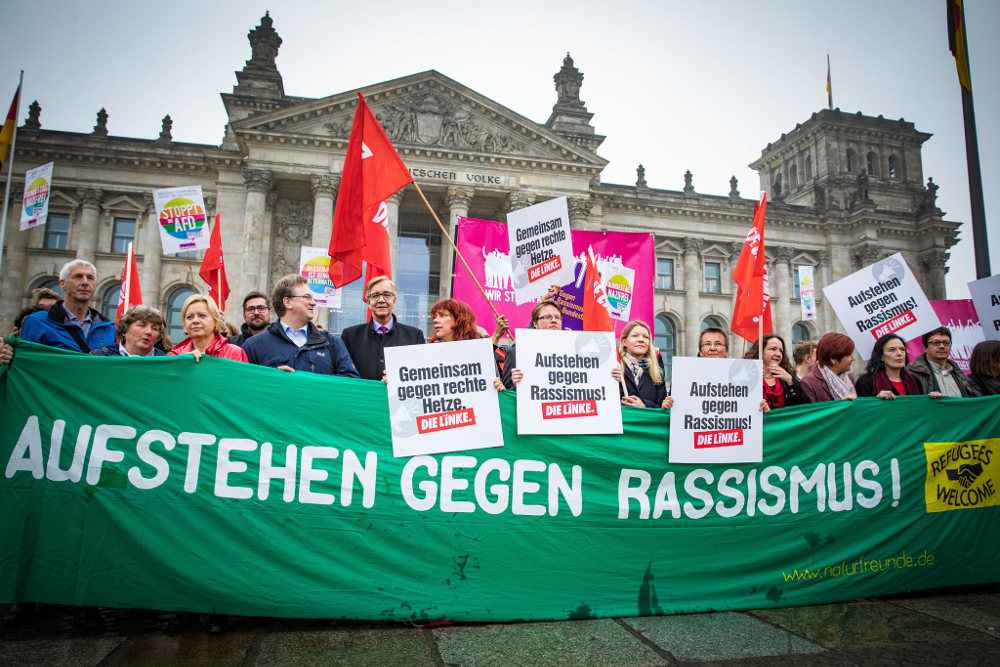
 Protest against the AfD in the Bundestag. The sign reads "Stand up against racism". Photo by: Martin Heinlein.[/caption]
Wagenknecht has stated that “Aufstehen” wants to improve democratic conditions in Germany, advance the interest of those who see themselves ignored by established politics, improve economic conditions and oppose right-wing politics.
Wagenknecht proposes that the rise of the populist-right party AFD (Alternative for Germany) over recent years in Germany is not solely to be explained by anti-immigrant animus in the population. While the frustration with the German immigration policies of recent years is palpable everywhere in the country, Wagenknecht argues that the root of dissent is rather based in rising social and economic ills, such as unemployment and rising rents.
The success of the AFD, as well as the large-scale protests against the immigration policies of Chancellor Merkel, revealed that there was indeed a large strata of German society that felt their needs to be ignored by the political elites in Berlin.
The AFD tapped into the frustration of voters by explicitly positioning themselves as an alternative to mainstream politics, both in name and in party position.
Hence, Wagenknecht concludes that tackling social issues like unemployment would resolve grievances that are currently fueling the rise of the populist-right in the country.
This analysis appears sensible yet it is questionable whether the general sense of disgruntlement against the mainstream political parties in Germany is really caused by economic malaise. The unemployment rate in Germany has been steadily declining since 2010 and is one of the lowest in Europe at 3.5% in 2018.
Nevertheless, the left-wing initiative “Aufstehen” is confident it will be able to win back right-wing AFD voters by broadening the available spectrum for protest-voting and offering another alternative to disgruntled citizens.
In an interview with RT Deutsch (The German subsidiary of Russian state television broadcaster RT), Linke politician and “Aufstehen” member Sevim Dagdelen stated that immigration had hit lower-income households hard due to increased competition for jobs, living space, and attention of the welfare institutions.
The potential political proximity of far-right and far-left positions thus becomes ever more apparent. Wagenknecht and Lafontaine are generally known for their economic isolationist tendencies and thus their movement does not shy away from making it explicit that they consider more restrictive immigration policies to be required. Yet, this sharply contrasts with the official position of the Linke which just recently reasserted its support for open borders.
While “Aufstehen” aims to be a movement that unifies the German Left, it will likely not receive much support from the Social Democratic Party (SPD). Oskar Lafontaine was the one who founded the far-left Linke in 2005 after himself leaving the SPD – thus arguably reducing the vote share of the SPD in the following election. As a result, many in the SPD believe that Lafontaine is thus responsible for the election of Merkel and the resulting loss of political control for left-wing parties.
At this stage, the movement has not been able to find much support from the established political parties of Germany. Even members of Wagenknecht’s and Lafontaine’s own party (Linke) have expressed their skepticism. It thus remains to be seen whether “Aufstehen” will rise to have significant influence in German politics or will soon be forgotten.
Protest against the AfD in the Bundestag. The sign reads "Stand up against racism". Photo by: Martin Heinlein.[/caption]
Wagenknecht has stated that “Aufstehen” wants to improve democratic conditions in Germany, advance the interest of those who see themselves ignored by established politics, improve economic conditions and oppose right-wing politics.
Wagenknecht proposes that the rise of the populist-right party AFD (Alternative for Germany) over recent years in Germany is not solely to be explained by anti-immigrant animus in the population. While the frustration with the German immigration policies of recent years is palpable everywhere in the country, Wagenknecht argues that the root of dissent is rather based in rising social and economic ills, such as unemployment and rising rents.
The success of the AFD, as well as the large-scale protests against the immigration policies of Chancellor Merkel, revealed that there was indeed a large strata of German society that felt their needs to be ignored by the political elites in Berlin.
The AFD tapped into the frustration of voters by explicitly positioning themselves as an alternative to mainstream politics, both in name and in party position.
Hence, Wagenknecht concludes that tackling social issues like unemployment would resolve grievances that are currently fueling the rise of the populist-right in the country.
This analysis appears sensible yet it is questionable whether the general sense of disgruntlement against the mainstream political parties in Germany is really caused by economic malaise. The unemployment rate in Germany has been steadily declining since 2010 and is one of the lowest in Europe at 3.5% in 2018.
Nevertheless, the left-wing initiative “Aufstehen” is confident it will be able to win back right-wing AFD voters by broadening the available spectrum for protest-voting and offering another alternative to disgruntled citizens.
In an interview with RT Deutsch (The German subsidiary of Russian state television broadcaster RT), Linke politician and “Aufstehen” member Sevim Dagdelen stated that immigration had hit lower-income households hard due to increased competition for jobs, living space, and attention of the welfare institutions.
The potential political proximity of far-right and far-left positions thus becomes ever more apparent. Wagenknecht and Lafontaine are generally known for their economic isolationist tendencies and thus their movement does not shy away from making it explicit that they consider more restrictive immigration policies to be required. Yet, this sharply contrasts with the official position of the Linke which just recently reasserted its support for open borders.
While “Aufstehen” aims to be a movement that unifies the German Left, it will likely not receive much support from the Social Democratic Party (SPD). Oskar Lafontaine was the one who founded the far-left Linke in 2005 after himself leaving the SPD – thus arguably reducing the vote share of the SPD in the following election. As a result, many in the SPD believe that Lafontaine is thus responsible for the election of Merkel and the resulting loss of political control for left-wing parties.
At this stage, the movement has not been able to find much support from the established political parties of Germany. Even members of Wagenknecht’s and Lafontaine’s own party (Linke) have expressed their skepticism. It thus remains to be seen whether “Aufstehen” will rise to have significant influence in German politics or will soon be forgotten.New Left-Wing Politics in Germany
Nicolas Wittstock
September 6, 2018
BERLIN (ViaNews) - After the phenomenal success of Emmanuel Macron’s En Marche-movement in France, follows the German “Aufstehen” movement – headed by politicians of the far-left seeking to change left-wing politics in Germany.
“Aufstehen”, which translates to “rising up” seeks to unify the political left-of-center forces in Germany in a novel way to oppose the politics of Chancellor Merkel and increase the political influence of left-wing ideals.
The details of the policies that the movement aims to advance have not been explicitly articulated at this point. However, it is clearly inspired by Macron’s successful challenge to the established political order.
“Aufstehen” seems to be an attempt to find a new avenue to contest the hold on political power that the Conservative Christian Party (CDU) has had for over a decade.
The movement is spearheaded by prominent politicians of the Linke, the far-left party of Germany – Oskar Lafontaine and Sarah Wagenknecht – while the latter has assumed a more vocal role of representing it.
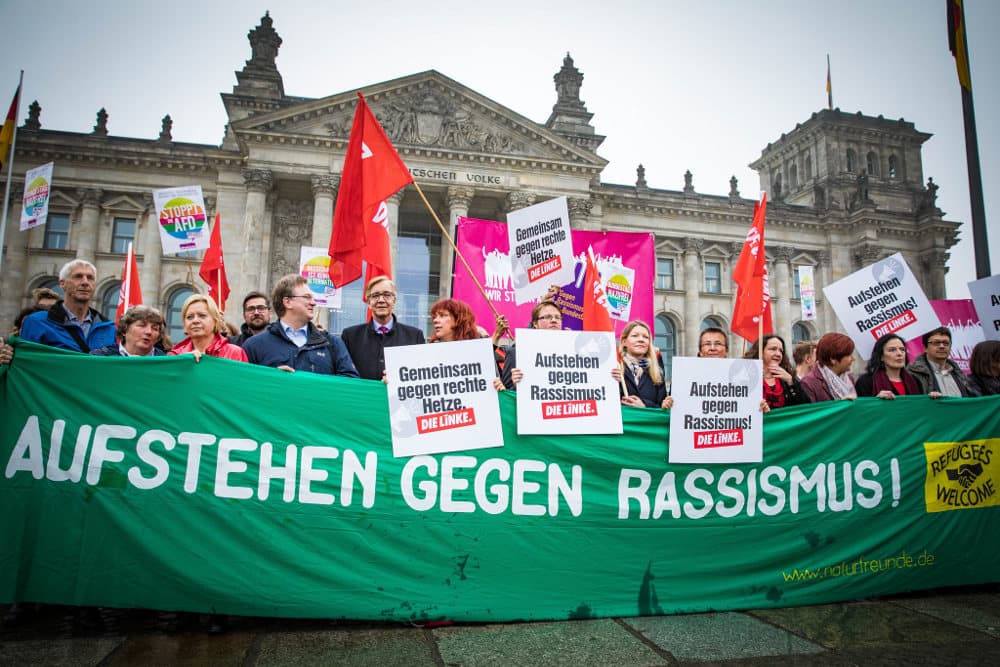
[caption id="attachment_5186" align="aligncenter" width="1000"] Protest against the AfD in the Bundestag. The sign reads "Stand up against racism". Photo by: Martin Heinlein.[/caption]
Wagenknecht has stated that “Aufstehen” wants to improve democratic conditions in Germany, advance the interest of those who see themselves ignored by established politics, improve economic conditions and oppose right-wing politics.
Wagenknecht proposes that the rise of the populist-right party AFD (Alternative for Germany) over recent years in Germany is not solely to be explained by anti-immigrant animus in the population. While the frustration with the German immigration policies of recent years is palpable everywhere in the country, Wagenknecht argues that the root of dissent is rather based in rising social and economic ills, such as unemployment and rising rents.
The success of the AFD, as well as the large-scale protests against the immigration policies of Chancellor Merkel, revealed that there was indeed a large strata of German society that felt their needs to be ignored by the political elites in Berlin.
The AFD tapped into the frustration of voters by explicitly positioning themselves as an alternative to mainstream politics, both in name and in party position.
Hence, Wagenknecht concludes that tackling social issues like unemployment would resolve grievances that are currently fueling the rise of the populist-right in the country.
This analysis appears sensible yet it is questionable whether the general sense of disgruntlement against the mainstream political parties in Germany is really caused by economic malaise. The unemployment rate in Germany has been steadily declining since 2010 and is one of the lowest in Europe at 3.5% in 2018.
Nevertheless, the left-wing initiative “Aufstehen” is confident it will be able to win back right-wing AFD voters by broadening the available spectrum for protest-voting and offering another alternative to disgruntled citizens.
In an interview with RT Deutsch (The German subsidiary of Russian state television broadcaster RT), Linke politician and “Aufstehen” member Sevim Dagdelen stated that immigration had hit lower-income households hard due to increased competition for jobs, living space, and attention of the welfare institutions.
The potential political proximity of far-right and far-left positions thus becomes ever more apparent. Wagenknecht and Lafontaine are generally known for their economic isolationist tendencies and thus their movement does not shy away from making it explicit that they consider more restrictive immigration policies to be required. Yet, this sharply contrasts with the official position of the Linke which just recently reasserted its support for open borders.
While “Aufstehen” aims to be a movement that unifies the German Left, it will likely not receive much support from the Social Democratic Party (SPD). Oskar Lafontaine was the one who founded the far-left Linke in 2005 after himself leaving the SPD – thus arguably reducing the vote share of the SPD in the following election. As a result, many in the SPD believe that Lafontaine is thus responsible for the election of Merkel and the resulting loss of political control for left-wing parties.
At this stage, the movement has not been able to find much support from the established political parties of Germany. Even members of Wagenknecht’s and Lafontaine’s own party (Linke) have expressed their skepticism. It thus remains to be seen whether “Aufstehen” will rise to have significant influence in German politics or will soon be forgotten.
Protest against the AfD in the Bundestag. The sign reads "Stand up against racism". Photo by: Martin Heinlein.[/caption]
Wagenknecht has stated that “Aufstehen” wants to improve democratic conditions in Germany, advance the interest of those who see themselves ignored by established politics, improve economic conditions and oppose right-wing politics.
Wagenknecht proposes that the rise of the populist-right party AFD (Alternative for Germany) over recent years in Germany is not solely to be explained by anti-immigrant animus in the population. While the frustration with the German immigration policies of recent years is palpable everywhere in the country, Wagenknecht argues that the root of dissent is rather based in rising social and economic ills, such as unemployment and rising rents.
The success of the AFD, as well as the large-scale protests against the immigration policies of Chancellor Merkel, revealed that there was indeed a large strata of German society that felt their needs to be ignored by the political elites in Berlin.
The AFD tapped into the frustration of voters by explicitly positioning themselves as an alternative to mainstream politics, both in name and in party position.
Hence, Wagenknecht concludes that tackling social issues like unemployment would resolve grievances that are currently fueling the rise of the populist-right in the country.
This analysis appears sensible yet it is questionable whether the general sense of disgruntlement against the mainstream political parties in Germany is really caused by economic malaise. The unemployment rate in Germany has been steadily declining since 2010 and is one of the lowest in Europe at 3.5% in 2018.
Nevertheless, the left-wing initiative “Aufstehen” is confident it will be able to win back right-wing AFD voters by broadening the available spectrum for protest-voting and offering another alternative to disgruntled citizens.
In an interview with RT Deutsch (The German subsidiary of Russian state television broadcaster RT), Linke politician and “Aufstehen” member Sevim Dagdelen stated that immigration had hit lower-income households hard due to increased competition for jobs, living space, and attention of the welfare institutions.
The potential political proximity of far-right and far-left positions thus becomes ever more apparent. Wagenknecht and Lafontaine are generally known for their economic isolationist tendencies and thus their movement does not shy away from making it explicit that they consider more restrictive immigration policies to be required. Yet, this sharply contrasts with the official position of the Linke which just recently reasserted its support for open borders.
While “Aufstehen” aims to be a movement that unifies the German Left, it will likely not receive much support from the Social Democratic Party (SPD). Oskar Lafontaine was the one who founded the far-left Linke in 2005 after himself leaving the SPD – thus arguably reducing the vote share of the SPD in the following election. As a result, many in the SPD believe that Lafontaine is thus responsible for the election of Merkel and the resulting loss of political control for left-wing parties.
At this stage, the movement has not been able to find much support from the established political parties of Germany. Even members of Wagenknecht’s and Lafontaine’s own party (Linke) have expressed their skepticism. It thus remains to be seen whether “Aufstehen” will rise to have significant influence in German politics or will soon be forgotten.