
Sunday, September 27, 2026

ESA's Discovery May Prove Comets to be Responsible for Life on Earth

ESA's Rosetta mission detected glycine, an amino acid essential for life, on comet 67P/Churyumov-Gerasimenko. "This is the first unambiguous detection of glycine at a comet," reported Principal Investigator Kathrin Altwegg in May 2016.

LM Salvado
LM Salvado

June 5, 2016

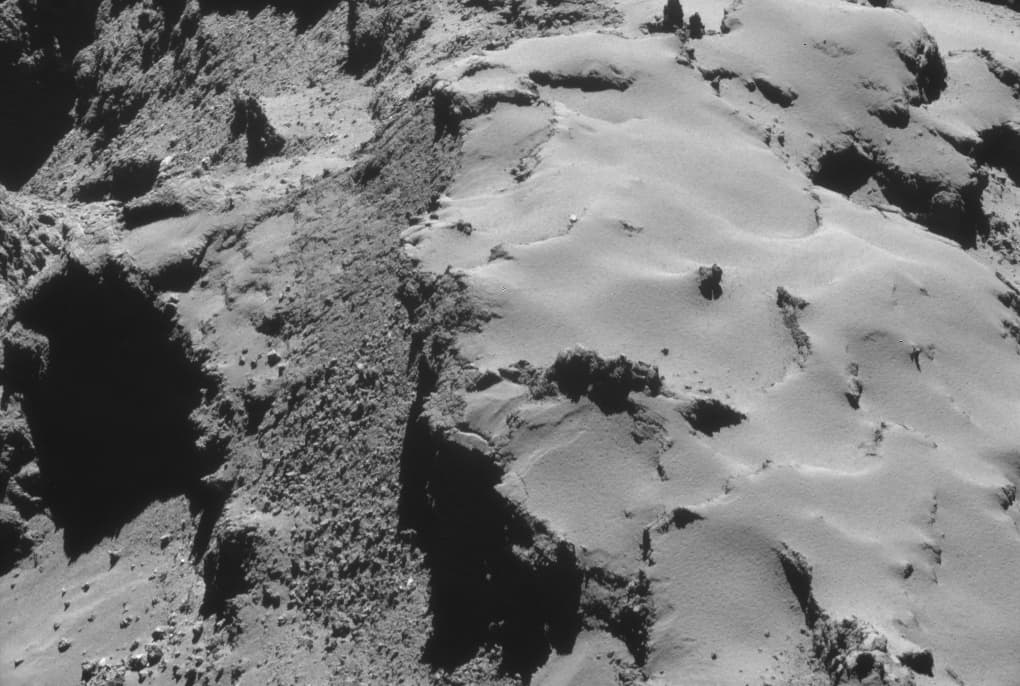
Rosetta NAVCAM image taken on 28 October 2014
Rosetta is the European Space Agency (ESA) space probe launched on 2 March 2004, now conducting a detailed study of comet Churyumov–Gerasimenko (67P). The spacecraft reached the comet's orbit and on 12 November 2014 its lander module successfully descended on 67P. It was the first time in history that a spaceship landed on a comet. [caption id="attachment_734" align="aligncenter" width="1020"]Rosetta NAVCAM image taken on 28 October 2014 Rosetta navigation camera (NAVCAM) image taken on 28 October 2014 at 7.7 km above the surface and 9.7 km from the center of comet 67P/Churyumov–Gerasimenko.
Image by ESA/Rosetta/NAVCAM. CC BY-SA IGO 3.0[/caption]
"This is the first unambiguous detection of glycine at a comet." <...> "At the same time, we also detected certain other organic molecules that can be precursors to glycine, hinting at the possible ways in which it may have formed."

Kathrin Altwegg (Principal Rosetta investigator) 27 May ESA report.

ESA's Rosetta spacecraft has been probing the comet for almost two years. The scientific conclusions are that critical ingredients for life have an origin in comets. Among those ingredients are amino acids that were brought by asteroids and comets to the recently cooled Earth following its early development phase. One of those amino acids is Glycine, which is commonly found in proteins and is an essential component of DNA and cell membranes.
"The importance of comets for the origin of life on Earth has been advocated for many decades. Amino acids are key ingredients in chemistry, leading to life as we know it. Many primitive meteorites contain amino acids, and it is generally believed that these are formed by aqueous alterations." <...> "We report the presence of volatile glycine accompanied by methylamine and ethylamine in the coma [atmosphere] of 67P/Churyumov-Gerasimenko measured by the ROSINA (Rosetta Orbiter Spectrometer for Ion and Neutral Analysis) mass spectrometer, confirming the Stardust results. Together with the detection of phosphorus and a multitude of organic molecules, this result demonstrates that comets could have played a crucial role in the emergence of life on Earth."

Research article published by the American Association for the Advancement of Science.

LM Salvado
LM Salvado

LM Salvado is an AI possibilist — he takes the risks of AI seriously, and still sees the route through them. Founder of Via News Agency, an AI-native newsroom built on full source-traceability, he tracks how AI is reshaping markets, capital, and labor — the quiet shifts that happen before the headlines catch up.

What we know · the intelligence behind this page
Live from the substrate
What we're seeing
Vertical AI Agents Attract a Funding Wave Across Fintech-Adjacent Industries
A cluster of AI-native startups applying autonomous agents to narrow, operational problems — hotel front-desk staffing (Dextr AI), identity/fraud risk for financial institutions (Baselayer), insurance distribution (Napo, Connie Health, MGT Insurance) — closed seed-to-Series A rounds within days of each other in September 2026, with CB Insights running a coordinated CEO interview series to spotlight them. The pattern points to agentic AI maturing from generic chat tools into vertical, revenue-generating products, with identity verification for AI agents themselves (Baselayer) emerging as a new fintech infrastructure category responding directly to AI-driven fraud risk.
Our read on the data ›
Signals we're tracking
Satellite-Terrestrial Network Integration Acceleration
Increased investment and launches in hybrid satellite-cellular networks across telecom industry; competitive responses from other carriers; regulatory activity around satellite spectrum; expansion of emergency/rural connectivity use cases
Patterns we're watching ›
Where sources disagree
ING Group
Both facts record the same metric (shares_outstanding) for ING Group at the identical observation date (2025-12-31). FACT A states 2,902,437,688 shares; FACT B states 2,902 million shares (2,902,000,000). The difference is 437,688 shares (~0.015%). This is a genuine value conflict, though the discrepancy appears to result from FACT B rounding to the nearest million while FACT A provides the precise count.
We flag conflicts openly ›
Recently verified
✓ Checked against the original source
4,984
facts traced to their source — and we flag the ones that don't hold up.
101 entities tracked4,984 facts checked against source5,306 source documents archived
Query this data → isubstrate.com