
Sunday, September 27, 2026

TSMC Boosts 2026 Capex to $10B+ as Global AI Chip Race Spans Taiwan, US, Germany

Taiwan Semiconductor Manufacturing Company raised its 2026 capital expenditure guidance on January 1, joining Intel's Malaysia expansion and Infineon's Dresden facility in a coordinated global buildout. The semiconductor industry is betting on sustained AI hardware demand through 2027, with TSMC targeting 3nm and 2nm chips for Nvidia GPUs while Marvell pursues optical interconnect technology to solve data bottlenecks in training clusters.

ViaNews Editorial Team

February 23, 2026

TSMC Boosts 2026 Capex to $10B+ as Global AI Chip Race Spans Taiwan, US, Germany
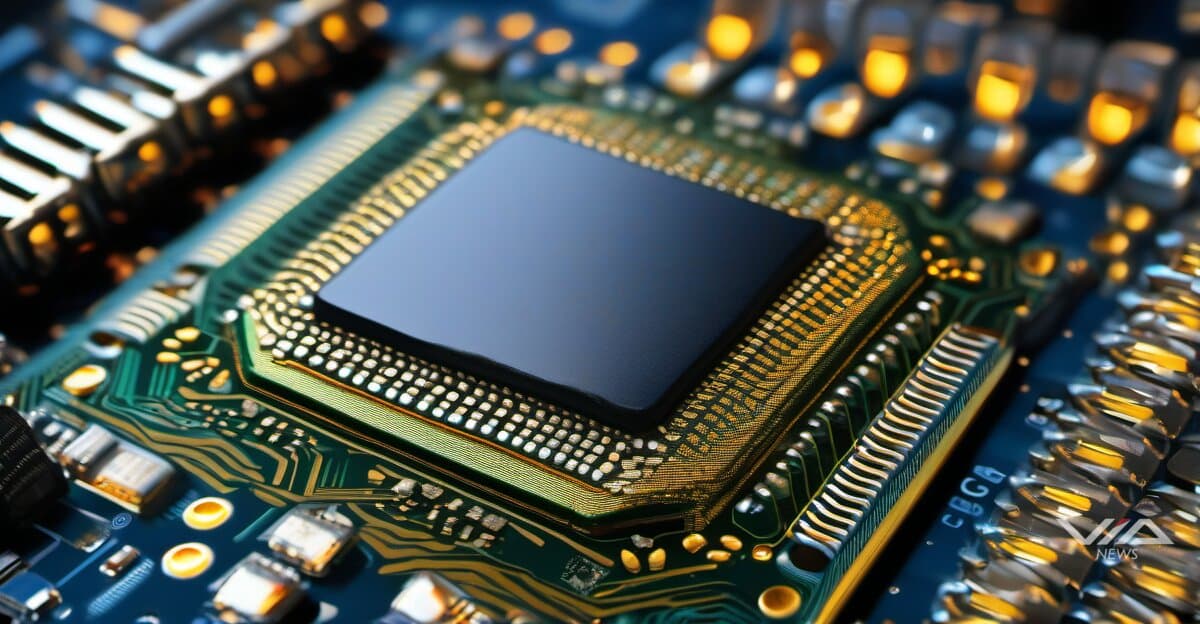
Image generated by AI for illustrative purposes. Not actual footage or photography from the reported events.

Taiwan Semiconductor Manufacturing Company raised its 2026 capital expenditure guidance on January 1, part of a global semiconductor buildout spanning Asia, North America, and Europe. Intel committed funds to a Malaysia packaging facility in December 2024, while Infineon Technologies began construction on a Dresden power semiconductor plant targeting late 2026 production.

The coordinated expansions follow a strategic shift in chip design priorities. Marvell Technology entered acquisition talks with Celestial AI in December 2024 for optical interconnect technology—photonics-based chips that move data between GPUs in training clusters. Current copper-based links max out at 800 Gbps, while next-generation language models require 1.6 Tbps interconnects. Celestial AI's silicon photonics promise 10 Tbps bandwidth.

TSMC's increased guidance targets advanced node capacity for 3nm and 2nm chips used in Nvidia's Blackwell and future Rubin GPU architectures. Intel's Malaysia facility addresses packaging substrate shortages that have constrained AI accelerator production since mid-2024. Infineon's Dresden site will manufacture power semiconductors for data center cooling systems serving AI workloads across European and Middle Eastern markets.

Microchip Technology reported "broad-based recovery" in revised guidance, citing AI infrastructure alongside automotive and industrial demand. The recovery signals spread beyond hyperscale data centers in the US and China to regional facilities in Southeast Asia, India, and the EU.

Investment timelines suggest structural confidence in AI demand. Infineon's Dresden project extends to 2028, well beyond typical semiconductor cycle peaks. TSMC, Intel, and Infineon spending patterns create a testable hypothesis: if AI chip revenue growth correlates with optical computing acquisitions through 2026, manufacturers view demand as permanent rather than cyclical. Early signals point to long-term bets—optical interconnects solve physics problems that pure compute scaling cannot address.


Sources:
1 Yahoo Finance, "Is It Time To Reassess Infineon Technologies (XTRA:IFX) After The Recent Share Price Pullback" (March 22, 2026)
2 Yahoo Finance, "OTCQX Best 50 Virtual Investor Conference: Presentations Now Available for Online Viewing" (March 20, 2026)
3 Yahoo Finance, "China’s secret weapon for smuggling AI chips might be hairdryers" (March 20, 2026)
4 Yahoo Finance, "How Investors May Respond To Microchip Technology (MCHP) Expanding Into High-Reliability SiC Power M" (March 20, 2026)
5 Yahoo Finance, "How The AI Data Center Cycle Is Reframing The Story For Nvidia (NVDA)" (March 22, 2026)

In this story · Knowledge Files

What we know · the intelligence behind this page
Live from the substrate
What we're seeing
Vertical AI Agents Attract a Funding Wave Across Fintech-Adjacent Industries
A cluster of AI-native startups applying autonomous agents to narrow, operational problems — hotel front-desk staffing (Dextr AI), identity/fraud risk for financial institutions (Baselayer), insurance distribution (Napo, Connie Health, MGT Insurance) — closed seed-to-Series A rounds within days of each other in September 2026, with CB Insights running a coordinated CEO interview series to spotlight them. The pattern points to agentic AI maturing from generic chat tools into vertical, revenue-generating products, with identity verification for AI agents themselves (Baselayer) emerging as a new fintech infrastructure category responding directly to AI-driven fraud risk.
Our read on the data ›
Signals we're tracking
Satellite-Terrestrial Network Integration Acceleration
Increased investment and launches in hybrid satellite-cellular networks across telecom industry; competitive responses from other carriers; regulatory activity around satellite spectrum; expansion of emergency/rural connectivity use cases
Patterns we're watching ›
Where sources disagree
ING Group
Both facts record the same metric (shares_outstanding) for ING Group at the identical observation date (2025-12-31). FACT A states 2,902,437,688 shares; FACT B states 2,902 million shares (2,902,000,000). The difference is 437,688 shares (~0.015%). This is a genuine value conflict, though the discrepancy appears to result from FACT B rounding to the nearest million while FACT A provides the precise count.
We flag conflicts openly ›
Recently verified
✓ Checked against the original source
4,984
facts traced to their source — and we flag the ones that don't hold up.
101 entities tracked4,984 facts checked against source5,306 source documents archived
Query this data → isubstrate.com