
Sunday, September 27, 2026

Tech Giants Deploy 1 Million Custom AI Chips to Challenge NVIDIA's Global Dominance

Anthropic will deploy 1 million AWS Trainium2 chips in the largest custom AI accelerator deal announced globally. The move follows Google's seventh-generation TPU release and Amazon's purpose-built AI data center, as hyperscalers worldwide seek alternatives to NVIDIA's 90% market share in AI chips.

ViaNews Editorial Team

February 27, 2026

Tech Giants Deploy 1 Million Custom AI Chips to Challenge NVIDIA's Global Dominance
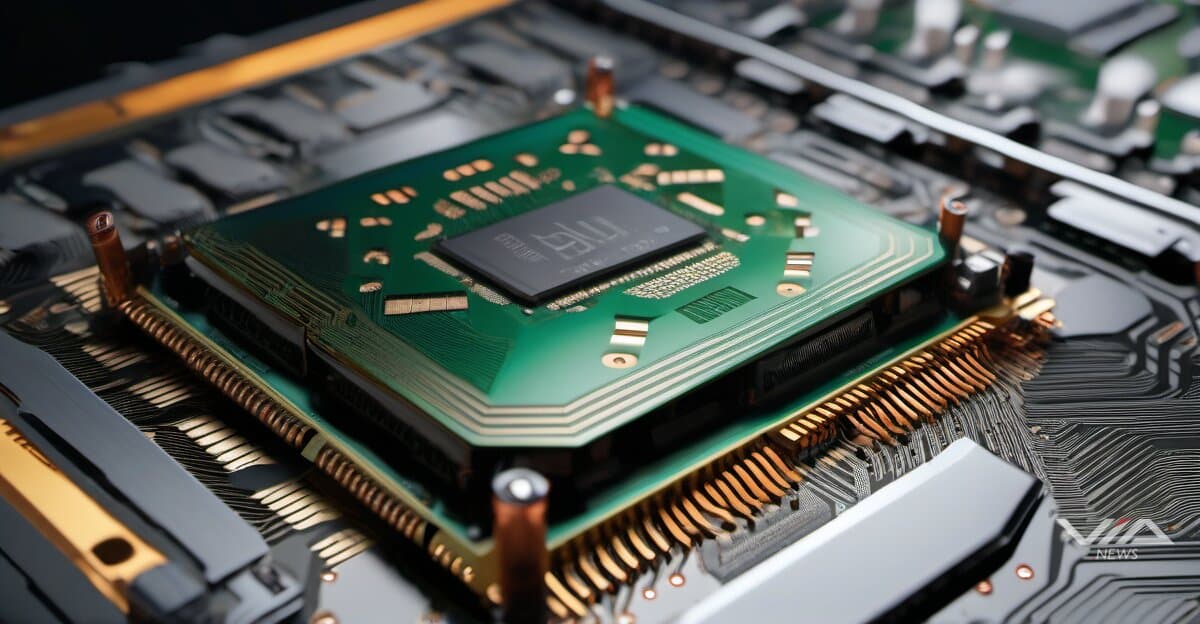
Image generated by AI for illustrative purposes. Not actual footage or photography from the reported events.

Anthropic committed to deploying 1 million AWS Trainium2 chips for Claude AI training on Amazon infrastructure, marking the largest custom accelerator deployment announced globally. The deal signals intensifying competition against NVIDIA, which controls an estimated 90% of worldwide AI chip sales.

Google released Ironwood, its seventh-generation TPU, extending a custom silicon strategy launched in 2016. The company reported strong Q3 2025 earnings driven partly by AI infrastructure investments. TPUs now power Gemini models and Google's cloud AI services across global data centers.

Amazon unveiled Project Rainier, an AI data center designed around Trainium chips rather than GPU configurations. The facility marks a shift from retrofitting existing centers to purpose-built infrastructure for custom accelerators. AWS AI revenue growth contributed to Amazon's Q3 2025 earnings beat.

Custom chips give hyperscalers control over cost-per-inference economics. Training large language models on GPUs costs millions per run globally. Purpose-built accelerators cut power consumption and eliminate GPU markup costs. Google reports TPUs deliver better performance-per-watt than comparable GPUs for transformer training.

The custom accelerator push faces technical barriers. NVIDIA's CUDA software ecosystem matured over 15 years. Developers worldwide must learn new frameworks like Amazon's Neuron SDK or Google's XLA compiler. Model portability between cloud providers decreases with proprietary chip training.

Cost-per-inference metrics will determine market share shifts in 2026. If Trainium and TPU deployments show 40-50% cost advantages over GPUs at comparable performance, economics favor rapid global adoption. Early benchmarks suggest custom chips match GPU performance on specific workloads but trail on general-purpose tasks.


Sources:
1 Yahoo Finance, "Here's Why Amazon's Biggest Bet in 2026 Could Backfire on Shareholders" (March 22, 2026)
2 Yahoo Finance, "Prediction: This Artificial Intelligence (AI) Stock Will Be Worth $5 Trillion by the End of 2026" (March 22, 2026)
3 News Report, "Anthropic steps up IPO prep in race against OpenAI - report" (December 03, 2025)
4 News Report, "Anthropic agrees to purchase startup Bun" (December 02, 2025)
5 Globe Newswire, "ROSEN, SKILLED INVESTOR COUNSEL, Encourages uniQure N.V. Investors to Secure Counsel Before Importan" (March 23, 2026)

In this story · Knowledge Files

What we know · the intelligence behind this page
Live from the substrate
What we're seeing
Vertical AI Agents Attract a Funding Wave Across Fintech-Adjacent Industries
A cluster of AI-native startups applying autonomous agents to narrow, operational problems — hotel front-desk staffing (Dextr AI), identity/fraud risk for financial institutions (Baselayer), insurance distribution (Napo, Connie Health, MGT Insurance) — closed seed-to-Series A rounds within days of each other in September 2026, with CB Insights running a coordinated CEO interview series to spotlight them. The pattern points to agentic AI maturing from generic chat tools into vertical, revenue-generating products, with identity verification for AI agents themselves (Baselayer) emerging as a new fintech infrastructure category responding directly to AI-driven fraud risk.
Our read on the data ›
Signals we're tracking
Satellite-Terrestrial Network Integration Acceleration
Increased investment and launches in hybrid satellite-cellular networks across telecom industry; competitive responses from other carriers; regulatory activity around satellite spectrum; expansion of emergency/rural connectivity use cases
Patterns we're watching ›
Where sources disagree
ING Group
Both facts record the same metric (shares_outstanding) for ING Group at the identical observation date (2025-12-31). FACT A states 2,902,437,688 shares; FACT B states 2,902 million shares (2,902,000,000). The difference is 437,688 shares (~0.015%). This is a genuine value conflict, though the discrepancy appears to result from FACT B rounding to the nearest million while FACT A provides the precise count.
We flag conflicts openly ›
Recently verified
✓ Checked against the original source
4,984
facts traced to their source — and we flag the ones that don't hold up.
101 entities tracked4,984 facts checked against source5,306 source documents archived
Query this data → isubstrate.com