
Sunday, September 27, 2026

Samsung-AMD Memory Deal Expands Global AI Chip Supply Chain as HBM Demand Surges

Samsung has partnered with AMD to supply High Bandwidth Memory components amid a global semiconductor industry capital expansion driven by AI infrastructure. The deal addresses critical HBM supply constraints as chipmakers worldwide race to secure advanced memory capacity for next-generation AI accelerators.

LM Salvado
LM Salvado

April 9, 2026

Samsung-AMD Memory Deal Expands Global AI Chip Supply Chain as HBM Demand Surges
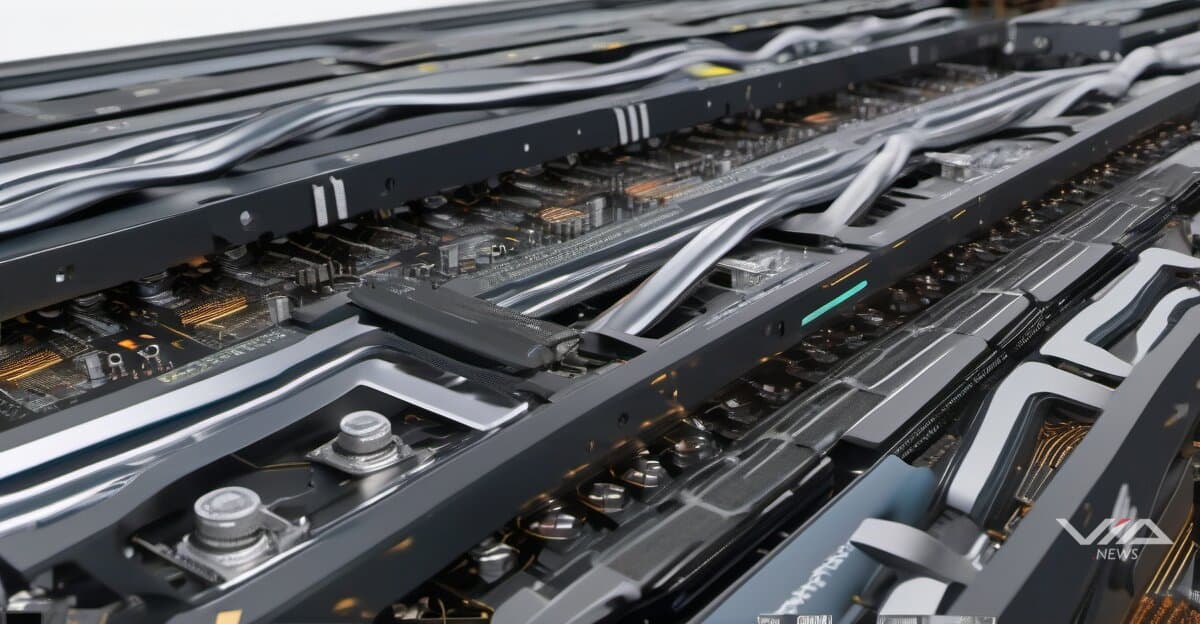
Image generated by AI for illustrative purposes. Not actual footage or photography from the reported events.

Samsung has partnered with AMD to supply High Bandwidth Memory components as global semiconductor investment enters an AI-driven expansion phase.1 The deal addresses surging demand for HBM in AI chip applications across data centers worldwide.

Semiconductor manufacturers are launching major capital expenditure programs focused on advanced packaging technologies and HBM production capacity.1 Industry analysts expect additional foundry capacity investments and memory partnerships to emerge globally within 90 days as AI infrastructure buildout accelerates.1

HBM technology has become essential for AI accelerators and GPUs, where memory bandwidth directly determines performance in training and inference workloads. Samsung's dual position in memory production and foundry services gives it exposure across multiple AI supply chain segments.

AMD competes globally against NVIDIA and Intel in AI chip markets, requiring secure access to advanced memory supplies. The Samsung partnership provides strategic supplier stability as AMD scales AI product lines for international customers.

Memory technology partnerships are multiplying worldwide as chipmakers seek to secure capacity for next-generation products. HBM manufacturing complexity has created supply bottlenecks that cross-border partnerships aim to resolve.

Samsung's integrated approach differs from pure-play foundries like Taiwan-based TSMC. The South Korean company can bundle memory and manufacturing services for customers building complete AI systems, offering advantages in markets from North America to Europe and Asia.

The global semiconductor supply chain is reorganizing around AI workload requirements that differ fundamentally from previous computing generations. Memory bandwidth, not just processor speed, now determines system performance across international data center deployments.

Current investment cycles typically last several years, suggesting the industry anticipates sustained AI infrastructure demand through the decade's end. The capital commitments span major semiconductor manufacturing regions including South Korea, Taiwan, the United States, and Europe.

In this story · Knowledge Files

About this analysis

This is a Via News analysis. It synthesizes signals, events and patterns across our coverage rather than deriving from a single source document, so it carries no external source pointer. Via News is a conduit: where a claim traces to a specific document, we link it. How we source

LM Salvado
LM Salvado

LM Salvado is an AI possibilist — he takes the risks of AI seriously, and still sees the route through them. Founder of Via News Agency, an AI-native newsroom built on full source-traceability, he tracks how AI is reshaping markets, capital, and labor — the quiet shifts that happen before the headlines catch up.

What we know · the intelligence behind this page
Live from the substrate
What we're seeing
Enterprise AI Agents Scale Up Through Partnerships and Funding, But Data Readiness Lags Ambition
A wave of vertical AI-agent startups (Swarm, Veridox, Avallon AI, DA2, F2, Earthian, Meanwhile, Covecta, Penguin AI, Maisa AI) is being funded and profiled just as major infrastructure players — Microsoft/Mistral, Siemens/NVIDIA, and Manulife/Microsoft — cement enterprise AI governance and compute partnerships. Yet a Google Cloud report shows AI agents still lack access to the majority of company data (only 45% on average), and insider selling at incumbent C3.ai signals investor caution even as adoption intent (100% planned agentic AI use within two years) races ahead of actual data infrastructure.
Our read on the data ›
Signals we're tracking
Satellite-Terrestrial Network Integration Acceleration
Increased investment and launches in hybrid satellite-cellular networks across telecom industry; competitive responses from other carriers; regulatory activity around satellite spectrum; expansion of emergency/rural connectivity use cases
Patterns we're watching ›
Where sources disagree
Berkshire Hathaway
Both facts report Berkshire Hathaway's cash position on 2026-01-01 with identical observation timestamps, but claim vastly different values: 380 billion USD vs 400 USD. These cannot both be true for the same entity at the same point in time. The magnitude of the discrepancy (a factor of ~10^9) rules out rounding, unit conversion, or methodological differences.
We flag conflicts openly ›
Recently verified
✓ Checked against the original source
4,984
facts traced to their source — and we flag the ones that don't hold up.
101 entities tracked4,984 facts checked against source5,306 source documents archived
Query this data → isubstrate.com