
Sunday, September 27, 2026

Nvidia Vera Rubin and Arteris FlexGen Drive Global Shift to AI-Specific Chip Architectures

Semiconductor firms worldwide are abandoning general-purpose chip designs for AI-optimized architectures as workload demands surge. Arteris FlexGen cuts interconnect design time while Nvidia's Vera Rubin targets AI training workloads. ARM's first manufacturing push and China's LG Innotek expansion into robotics signal a fragmented global race for specialized silicon.

LM Salvado
LM Salvado

April 12, 2026

Source Trace Score12 source documents12 with a live linkVerifiability: Strong
Nvidia Vera Rubin and Arteris FlexGen Drive Global Shift to AI-Specific Chip Architectures
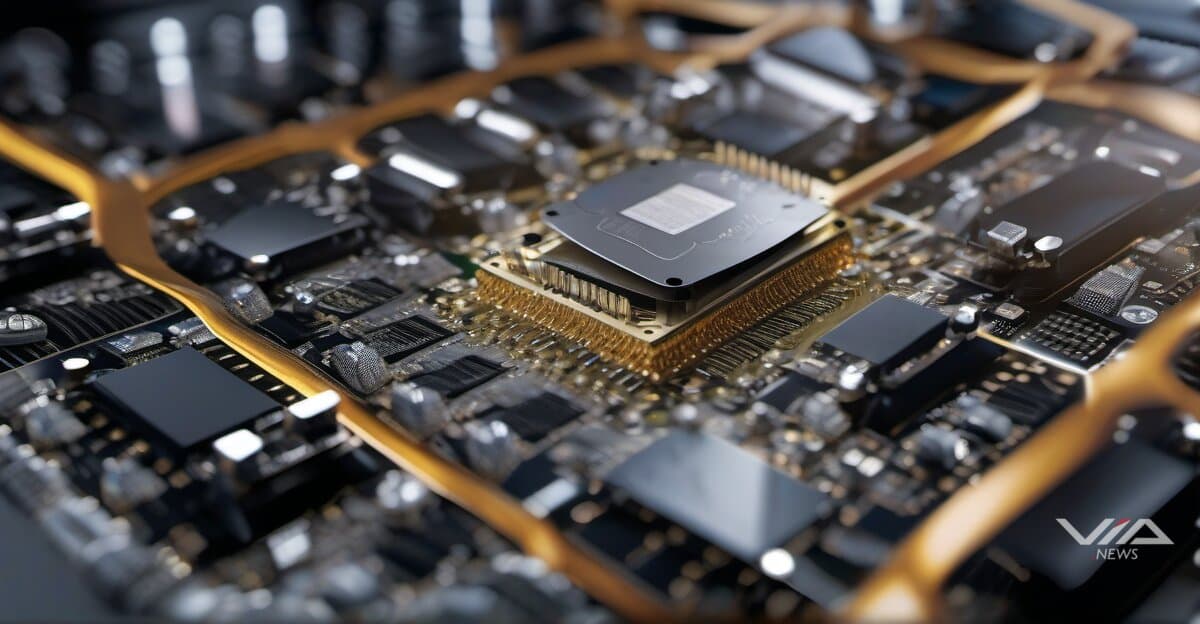
Image generated by AI for illustrative purposes. Not actual footage or photography from the reported events.

The global semiconductor industry is pivoting from decades of general-purpose chip design to AI-specific architectures as data center and edge computing demands accelerate. Arteris FlexGen NoC enables engineering teams worldwide to generate optimized interconnects with improved power, performance, and area results in a fraction of traditional design time.1 Nvidia's Vera Rubin architecture represents the latest GPU design tailored for AI training and inference workloads across hyperscale data centers from North America to Asia-Pacific.

Israel-based Camtek secured $31M in orders for AI packaging solutions, reflecting accelerating global demand for advanced chip assembly technologies that enable high-density stacking.2 These packaging systems are critical for connecting high-performance AI processors that require unprecedented data throughput between cores and memory, with adoption accelerating across fab facilities in Taiwan, South Korea, and the United States.

British chip designer ARM is entering manufacturing for the first time, targeting $15B in annual revenue within five years—a move that puts it in direct competition with Asian foundries and traditional licensees.3 The shift signals confidence that AI workloads require purpose-built silicon beyond general-purpose processors. ARM's Neoverse platform has already gained traction in cloud AI infrastructure from Amazon Web Services to Alibaba Cloud.

South Korea's LG Innotek is expanding beyond autonomous driving into drones and robotics using U.S.-based Applied Intuition's software platform, positioning for leadership in physical AI markets across manufacturing hubs in Asia and Europe.4 The company aims to enhance sensing modules that integrate AI processing at the edge, reducing latency for real-time autonomous systems.

U.S. chipmaker Wolfspeed refinanced $97M in debt, cutting annual interest expense by $62M to fund domestic silicon carbide production capacity as Washington prioritizes onshore semiconductor manufacturing.5 Silicon carbide chips enable efficient power conversion in AI data centers globally, where energy consumption constrains deployment scale from Frankfurt to Singapore.

The convergence of specialized architectures, advanced packaging, and compound semiconductors marks a departure from the general-purpose era. Companies investing in AI-specific silicon are betting workload specialization will deliver performance gains that justify higher development costs and fragmented markets across training, inference, and edge computing.

Source documents

Via News is a conduit. We point to the source documents behind this report — we don't replace them. Trace any claim to its source and decide what to trust. How we source

Source Trace Score12 source documents12 with a live linkVerifiability: Strong
  1. [1]News articleYahoo Finance· March 29, 2026
    Applied Intuition and LG Innotek Enter Strategic Partnership to Advance Autonomous Vehicle Development
  2. [2]News articleYahoo Finance· March 25, 2026
    Arteris Named to Fast Company’s Annual List of the World’s Most Innovative Companies of 2026
  3. [3]News articleYahoo Finance· April 3, 2026
    Camtek’s US$31m AI Packaging Order Puts OSAT Exposure In Focus
  4. [4]News articleThe Verge AI
    Intel will help build Elon Musk’s Terafab AI chip factory
  5. [5]News articleYahoo Finance· March 29, 2026
    LG Innotek Accelerates Physical AI Market Entry Through Partnership with Applied Intuition
  6. [6]News articleNasdaq· March 25, 2026
    Stocks Climb on Hopes of US-Iran Diplomacy
  7. [7]News articleNasdaq· March 25, 2026
    Stocks Finish Higher on US Push to End Iran War
  8. [8]News articleNasdaq· March 25, 2026
    Stocks Rally on US Peace Plan to End Iran War
  9. [9]News articleYahoo Finance· March 26, 2026
    Strategic Refinancing and New Equity Issuance Support Wolfspeed’s Long-term Growth Potential
  10. [10]News articleYahoo Finance· March 25, 2026
    Universal Display to Highlight OLED Emissive Layer Advances for Display Efficiency and Performance at ICDT 2026
  11. [11]News articleYahoo Finance· March 19, 2026
    A New U.S. Facility Could Break China’s Grip on Critical Materials
  12. [12]News articleYahoo Finance· March 25, 2026
    Here's How Micron Technology, Nvidia, and AMD Could Help This Unstoppable ETF Turn $250,000 Into $1 Million in 10 Years

In this story · Knowledge Files

LM Salvado
LM Salvado

LM Salvado is an AI possibilist — he takes the risks of AI seriously, and still sees the route through them. Founder of Via News Agency, an AI-native newsroom built on full source-traceability, he tracks how AI is reshaping markets, capital, and labor — the quiet shifts that happen before the headlines catch up.

What we know · the intelligence behind this page
Live from the substrate
What we're seeing
Vertical AI Agents Attract a Funding Wave Across Fintech-Adjacent Industries
A cluster of AI-native startups applying autonomous agents to narrow, operational problems — hotel front-desk staffing (Dextr AI), identity/fraud risk for financial institutions (Baselayer), insurance distribution (Napo, Connie Health, MGT Insurance) — closed seed-to-Series A rounds within days of each other in September 2026, with CB Insights running a coordinated CEO interview series to spotlight them. The pattern points to agentic AI maturing from generic chat tools into vertical, revenue-generating products, with identity verification for AI agents themselves (Baselayer) emerging as a new fintech infrastructure category responding directly to AI-driven fraud risk.
Our read on the data ›
Signals we're tracking
Satellite-Terrestrial Network Integration Acceleration
Increased investment and launches in hybrid satellite-cellular networks across telecom industry; competitive responses from other carriers; regulatory activity around satellite spectrum; expansion of emergency/rural connectivity use cases
Patterns we're watching ›
Where sources disagree
ING Group
Both facts record the same metric (shares_outstanding) for ING Group at the identical observation date (2025-12-31). FACT A states 2,902,437,688 shares; FACT B states 2,902 million shares (2,902,000,000). The difference is 437,688 shares (~0.015%). This is a genuine value conflict, though the discrepancy appears to result from FACT B rounding to the nearest million while FACT A provides the precise count.
We flag conflicts openly ›
Recently verified
✓ Checked against the original source
4,984
facts traced to their source — and we flag the ones that don't hold up.
101 entities tracked4,984 facts checked against source5,306 source documents archived
Query this data → isubstrate.com