
Sunday, September 27, 2026

Nvidia Launches CUDA-Q and NVQLink, Embedding Quantum Into Its Global Compute Platform

Nvidia has released CUDA-Q and NVQLink, integrating quantum computing directly into its CUDA ecosystem used by millions of developers worldwide. The tools connect classical and quantum processors in hybrid workflows, positioning Nvidia as the integration layer for a global quantum transition. A companion AI model targets quantum error correction — the field's central technical barrier.

LM Salvado
LM Salvado

June 12, 2026

Nvidia Launches CUDA-Q and NVQLink, Embedding Quantum Into Its Global Compute Platform
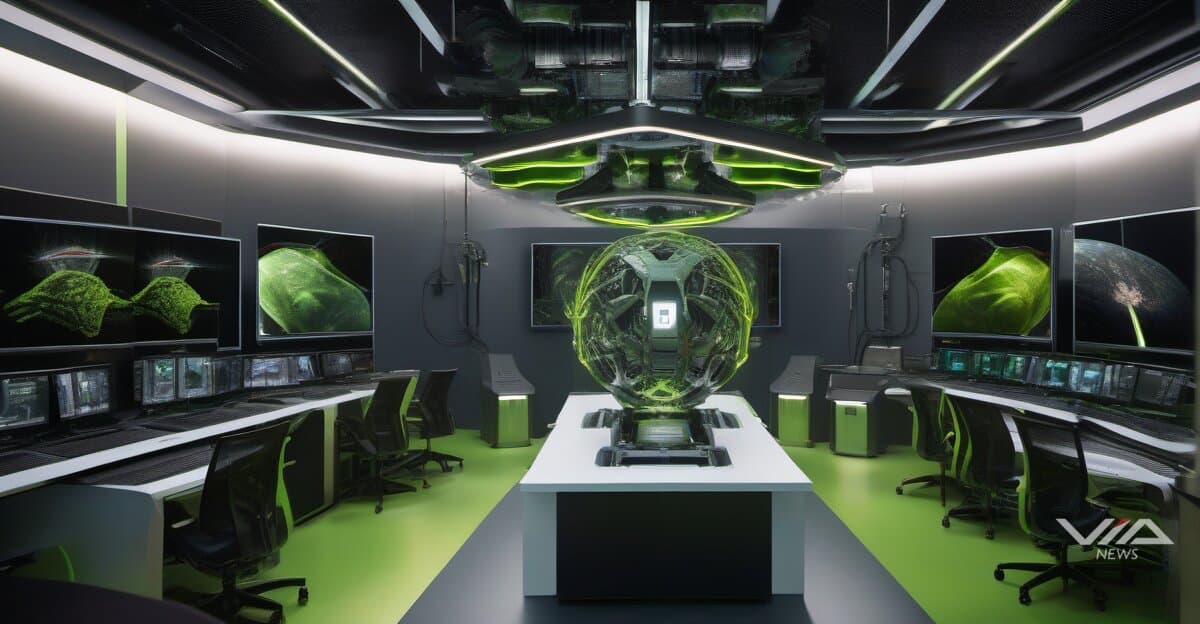
Image generated by AI for illustrative purposes. Not actual footage or photography from the reported events.

Nvidia has released CUDA-Q and NVQLink, extending its dominant AI infrastructure into quantum-classical hybrid computing.1 The move makes Nvidia a cross-paradigm platform, not just an AI hardware vendor.

CUDA-Q is built on the same foundation behind Nvidia's AI dominance across US, European, and Asian data centers. NVQLink connects classical and quantum processors within hybrid workflows.1 Developers already using CUDA — millions globally — can extend workloads into quantum circuits without switching toolchains.

Nvidia also released a generative AI model for quantum error correction.1 Error correction is the central obstacle to commercial quantum viability. Applying AI to solve it creates a compounding advantage: Nvidia's infrastructure accelerates quantum maturation while expanding its own addressable market.

The competitive landscape is international. Alphabet, IBM, and IonQ lead in the US. China's government has committed billions to sovereign quantum programs. The EU Quantum Flagship initiative funds research across member states. Nvidia now enters all these markets as a toolchain provider rather than a hardware competitor.

Nvidia competes directly with Alphabet in quantum while simultaneously supplying AI infrastructure to Alphabet and most of its rivals.1 That asymmetry is structural: Nvidia's quantum bets are funded by AI revenue. Pure-play quantum companies — whether in Boston, Amsterdam, or Beijing — carry undiversified technology risk.

Pure-play quantum stocks globally face binary milestone risk tied to qubit counts, error rates, and fault tolerance timelines. Nvidia's revenue base is not exposed to that risk in the same way.1 Its quantum investments are additions to a profitable core.

The CUDA ecosystem's network effects extend internationally. Existing enterprise pipelines, tooling, and developer fluency lower adoption friction for CUDA-Q across every market. A competing quantum framework built outside CUDA faces a steeper global adoption curve.

Nvidia's quantum strategy is infrastructure for a years-long transition — built on top of infrastructure already generating revenue today.1

In this story · Knowledge Files

About this analysis

This is a Via News analysis. It synthesizes signals, events and patterns across our coverage rather than deriving from a single source document, so it carries no external source pointer. Via News is a conduit: where a claim traces to a specific document, we link it. How we source

LM Salvado
LM Salvado

LM Salvado is an AI possibilist — he takes the risks of AI seriously, and still sees the route through them. Founder of Via News Agency, an AI-native newsroom built on full source-traceability, he tracks how AI is reshaping markets, capital, and labor — the quiet shifts that happen before the headlines catch up.

What we know · the intelligence behind this page
Live from the substrate
What we're seeing
Vertical AI Agents Attract a Funding Wave Across Fintech-Adjacent Industries
A cluster of AI-native startups applying autonomous agents to narrow, operational problems — hotel front-desk staffing (Dextr AI), identity/fraud risk for financial institutions (Baselayer), insurance distribution (Napo, Connie Health, MGT Insurance) — closed seed-to-Series A rounds within days of each other in September 2026, with CB Insights running a coordinated CEO interview series to spotlight them. The pattern points to agentic AI maturing from generic chat tools into vertical, revenue-generating products, with identity verification for AI agents themselves (Baselayer) emerging as a new fintech infrastructure category responding directly to AI-driven fraud risk.
Our read on the data ›
Signals we're tracking
Satellite-Terrestrial Network Integration Acceleration
Increased investment and launches in hybrid satellite-cellular networks across telecom industry; competitive responses from other carriers; regulatory activity around satellite spectrum; expansion of emergency/rural connectivity use cases
Patterns we're watching ›
Where sources disagree
ING Group
Both facts record the same metric (shares_outstanding) for ING Group at the identical observation date (2025-12-31). FACT A states 2,902,437,688 shares; FACT B states 2,902 million shares (2,902,000,000). The difference is 437,688 shares (~0.015%). This is a genuine value conflict, though the discrepancy appears to result from FACT B rounding to the nearest million while FACT A provides the precise count.
We flag conflicts openly ›
Recently verified
✓ Checked against the original source
4,984
facts traced to their source — and we flag the ones that don't hold up.
101 entities tracked4,984 facts checked against source5,306 source documents archived
Query this data → isubstrate.com