
Sunday, September 27, 2026

Nvidia Buys Groq as US Tech Giants Lock Up AI's Global Silicon Supply Chain

Nvidia acquired LPU chip startup Groq and launched its own Vera CPUs as Broadcom finalizes custom processor deals with Alphabet and OpenAI simultaneously. The consolidation concentrates AI compute control in a handful of US firms with dedicated TSMC manufacturing capacity in Taiwan. Nations and companies outside this circle face a widening infrastructure gap with direct implications for AI sovereignty.

LM Salvado
LM Salvado

May 25, 2026

Nvidia Buys Groq as US Tech Giants Lock Up AI's Global Silicon Supply Chain
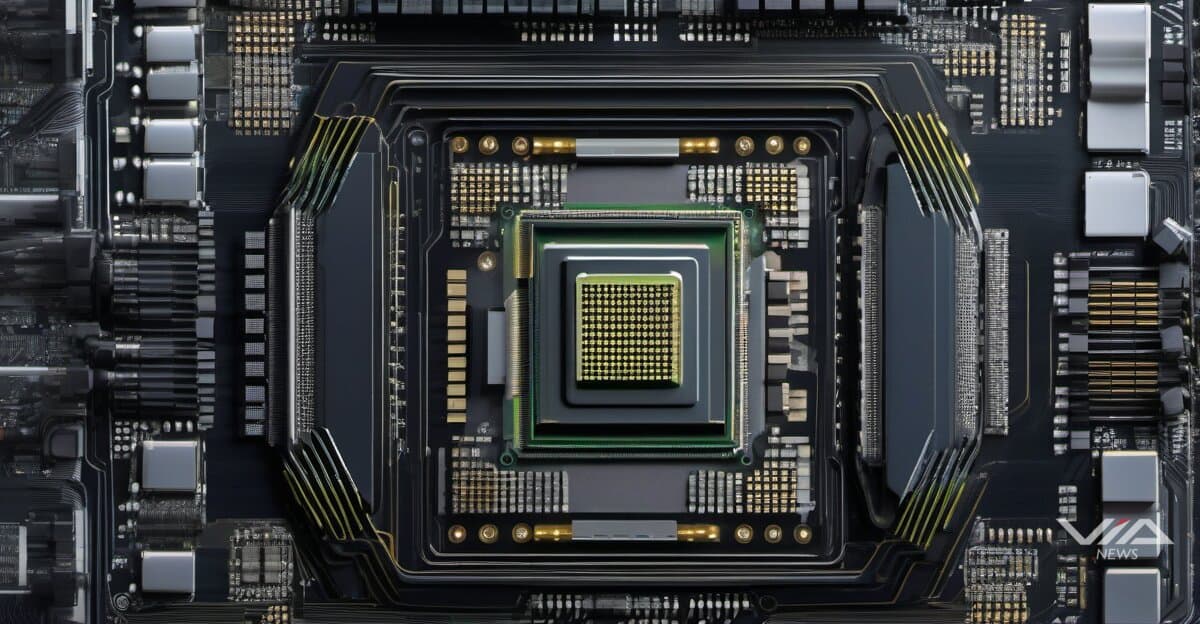
Image generated by AI for illustrative purposes. Not actual footage or photography from the reported events.

Nvidia acquired Groq, the LPU inference chip startup, and launched its own Vera CPUs this week — completing a vertical integration play that extends well beyond American borders.1

Broadcom is simultaneously building custom AI processors for Alphabet and OpenAI, with Arm joining the OpenAI collaboration.1 Three of the world's most powerful AI operators are now co-designing the silicon that runs their models.

The consolidation concentrates AI compute authority in a small cluster of US firms with dedicated manufacturing through TSMC in Taiwan. Alphabet's TPU program, developed with Broadcom over years, is the template. What has changed is scale and simultaneity: multiple hyperscalers are locking in custom silicon relationships at the same moment.

For AI programs outside this circle — European sovereign AI initiatives, Gulf-state cloud buildouts, Indian infrastructure ambitions — the strategic gap is widening. Custom chips tuned to specific model architectures deliver better performance-per-watt than commodity GPUs. At billions of inference queries daily, that efficiency advantage compounds into significant cost separation.

Tiger Global has increased stakes in Nvidia, Broadcom, and TSMC concurrently.1 The investment pattern signals where infrastructure value accrues: not in GPU purchasing, but in custom silicon partnerships and dedicated manufacturing capacity.

Taiwan's position is central and exposed. TSMC manufactures the chips undergirding this consolidation. Geopolitical risk around the Taiwan Strait is therefore also AI infrastructure risk — a calculation European and Asian governments are actively pricing into national technology strategies.

China's push for chip independence, accelerated by US export controls, represents the only parallel vertical integration effort at comparable ambition. Chinese fabs remain multiple generations behind TSMC in leading-edge capacity, limiting near-term competitive parity.

Nvidia has an estimated 18-24 month window before custom silicon deployments create structural pressure on its commodity GPU business.1 The Groq acquisition and Vera CPU launch are direct responses to that clock.

The race to own AI's silicon stack is no longer a US domestic story. It is the central infrastructure competition shaping AI capacity worldwide.

In this story · Knowledge Files

About this analysis

This is a Via News analysis. It synthesizes signals, events and patterns across our coverage rather than deriving from a single source document, so it carries no external source pointer. Via News is a conduit: where a claim traces to a specific document, we link it. How we source

LM Salvado
LM Salvado

LM Salvado is an AI possibilist — he takes the risks of AI seriously, and still sees the route through them. Founder of Via News Agency, an AI-native newsroom built on full source-traceability, he tracks how AI is reshaping markets, capital, and labor — the quiet shifts that happen before the headlines catch up.

What we know · the intelligence behind this page
Live from the substrate
What we're seeing
Vertical AI Agents Attract a Funding Wave Across Fintech-Adjacent Industries
A cluster of AI-native startups applying autonomous agents to narrow, operational problems — hotel front-desk staffing (Dextr AI), identity/fraud risk for financial institutions (Baselayer), insurance distribution (Napo, Connie Health, MGT Insurance) — closed seed-to-Series A rounds within days of each other in September 2026, with CB Insights running a coordinated CEO interview series to spotlight them. The pattern points to agentic AI maturing from generic chat tools into vertical, revenue-generating products, with identity verification for AI agents themselves (Baselayer) emerging as a new fintech infrastructure category responding directly to AI-driven fraud risk.
Our read on the data ›
Signals we're tracking
Satellite-Terrestrial Network Integration Acceleration
Increased investment and launches in hybrid satellite-cellular networks across telecom industry; competitive responses from other carriers; regulatory activity around satellite spectrum; expansion of emergency/rural connectivity use cases
Patterns we're watching ›
Where sources disagree
ING Group
Both facts record the same metric (shares_outstanding) for ING Group at the identical observation date (2025-12-31). FACT A states 2,902,437,688 shares; FACT B states 2,902 million shares (2,902,000,000). The difference is 437,688 shares (~0.015%). This is a genuine value conflict, though the discrepancy appears to result from FACT B rounding to the nearest million while FACT A provides the precise count.
We flag conflicts openly ›
Recently verified
✓ Checked against the original source
4,984
facts traced to their source — and we flag the ones that don't hold up.
101 entities tracked4,984 facts checked against source5,306 source documents archived
Query this data → isubstrate.com