
Sunday, September 27, 2026

Huawei Targets 750,000 AI Chip Shipments in 2026 as US Export Curbs Reshape Global Semiconductor Market

Huawei aims to ship 750,000 units of its 950PR AI chip in 2026 as US export restrictions drive Chinese tech giants ByteDance and Alibaba away from Nvidia. The chip's CUDA compatibility addresses a critical migration barrier that has hampered previous domestic alternatives in China's race for semiconductor independence.

LM Salvado
LM Salvado

March 30, 2026

Huawei Targets 750,000 AI Chip Shipments in 2026 as US Export Curbs Reshape Global Semiconductor Market
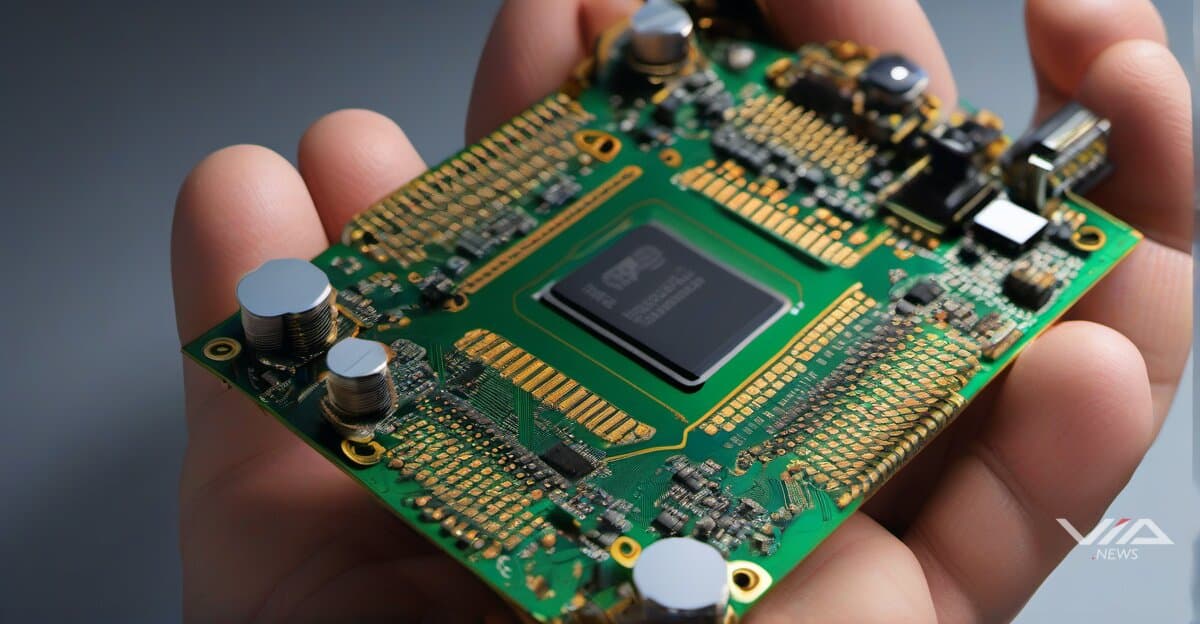
Image generated by AI for illustrative purposes. Not actual footage or photography from the reported events.

Huawei plans to ship 750,000 units of its 950PR AI chip in 2026, capitalizing on US export restrictions that have blocked Nvidia's advanced processors from reaching Chinese buyers. ByteDance and Alibaba are preparing orders after testing confirmed the chip meets their AI infrastructure requirements.

The 950PR's compatibility with CUDA—Nvidia's widely-used programming framework—solves a persistent challenge facing China's semiconductor industry. Previous domestic chips required extensive software rewrites, slowing adoption. Chinese developers report they can now migrate AI models from Nvidia-based systems with significantly less friction.

US restrictions introduced in recent years have barred many of Nvidia's AI chips from Chinese customers, including the H100 and A100 models that power data centers globally. Beijing responded with policies encouraging domestic chip adoption, accelerating what industry observers expected would be a decade-long transition.

ByteDance and Alibaba, which operate among Asia's largest AI computing deployments, validated the 950PR's performance in recent testing cycles. Both companies have relied on CUDA-based infrastructure, making seamless migration capability essential for any alternative chipset.

Chinese tech firms indicate they plan broader deployment of the 950PR compared to earlier domestic chip generations. The reduced software rewrite burden addresses the main bottleneck that limited uptake of previous Huawei and Cambricon offerings.

Huawei's 750,000-unit target would capture substantial market share in China's AI chip sector, where Nvidia previously dominated before export controls took effect. The volume suggests Huawei expects to replace a significant portion of the restricted Nvidia products across Chinese data centers.

The development highlights how technology export restrictions can reshape global semiconductor supply chains. Rather than halting AI development in China, the US curbs created market conditions that accelerated domestic alternatives. Companies like Huawei gained urgency to solve compatibility challenges that previously deterred customers from switching away from Nvidia's ecosystem.

The shift has implications beyond China. As countries worldwide assess semiconductor supply chain vulnerabilities exposed by US-China tensions, domestic chip initiatives have gained traction in Europe, India, and Southeast Asia. Huawei's progress demonstrates that determined investment in compatibility layers can overcome ecosystem lock-in effects.

In this story · Knowledge Files

About this analysis

This is a Via News analysis. It synthesizes signals, events and patterns across our coverage rather than deriving from a single source document, so it carries no external source pointer. Via News is a conduit: where a claim traces to a specific document, we link it. How we source

LM Salvado
LM Salvado

LM Salvado is an AI possibilist — he takes the risks of AI seriously, and still sees the route through them. Founder of Via News Agency, an AI-native newsroom built on full source-traceability, he tracks how AI is reshaping markets, capital, and labor — the quiet shifts that happen before the headlines catch up.

What we know · the intelligence behind this page
Live from the substrate
What we're seeing
Enterprise AI Agents Scale Up Through Partnerships and Funding, But Data Readiness Lags Ambition
A wave of vertical AI-agent startups (Swarm, Veridox, Avallon AI, DA2, F2, Earthian, Meanwhile, Covecta, Penguin AI, Maisa AI) is being funded and profiled just as major infrastructure players — Microsoft/Mistral, Siemens/NVIDIA, and Manulife/Microsoft — cement enterprise AI governance and compute partnerships. Yet a Google Cloud report shows AI agents still lack access to the majority of company data (only 45% on average), and insider selling at incumbent C3.ai signals investor caution even as adoption intent (100% planned agentic AI use within two years) races ahead of actual data infrastructure.
Our read on the data ›
Signals we're tracking
Satellite-Terrestrial Network Integration Acceleration
Increased investment and launches in hybrid satellite-cellular networks across telecom industry; competitive responses from other carriers; regulatory activity around satellite spectrum; expansion of emergency/rural connectivity use cases
Patterns we're watching ›
Where sources disagree
Berkshire Hathaway
Both facts report Berkshire Hathaway's cash position on 2026-01-01 with identical observation timestamps, but claim vastly different values: 380 billion USD vs 400 USD. These cannot both be true for the same entity at the same point in time. The magnitude of the discrepancy (a factor of ~10^9) rules out rounding, unit conversion, or methodological differences.
We flag conflicts openly ›
Recently verified
✓ Checked against the original source
4,984
facts traced to their source — and we flag the ones that don't hold up.
101 entities tracked4,984 facts checked against source5,306 source documents archived
Query this data → isubstrate.com