
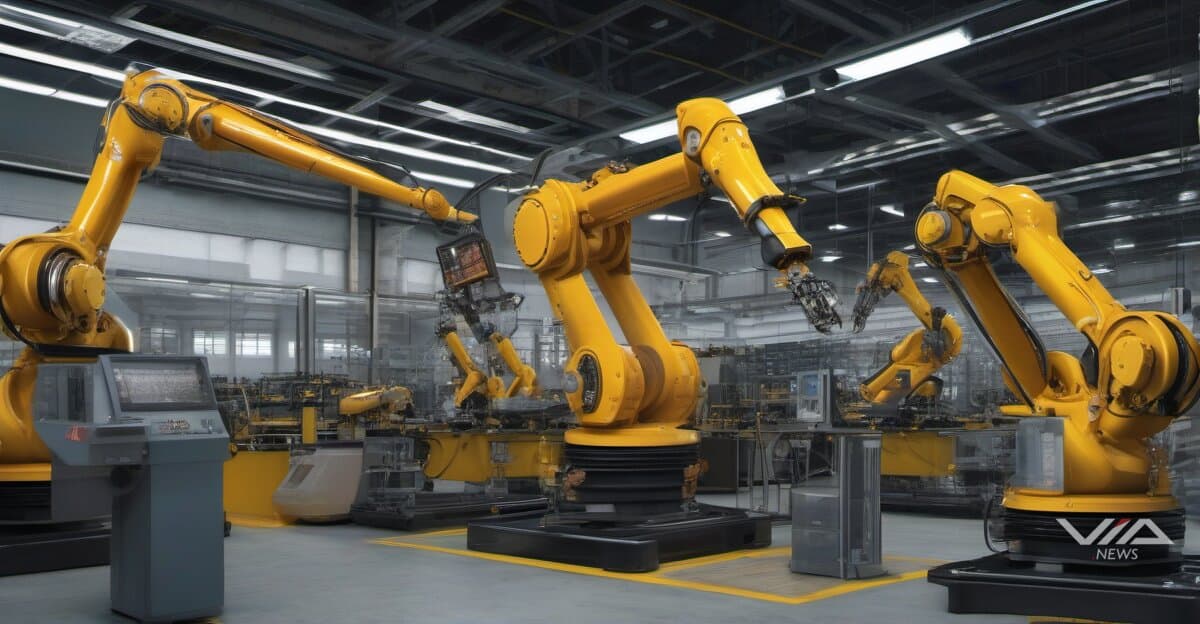
Industrial robot sales reached record levels globally as manufacturers respond to persistent labor shortages, with infrastructure spending projected to hit $30 billion by 2026 according to the International Federation of Robotics. The automation wave spans manufacturing centers from Germany's industrial heartland to China's export zones and North American production facilities.
CoreWeave's capital expenditure illustrates the scale: spending will jump from $15.4 billion in 2025 to at least $30 billion in 2026 for data centers supporting AI-powered automation systems. These facilities serve manufacturers deploying robots that process machine vision and predictive maintenance locally rather than relying on cloud connectivity.
AMD launched its Ryzen AI 400 Series processors targeting industrial applications, the first chips designed for AI-enhanced operations on factory floors. Jack Huynh, AMD executive, compared the shift to desktop PCs evolving into intelligent assistants. Marvell Technology reported $2.08 billion in Q3 revenue, reflecting demand for robotics connectivity infrastructure.
Labor constraints drive adoption across developed economies. Manufacturing sectors report unfilled positions despite wage increases, improving automation ROI calculations. Robots that required 3-5 years to justify investments now deliver faster payback as human labor costs rise and availability shrinks.
The market splits between traditional automation vendors retrofitting existing robots with AI capabilities and startups building AI-native systems requiring different processor architectures. Both approaches create cascading demand for edge AI processors, industrial networking equipment, and specialized sensors.
Traditional robots operated on fixed programs with simple controllers. AI-enabled systems need edge processors for machine vision, predictive maintenance algorithms, and adaptive workflow management installed at manufacturing sites. The infrastructure requirements extend beyond robot manufacturers to chip makers, networking suppliers, and sensor producers expanding production capacity.
Monitoring robot shipment volumes alongside edge AI processor sales will reveal adoption patterns as manufacturers worldwide shift from labor-intensive to automated production systems.
Sources:
1 Yahoo Finance, "QBit Semiconductor Plans Taiwan IPO in 2026" (March 23, 2026)
2 Yahoo Finance, "Elon Musk's Terafab bet: what it means for Tesla investors" (March 22, 2026)
3 Yahoo Finance, "AMD vs. Broadcom: Which Semiconductor Stock is a Buy Right Now?" (March 19, 2026)
4 Yahoo Finance, "Can Intel's Partnership With NVIDIA on Xeon 6 Propel Its Shares?" (March 17, 2026)
5 Yahoo Finance, "Has The Recent Pullback Opened An Opportunity In Colgate-Palmolive (CL)?" (March 22, 2026)