
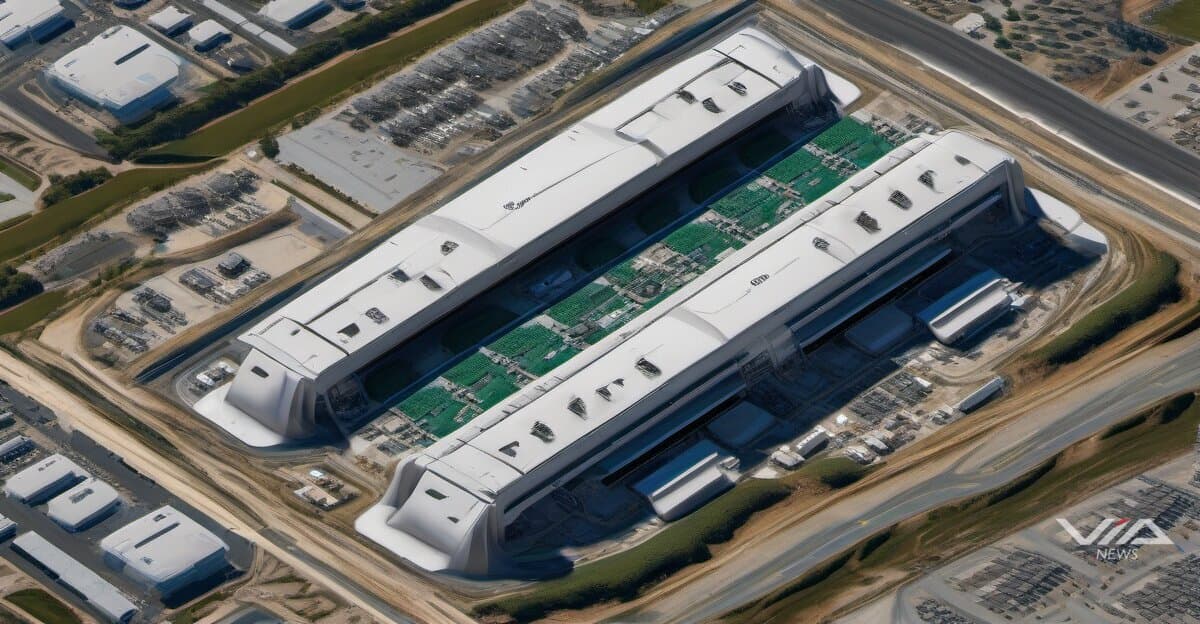
Broadcom is rapidly transforming from a traditional semiconductor and enterprise software company into one of the most critical enablers of AI infrastructure worldwide, securing over $21 billion in custom silicon orders that underscore the massive buildout of computational capacity now underway across the global hyperscaler ecosystem.
The California-based chip giant has landed major design wins for custom XPUs (accelerated processing units) and TPUs (tensor processing units) from multiple hyperscale cloud providers operating internationally, including San Francisco-based Anthropic, which has committed $10 billion, alongside an additional $11 billion in orders from other clients. A fifth undisclosed customer recently added $1 billion to Broadcom's AI silicon backlog, demonstrating broad-based demand across continents and market segments.
These custom chip orders represent a fundamental shift in how AI infrastructure is being constructed globally. Rather than relying solely on off-the-shelf GPUs—a market currently dominated by U.S.-based Nvidia—hyperscalers from North America, Europe, and Asia are increasingly investing in application-specific integrated circuits (ASICs) optimized for their particular AI workloads. This trend mirrors broader geopolitical efforts by nations including China, the European Union, and Japan to reduce dependence on foreign chip suppliers and develop indigenous AI capabilities.
The strategic importance of this shift transcends commercial considerations, touching on national security and technological sovereignty. Custom silicon allows AI companies to optimize performance-per-watt, reduce costs over time, and gain architectural differentiation in an increasingly competitive global landscape. For companies and nations building frontier AI models—which require enormous computational resources rivaling those of major scientific installations—custom chips designed specifically for training and inference workloads can deliver significant advantages over general-purpose accelerators.
Broadcom's momentum extends beyond custom silicon into power infrastructure, a challenge facing AI developers worldwide. The company has partnered with OpenAI on a 10-gigawatt data center initiative, reflecting the staggering energy requirements of modern AI infrastructure. To put this in international perspective, 10 gigawatts equals roughly the output of ten large nuclear power plants—more than the total electricity generation capacity of countries like Portugal or New Zealand—highlighting both the energy-intensive nature of AI development and the infrastructure challenges facing nations seeking to compete in this space.
The company's Q1 FY2026 guidance suggests this global AI infrastructure boom shows no signs of slowing. As large language models continue to scale and new AI applications emerge across industries from manufacturing to healthcare worldwide, demand for specialized computational hardware is expected to grow exponentially. Broadcom's order book provides visibility into sustained capital deployment from hyperscalers across multiple continents over the coming years.
This transformation marks a significant strategic pivot for Broadcom, which has historically been known for its networking chips and the controversial VMware acquisition. The AI infrastructure opportunity appears to be reshaping not only the company's growth trajectory but also its role in the global technology supply chain, with custom silicon and AI-optimized networking becoming core growth drivers with international strategic implications.
For the broader international AI ecosystem, Broadcom's success illustrates a critical trend: the companies providing fundamental infrastructure for the AI revolution—specialized semiconductors, high-bandwidth networking equipment, and power systems—may prove as strategically valuable as the AI model developers themselves. As governments from Washington to Brussels to Beijing craft industrial policies around AI competitiveness, control over this foundational hardware layer is emerging as a key battleground in the global technology competition of the 21st century.