
Sunday, September 27, 2026

AMD wins Meta GPU contract, challenging NVIDIA's 80% dominance in global AI chip market

AMD secured a GPU supply deal with Meta on February 25, 2026, sending its stock up 10% as the company breaks into AI infrastructure dominated by NVIDIA. The agreement marks a shift in the $50+ billion AI accelerator market as hyperscalers worldwide pursue multi-vendor strategies to reduce supply chain concentration and improve pricing leverage.

ViaNews Editorial Team

February 26, 2026

AMD wins Meta GPU contract, challenging NVIDIA's 80% dominance in global AI chip market
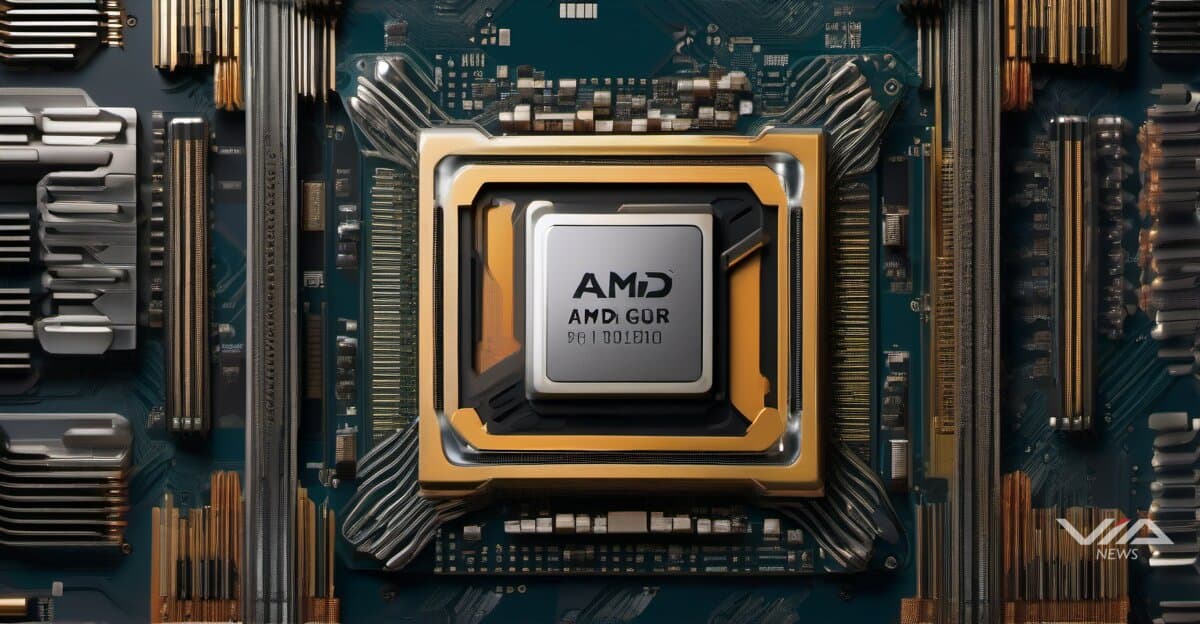
Image generated by AI for illustrative purposes. Not actual footage or photography from the reported events.

AMD closed a major GPU supply agreement with Meta on February 25, 2026, gaining a foothold in AI infrastructure where NVIDIA controls over 80% of the global market. AMD shares surged 10% as investors recognized the strategic breakthrough in the rapidly expanding AI accelerator sector.

Meta joins hyperscalers across North America, Europe, and Asia pursuing multi-vendor GPU strategies. The trend reflects supply constraints from NVIDIA's tight production capacity, which has left data centers from Frankfurt to Singapore competing for allocation. Companies want negotiating leverage and backup suppliers as AI infrastructure spending accelerates globally in 2026.

AMD's MI300 series accelerators have narrowed the performance gap for certain workloads, making them viable alternatives for training models and running inference tasks. NVIDIA maintains advantages in software ecosystem maturity—its CUDA platform remains the industry standard across research institutions and enterprises worldwide—but AMD's competitive pricing appeals to cost-conscious deployments.

The competitive pressure arrives as NVIDIA expands partnerships globally, including recent silicon photonics work with Lumentum and data center agreements with Vertiv. Additional AMD wins among Europe's cloud providers or Asian tech giants would confirm a sustained market shift rather than an isolated deal.

Market observers will track AMD's share of AI/ML workloads over 12 months as the key metric. Performance benchmarks comparing the two suppliers will determine how much business AMD realistically captures from enterprise customers spanning financial services in London, manufacturing in Seoul, and research centers in Tel Aviv.

For AMD, the Meta contract provides reference customer credibility needed to pursue deployments across international markets. The diversification signals AI infrastructure is maturing from single-vendor dependence toward competitive supplier dynamics, potentially improving chip availability and pricing for customers worldwide.


Sources:
1 Yahoo Finance, "Marvell Technology Inc. (MRVL) Unveils Advanced Switch for AI Data Center Scale-Up Infrastructure" (March 22, 2026)
2 Yahoo Finance, "Is It Too Late To Consider Lumentum Holdings (LITE) After An 83% Year To Date Surge?" (March 21, 2026)
3 Yahoo Finance, "Assessing ESAB (ESAB) Valuation After Recent Share Price Weakness" (March 22, 2026)
4 Yahoo Finance, "Meta Stock Slips Below $600. Time to Buy?" (March 21, 2026)
5 Yahoo Finance, "Is Everpure, Inc. (PSTG) A Good Stock To Buy Now?" (March 21, 2026)

What we know · the intelligence behind this page
Live from the substrate
What we're seeing
Vertical AI Agents Attract a Funding Wave Across Fintech-Adjacent Industries
A cluster of AI-native startups applying autonomous agents to narrow, operational problems — hotel front-desk staffing (Dextr AI), identity/fraud risk for financial institutions (Baselayer), insurance distribution (Napo, Connie Health, MGT Insurance) — closed seed-to-Series A rounds within days of each other in September 2026, with CB Insights running a coordinated CEO interview series to spotlight them. The pattern points to agentic AI maturing from generic chat tools into vertical, revenue-generating products, with identity verification for AI agents themselves (Baselayer) emerging as a new fintech infrastructure category responding directly to AI-driven fraud risk.
Our read on the data ›
Signals we're tracking
Satellite-Terrestrial Network Integration Acceleration
Increased investment and launches in hybrid satellite-cellular networks across telecom industry; competitive responses from other carriers; regulatory activity around satellite spectrum; expansion of emergency/rural connectivity use cases
Patterns we're watching ›
Where sources disagree
ING Group
Both facts record the same metric (shares_outstanding) for ING Group at the identical observation date (2025-12-31). FACT A states 2,902,437,688 shares; FACT B states 2,902 million shares (2,902,000,000). The difference is 437,688 shares (~0.015%). This is a genuine value conflict, though the discrepancy appears to result from FACT B rounding to the nearest million while FACT A provides the precise count.
We flag conflicts openly ›
Recently verified
✓ Checked against the original source
4,984
facts traced to their source — and we flag the ones that don't hold up.
101 entities tracked4,984 facts checked against source5,306 source documents archived
Query this data → isubstrate.com