
Sunday, September 27, 2026

AI Warehouse Robots Hit 98% Accuracy as Global Autonomous Vehicle Rollout Targets 2026

Warehouse robotics systems have reached 98% accuracy across commercial deployments in logistics, manufacturing, and autonomous vehicle production. Automakers worldwide confirmed 2026-2027 timelines for mass production of self-driving vehicles, backed by AI-RAN 5G infrastructure enabling real-time navigation processing. Five sectors now operate multi-site implementations with documented returns on investment.

Source Trace Score12 source documents12 with a live linkVerifiability: Strong
AI Warehouse Robots Hit 98% Accuracy as Global Autonomous Vehicle Rollout Targets 2026
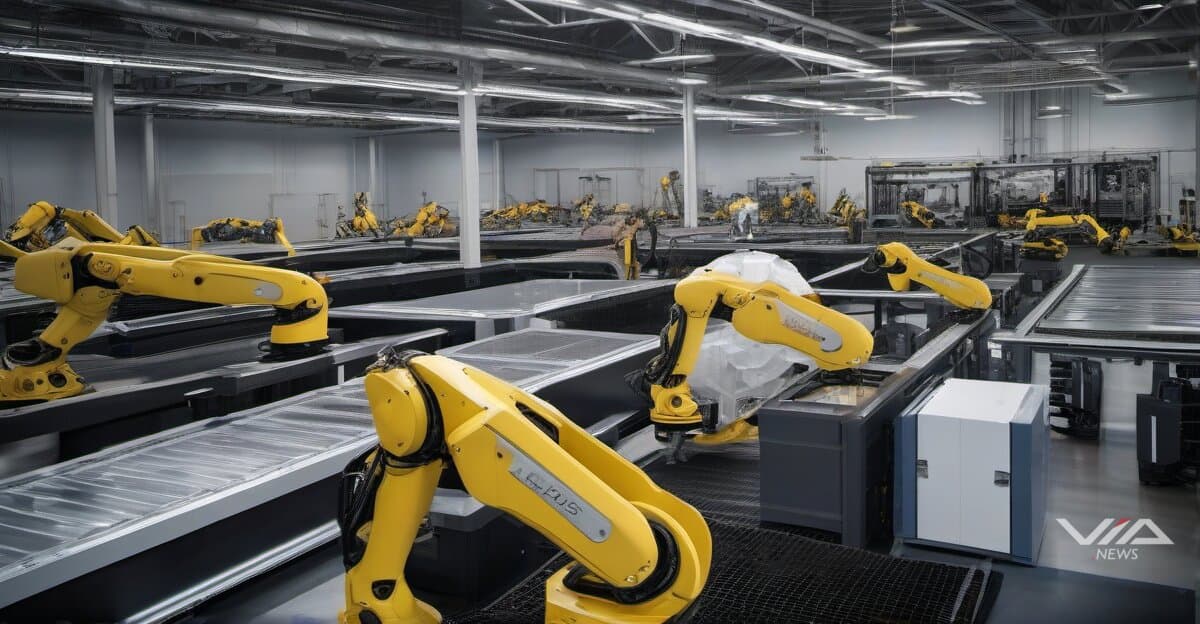
Image generated by AI for illustrative purposes. Not actual footage or photography from the reported events.

AI-powered warehouse robotics have achieved 98% accuracy rates as autonomous vehicle manufacturers across North America, Europe, and Asia confirm 2026-2027 production targets for commercial rollout.

Warehouse automation leads global deployment maturity. Computer vision and machine learning systems now handle inventory management, order fulfillment, and quality control with minimal human oversight. These systems match or exceed human performance in repetitive tasks while operating continuously.

Autonomous vehicle production relies on convergent AI and AI-RAN 5G telecom infrastructure. Real-time processing capabilities support navigation and object recognition systems required for mass manufacturing timelines announced by automakers in multiple markets.

Defense contractors and industrial manufacturers have formed international partnerships to deploy physical AI in production facilities. Integrated sensor systems, actuators, and decision algorithms perform complex assembly tasks previously requiring human dexterity across automotive plants in Germany, electronics facilities in East Asia, and food processing operations in North America.

Regulatory agencies in the US, EU, and Asia-Pacific markets have expanded approvals for assistive robotics in healthcare and service industries. Cleared applications include patient mobility assistance, surgical support, and rehabilitation therapy following safety validation studies.

Manufacturing automation benefits from adaptive robots that adjust to production line changes without extensive reprogramming. Machine learning models learn assembly patterns from human demonstrations, then optimize processes through repetition. Factories report 30-40% efficiency gains after full integration.

Five sectors dominate current deployments worldwide: logistics fulfillment centers, automotive manufacturing, warehouse inventory management, food processing facilities, and electronics assembly plants. Each has progressed from proof-of-concept to multi-site implementations with documented ROI.

Standardized component availability—vision systems, manipulator arms, mobility platforms—enables companies to integrate custom AI models trained on industry-specific datasets. This modular approach reduces deployment costs and accelerates timelines across international markets.

Source documents

Via News is a conduit. We point to the source documents behind this report — we don't replace them. Trace any claim to its source and decide what to trust. How we source

Source Trace Score12 source documents12 with a live linkVerifiability: Strong
  1. [1]News articleCrunchbase News
    5 Interesting Startup Deals You May Have Missed: Plant-Based Clothing Dyes, A Shoebox-Picking Robot, And Power Generated On The Moon
  2. [2]News articleYahoo Finance· February 3, 2026
    Dassault Systèmes and NVIDIA Partner to Build Industrial AI Platform Powering Virtual Twins
  3. [3]News articleYahoo Finance· February 17, 2026
    Lifeward’s ReWalk™ Personal Exoskeleton Now Covered by Aetna, Coverage Expands to Include Three of the Largest Medicare Advantage Insurers
  4. [4]News articleYahoo Finance· January 5, 2026
    Lucid, Nuro, and Uber Unveil Global Robotaxi at CES, Announce Autonomous On-Road Testing
  5. [5]News articleIEEE Spectrum
    Xiangyi Cheng Is Bringing AR to Classrooms and Hospitals
  6. [6]Press releaseGlobeNewswire· February 13, 2026
    $9.8 Billion in Autonomy Spending Hits the AI-Boosted Defense Supply Chain
  7. [7]News articleYahoo Finance· December 8, 2025
    Apple won’t be the same in 2026. Meet the company’s next generation of leaders and rising stars after its biggest executive exodus in years
  8. [8]Press releaseGlobeNewswire· February 23, 2026
    Deep Learning Market Size to Surpass $296B by 2031 as Autonomous Systems and Robotics are Set to Grow at 37.2% CAGR, Says a 2026 Mordor Intelligence Report
  9. [9]News articleYahoo Finance· February 25, 2026
    Innoviz Reports Fourth Quarter and Full Year 2025 Results
  10. [10]Press releaseGlobeNewswire· March 1, 2026
    Nokia accelerates AI-RAN momentum with new partnerships driving path to AI-Native 6G #MWC26
  11. [11]News articleMIT Technology Review
    The Download: how America lost its lead in the hunt for alien life, and ambitious battery claims
  12. [12]News articleIEEE Spectrum
    Video Friday: Humanoid Robots Celebrate Spring
What we know · the intelligence behind this page
Live from the substrate
What we're seeing
Vertical AI Agents Attract a Funding Wave Across Fintech-Adjacent Industries
A cluster of AI-native startups applying autonomous agents to narrow, operational problems — hotel front-desk staffing (Dextr AI), identity/fraud risk for financial institutions (Baselayer), insurance distribution (Napo, Connie Health, MGT Insurance) — closed seed-to-Series A rounds within days of each other in September 2026, with CB Insights running a coordinated CEO interview series to spotlight them. The pattern points to agentic AI maturing from generic chat tools into vertical, revenue-generating products, with identity verification for AI agents themselves (Baselayer) emerging as a new fintech infrastructure category responding directly to AI-driven fraud risk.
Our read on the data ›
Signals we're tracking
Satellite-Terrestrial Network Integration Acceleration
Increased investment and launches in hybrid satellite-cellular networks across telecom industry; competitive responses from other carriers; regulatory activity around satellite spectrum; expansion of emergency/rural connectivity use cases
Patterns we're watching ›
Where sources disagree
ING Group
Both facts record the same metric (shares_outstanding) for ING Group at the identical observation date (2025-12-31). FACT A states 2,902,437,688 shares; FACT B states 2,902 million shares (2,902,000,000). The difference is 437,688 shares (~0.015%). This is a genuine value conflict, though the discrepancy appears to result from FACT B rounding to the nearest million while FACT A provides the precise count.
We flag conflicts openly ›
Recently verified
✓ Checked against the original source
4,984
facts traced to their source — and we flag the ones that don't hold up.
101 entities tracked4,984 facts checked against source5,306 source documents archived
Query this data → isubstrate.com