
Sunday, September 27, 2026

AI Trading Systems Deploy Across Global Crypto Markets as Institutional Firms Race for Speed

Institutional market makers and retail crypto exchanges worldwide are deploying Google TPU-powered deep learning systems to execute algorithmic trades. Flow Traders launched neural network-based market making operations while BitMart integrated AI across its trading infrastructure. Platforms like nof1.ai now offer retail traders access to institutional-grade AI tools previously limited to hedge funds.

Source Trace Score3 source documents3 with a live linkVerifiability: Strong
AI Trading Systems Deploy Across Global Crypto Markets as Institutional Firms Race for Speed
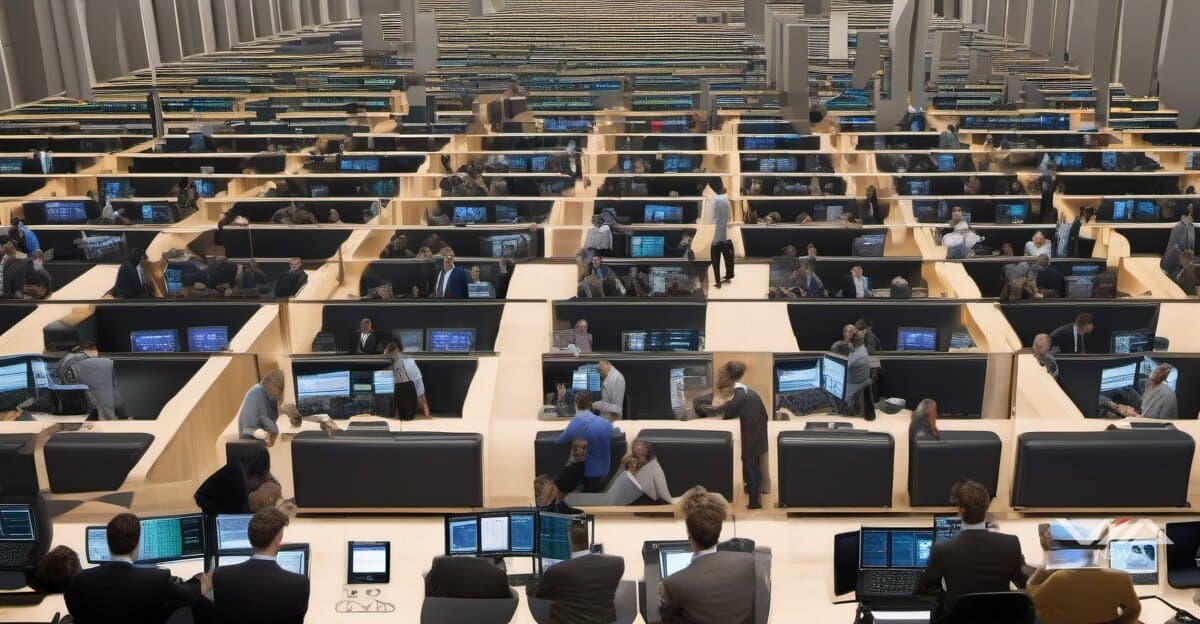
Image generated by AI for illustrative purposes. Not actual footage or photography from the reported events.

Global crypto trading firms are deploying Google TPU-powered deep learning systems to automate market making and trade execution across international exchanges. Flow Traders, a Netherlands-based market maker operating across Asia, Europe, and the Americas, launched neural network systems optimizing liquidity provision in digital asset markets.

BitMart rolled out AI-powered trading infrastructure integrating machine learning for price prediction and automated order routing. The Cayman Islands-based exchange, serving users across 180 countries, reported improved execution efficiency following deployment.

Retail traders globally gained access to institutional AI tools through nof1.ai, which runs live capital trading competitions. The platform democratizes algorithmic trading infrastructure previously exclusive to hedge funds operating in traditional financial centers like London, New York, and Singapore.

Google's Gemini 3 language model is being integrated for sentiment analysis across international markets. The AI processes social media feeds, regulatory filings from multiple jurisdictions, and market commentary in various languages to generate trading signals.

The AI deployment coincides with diverging regulatory approaches worldwide. Tether's USDT faced credit rating downgrades while European regulators approved the first Bittensor exchange-traded product, highlighting the fragmented global regulatory landscape for crypto assets.

Bitcoin's volatility created testing conditions for AI systems across time zones. The cryptocurrency reached all-time highs before entering correction, providing diverse market scenarios for machine learning models trading across Asian, European, and American sessions.

TPU infrastructure costs remain prohibitive for smaller operations in emerging markets. Google's tensor processing units outperform traditional GPUs for deep learning but require significant capital investment, creating competitive advantages for well-funded firms in developed markets.

Market makers report AI systems reduced latency during high-volatility periods across international exchanges. The technology enables simultaneous risk management across multiple trading pairs and geographic markets, responding faster than human traders to global market movements.

The convergence of AI infrastructure and global crypto markets creates new competitive dynamics where computational power determines trading performance alongside traditional financial analysis, concentrating advantages among technologically sophisticated firms.

Source documents

Via News is a conduit. We point to the source documents behind this report — we don't replace them. Trace any claim to its source and decide what to trust. How we source

Source Trace Score3 source documents3 with a live linkVerifiability: Strong
  1. [1]Press releaseGlobeNewswire· January 13, 2026
    BitMart 2025 Annual Review: Building a More Complete Financial Infrastructure to Drive Long-Term Sustainable Growth
  2. [2]Press releaseGlobeNewswire· December 5, 2025
    CoinEx Research November 2025 Report: Painvember's Brutal Reality Check
  3. [3]News articleYahoo Finance· February 12, 2026
    Flow Traders 4Q and FY 2025 Results

In this story · Knowledge Files

What we know · the intelligence behind this page
Live from the substrate
What we're seeing
Vertical AI Agents Attract a Funding Wave Across Fintech-Adjacent Industries
A cluster of AI-native startups applying autonomous agents to narrow, operational problems — hotel front-desk staffing (Dextr AI), identity/fraud risk for financial institutions (Baselayer), insurance distribution (Napo, Connie Health, MGT Insurance) — closed seed-to-Series A rounds within days of each other in September 2026, with CB Insights running a coordinated CEO interview series to spotlight them. The pattern points to agentic AI maturing from generic chat tools into vertical, revenue-generating products, with identity verification for AI agents themselves (Baselayer) emerging as a new fintech infrastructure category responding directly to AI-driven fraud risk.
Our read on the data ›
Signals we're tracking
Satellite-Terrestrial Network Integration Acceleration
Increased investment and launches in hybrid satellite-cellular networks across telecom industry; competitive responses from other carriers; regulatory activity around satellite spectrum; expansion of emergency/rural connectivity use cases
Patterns we're watching ›
Where sources disagree
ING Group
Both facts record the same metric (shares_outstanding) for ING Group at the identical observation date (2025-12-31). FACT A states 2,902,437,688 shares; FACT B states 2,902 million shares (2,902,000,000). The difference is 437,688 shares (~0.015%). This is a genuine value conflict, though the discrepancy appears to result from FACT B rounding to the nearest million while FACT A provides the precise count.
We flag conflicts openly ›
Recently verified
✓ Checked against the original source
4,984
facts traced to their source — and we flag the ones that don't hold up.
101 entities tracked4,984 facts checked against source5,306 source documents archived
Query this data → isubstrate.com