
Sunday, September 27, 2026

AI cloud firms build own data centers as infrastructure delays outpace chip shortages globally

Data center capacity has replaced semiconductor supply as the primary bottleneck for AI infrastructure worldwide. CoreWeave and other specialized cloud providers are moving toward vertical integration, building their own facilities to bypass third-party delays that now exceed GPU procurement times.

ViaNews Editorial Team

February 24, 2026

AI cloud firms build own data centers as infrastructure delays outpace chip shortages globally
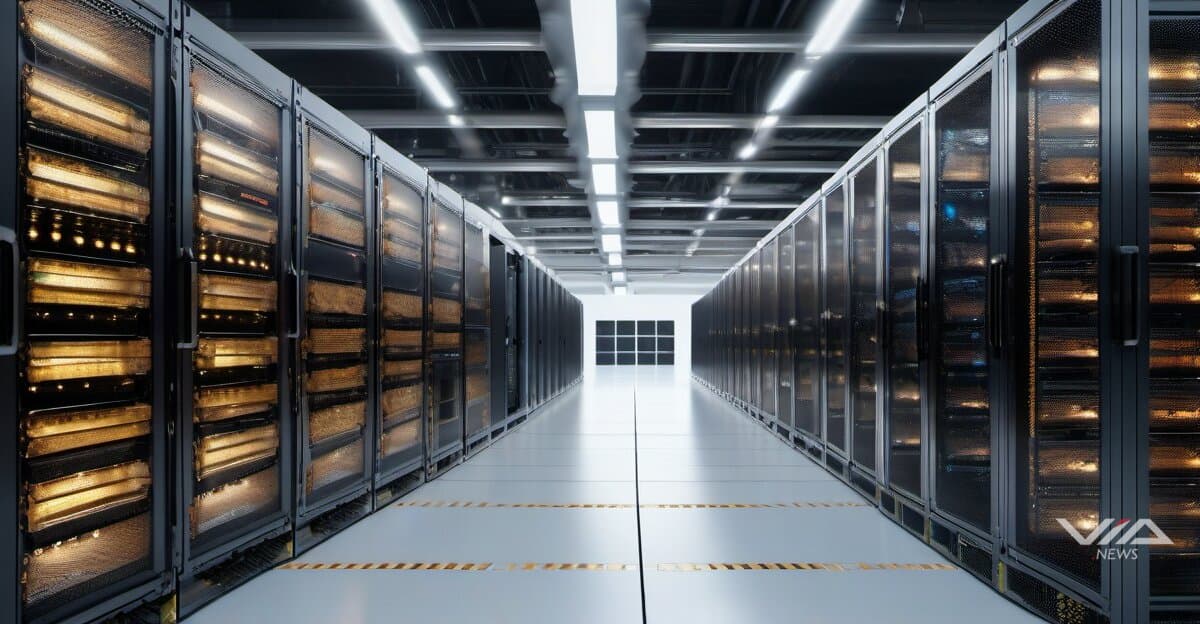
Image generated by AI for illustrative purposes. Not actual footage or photography from the reported events.

Data center infrastructure has become the primary constraint for AI cloud deployment globally, overtaking chip availability as the dominant bottleneck. CoreWeave reports delays stem from "powered shell" data center capacity—not semiconductors or power supply—prompting the company to build its own facilities.

The shift marks a reversal from 2023-2024, when GPU scarcity drove AI deployment timelines worldwide. Specialized cloud providers now face longer waits for rack space, power connections, and cooling systems than for procuring advanced AI accelerators.

CoreWeave is embedding self-build capabilities into its supply chain, following vertical integration patterns pioneered by hyperscalers like AWS and Google Cloud. The move represents a strategic departure from asset-light models that relied on colocation providers across North America, Europe, and Asia-Pacific markets.

The company has diversified its data center partnerships to manage constraints. Internal projections indicate Q1 2026 will eliminate most current deployment delays through combined self-build and partnership approaches.

Surging demand for AI inference and training infrastructure is outpacing traditional data center construction cycles in established markets. Hyperscalers and AI-focused providers compete for limited availability in existing facilities from Northern Virginia to Frankfurt to Singapore while racing to bring new capacity online.

Industry observers expect more AI infrastructure companies to announce self-build initiatives through 2026 as time-to-deployment becomes competitive differentiation. Providers with captive data center capacity can offer faster provisioning for enterprise AI workloads, particularly in power-constrained European and Asian markets.

The infrastructure crunch affects model training timelines, inference deployment schedules, and AI application scaling globally. Companies dependent on third-party cloud infrastructure face extended wait times for new capacity, with delays most acute in regions with limited power grid expansion and restrictive zoning regulations.

CoreWeave's Q1 2026 timeline will test whether vertical integration and provider diversification can compress deployment cycles under supply-constrained conditions across multiple continents.


Sources:
1 Nasdaq, "Think You Can Ignore RMDs? Here's What It Could Cost You." (March 23, 2026)
2 Globe Newswire, "New Crypto: Pepeto Presale Stage Update While Dogecoin Price Prediction Heats Up After Elon Musk Dog" (March 23, 2026)

In this story · Knowledge Files

What we know · the intelligence behind this page
Live from the substrate
What we're seeing
Vertical AI Agents Attract a Funding Wave Across Fintech-Adjacent Industries
A cluster of AI-native startups applying autonomous agents to narrow, operational problems — hotel front-desk staffing (Dextr AI), identity/fraud risk for financial institutions (Baselayer), insurance distribution (Napo, Connie Health, MGT Insurance) — closed seed-to-Series A rounds within days of each other in September 2026, with CB Insights running a coordinated CEO interview series to spotlight them. The pattern points to agentic AI maturing from generic chat tools into vertical, revenue-generating products, with identity verification for AI agents themselves (Baselayer) emerging as a new fintech infrastructure category responding directly to AI-driven fraud risk.
Our read on the data ›
Signals we're tracking
Satellite-Terrestrial Network Integration Acceleration
Increased investment and launches in hybrid satellite-cellular networks across telecom industry; competitive responses from other carriers; regulatory activity around satellite spectrum; expansion of emergency/rural connectivity use cases
Patterns we're watching ›
Where sources disagree
ING Group
Both facts record the same metric (shares_outstanding) for ING Group at the identical observation date (2025-12-31). FACT A states 2,902,437,688 shares; FACT B states 2,902 million shares (2,902,000,000). The difference is 437,688 shares (~0.015%). This is a genuine value conflict, though the discrepancy appears to result from FACT B rounding to the nearest million while FACT A provides the precise count.
We flag conflicts openly ›
Recently verified
✓ Checked against the original source
4,984
facts traced to their source — and we flag the ones that don't hold up.
101 entities tracked4,984 facts checked against source5,306 source documents archived
Query this data → isubstrate.com