
Sunday, September 27, 2026

AI Chip Packaging Equipment to Grow 15-19% Through 2026 as Global Data Center Race Intensifies

KLA Corp. projects mid-to-high teens revenue growth in advanced packaging equipment through 2026, outpacing broader semiconductor industry rates. The forecast reflects global competition in AI infrastructure, with TSMC, Samsung, and Intel each investing billions in proprietary packaging technologies. Advanced packaging now rivals transistor scaling as the primary performance differentiator in AI accelerators.

AI Chip Packaging Equipment to Grow 15-19% Through 2026 as Global Data Center Race Intensifies
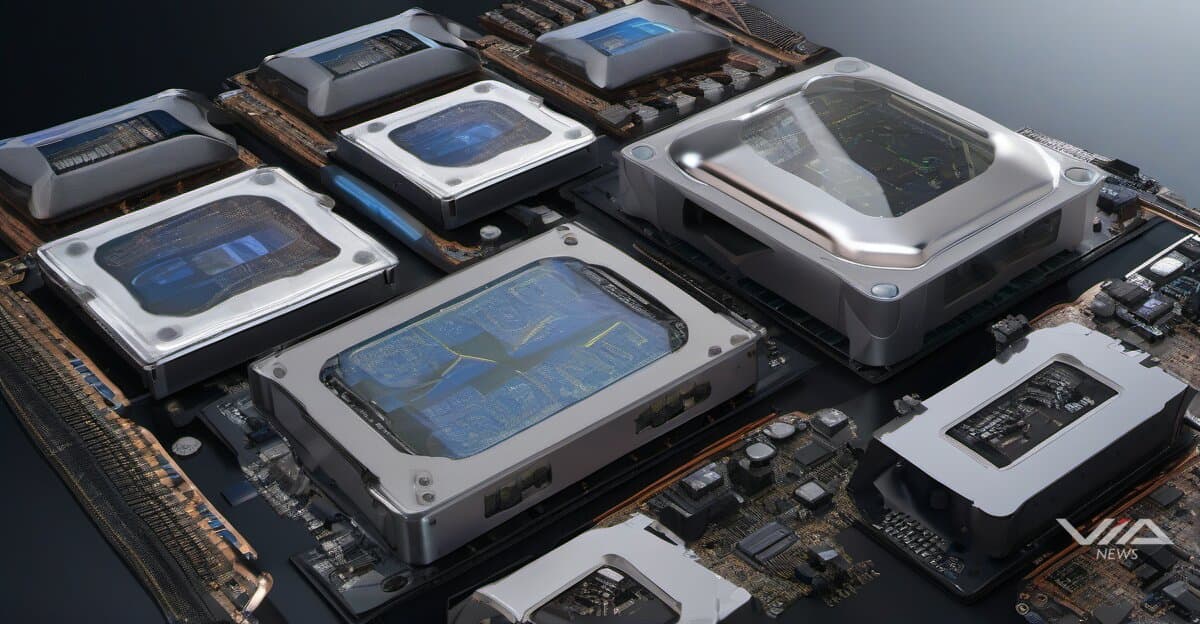
Image generated by AI for illustrative purposes. Not actual footage or photography from the reported events.

KLA Corp. expects 15-19% annual revenue growth in advanced packaging equipment through calendar 2026, CEO Michael E. Hurlston told investors. The projection exceeds broader semiconductor equipment industry growth and underscores packaging's role as a competitive battleground across Asia, Europe, and North America.

Advanced packaging stacks chips vertically or arranges them horizontally to solve bandwidth and latency bottlenecks that single-chip designs cannot address. TSMC's CoWoS technology dominates high-end AI chips in Taiwan, while Samsung's X-Cube and Intel's Foveros represent South Korea's and America's competing approaches. Each requires specialized inspection equipment to detect nanometer-scale defects across multi-layer structures.

Indium phosphide production capacity surged over 20% in Q4 2024 alone, Hurlston reported. The material enables electro-absorption modulated lasers used in most initial 1.6 terabit-per-second optical transceivers. These interconnects move data between AI chips in data centers worldwide, with 200-gigabit lane speeds exceeding performance expectations.

Nvidia's latest GPUs use TSMC's CoWoS-L to integrate HBM3E memory from SK Hynix and Micron. AMD's MI300 series employs 3D chip stacking. Both designs prioritize packaging innovation over traditional transistor scaling—a shift that benefits equipment suppliers like KLA, Applied Materials, and Tokyo Electron.

The 2026 forecast suggests packaging equipment demand will track AI infrastructure buildout rather than consumer electronics cycles. Hyperscalers including Amazon, Microsoft, Google, and China's ByteDance continue data center expansion despite potential slowdowns in smartphones and PCs. Advanced packaging revenue as a share of total fab spending should rise measurably through 2026, making it a key metric for identifying which suppliers capture AI-driven growth across global markets.


Sources:
1 Globe Newswire, "Willis partners with Circle Asia to launch Asia’s first insurance facility for collectors and galler" (March 23, 2026)
2 Yahoo Finance, "CNOOC Names Huang Yongzhang as Chief Executive Officer" (March 23, 2026)
3 Nasdaq, "The Nasdaq Is on the Verge of a Correction. 4 Things Investors Need To Remember" (March 23, 2026)
4 Nasdaq, "AI-Driven Fear Slashed Toast Stock by 43%, Even as Free Cash Flow Hit Records" (March 23, 2026)
5 Nasdaq, "2 Artificial Intelligence (AI) Stocks That Are Quietly Outperforming Micron Technology in 2026 With " (March 21, 2026)

In this story · Knowledge Files

What we know · the intelligence behind this page
Live from the substrate
What we're seeing
Vertical AI Agents Attract a Funding Wave Across Fintech-Adjacent Industries
A cluster of AI-native startups applying autonomous agents to narrow, operational problems — hotel front-desk staffing (Dextr AI), identity/fraud risk for financial institutions (Baselayer), insurance distribution (Napo, Connie Health, MGT Insurance) — closed seed-to-Series A rounds within days of each other in September 2026, with CB Insights running a coordinated CEO interview series to spotlight them. The pattern points to agentic AI maturing from generic chat tools into vertical, revenue-generating products, with identity verification for AI agents themselves (Baselayer) emerging as a new fintech infrastructure category responding directly to AI-driven fraud risk.
Our read on the data ›
Signals we're tracking
Satellite-Terrestrial Network Integration Acceleration
Increased investment and launches in hybrid satellite-cellular networks across telecom industry; competitive responses from other carriers; regulatory activity around satellite spectrum; expansion of emergency/rural connectivity use cases
Patterns we're watching ›
Where sources disagree
ING Group
Both facts record the same metric (shares_outstanding) for ING Group at the identical observation date (2025-12-31). FACT A states 2,902,437,688 shares; FACT B states 2,902 million shares (2,902,000,000). The difference is 437,688 shares (~0.015%). This is a genuine value conflict, though the discrepancy appears to result from FACT B rounding to the nearest million while FACT A provides the precise count.
We flag conflicts openly ›
Recently verified
✓ Checked against the original source
4,984
facts traced to their source — and we flag the ones that don't hold up.
101 entities tracked4,984 facts checked against source5,306 source documents archived
Query this data → isubstrate.com