
Sunday, September 27, 2026

NVIDIA Lands Nine Global Enterprise Partners in 48 Hours at GTC Taipei, Spanning Five Industries

Nine major companies — from Germany's Siemens to the New York Stock Exchange — committed to NVIDIA AI infrastructure at GTC Taipei within 48 hours. The cluster spans chip design, financial markets, cybersecurity, cloud, and creative software. Analysts link such multi-sector announcements to NVIDIA revenue acceleration within one to two quarters.

LM Salvado
LM Salvado

June 8, 2026

NVIDIA Lands Nine Global Enterprise Partners in 48 Hours at GTC Taipei, Spanning Five Industries
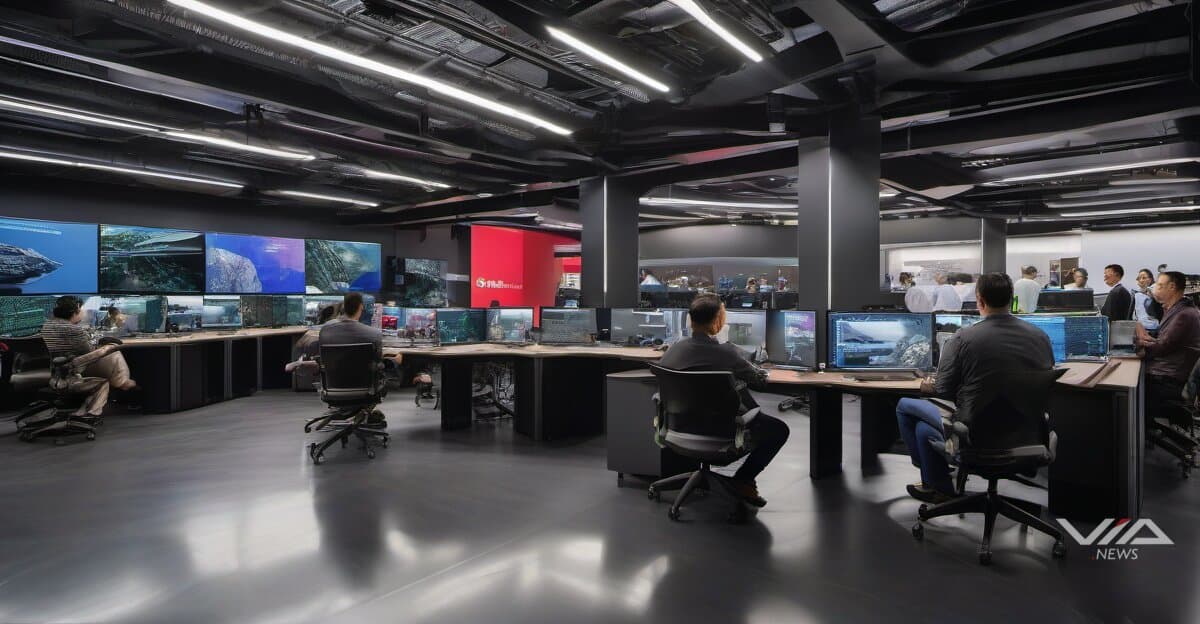
Image generated by AI for illustrative purposes. Not actual footage or photography from the reported events.

Nine global enterprises announced AI infrastructure partnerships with NVIDIA at GTC Taipei within a 48-hour window, spanning five distinct industries.1 The partners: Adobe, Microsoft, Canonical, Red Hat, Cadence, Siemens, Synopsys, the New York Stock Exchange, CrowdStrike, and Palantir.1

The geographic spread is notable. Siemens brings German industrial engineering into the NVIDIA stack. Canonical and Red Hat anchor open-source enterprise Linux globally. NYSE extends Wall Street financial infrastructure into AI hardware. Adobe ties generative AI to creative pipelines across media markets worldwide.1

The Taipei Signal

Hosting GTC in Taipei is deliberate. Taiwan sits at the center of global semiconductor manufacturing. Anchoring a major partnership cluster there signals direct engagement with Asia-Pacific supply chains — not just Silicon Valley procurement cycles. Regional AI infrastructure investment from Japan, South Korea, and Southeast Asia feeds into the same hardware ecosystem.

Pattern and Forecast

Multi-sector partnership clusters at NVIDIA GTC events have historically preceded quarterly revenue beats by one to two quarters.1 Enterprise partners convert announcements into hardware orders as internal deployment timelines advance. If the pattern holds, NVIDIA data center revenue acceleration could materialize in Q3 or Q4 2026.1

Why the Breadth Matters Globally

Earlier AI hardware cycles concentrated demand among US hyperscalers — Amazon, Google, Microsoft. That single-sector structure created revenue volatility when large buyers adjusted spend.1 Multi-vertical adoption restructures that risk profile internationally.

EDA vendors Cadence, Siemens, and Synopsys embed AI acceleration into chip design workflows — compute demand here scales with design complexity across global semiconductor programs.1 CrowdStrike and Palantir extend adoption into cybersecurity and intelligence workloads, sectors growing rapidly outside the US.

When chip design, financial markets, cybersecurity, media, and cloud OS commit simultaneously across multiple continents, no single sector slowdown derails aggregate demand. For enterprise technology buyers worldwide, the 48-hour cluster compresses decision timelines. Tier-one vendors committing together lowers adoption risk and accelerates internal procurement approvals globally.

In this story · Knowledge Files

About this analysis

This is a Via News analysis. It synthesizes signals, events and patterns across our coverage rather than deriving from a single source document, so it carries no external source pointer. Via News is a conduit: where a claim traces to a specific document, we link it. How we source

LM Salvado
LM Salvado

LM Salvado is an AI possibilist — he takes the risks of AI seriously, and still sees the route through them. Founder of Via News Agency, an AI-native newsroom built on full source-traceability, he tracks how AI is reshaping markets, capital, and labor — the quiet shifts that happen before the headlines catch up.

What we know · the intelligence behind this page
Live from the substrate
What we're seeing
Vertical AI Agents Attract a Funding Wave Across Fintech-Adjacent Industries
A cluster of AI-native startups applying autonomous agents to narrow, operational problems — hotel front-desk staffing (Dextr AI), identity/fraud risk for financial institutions (Baselayer), insurance distribution (Napo, Connie Health, MGT Insurance) — closed seed-to-Series A rounds within days of each other in September 2026, with CB Insights running a coordinated CEO interview series to spotlight them. The pattern points to agentic AI maturing from generic chat tools into vertical, revenue-generating products, with identity verification for AI agents themselves (Baselayer) emerging as a new fintech infrastructure category responding directly to AI-driven fraud risk.
Our read on the data ›
Signals we're tracking
Satellite-Terrestrial Network Integration Acceleration
Increased investment and launches in hybrid satellite-cellular networks across telecom industry; competitive responses from other carriers; regulatory activity around satellite spectrum; expansion of emergency/rural connectivity use cases
Patterns we're watching ›
Where sources disagree
ING Group
Both facts record the same metric (shares_outstanding) for ING Group at the identical observation date (2025-12-31). FACT A states 2,902,437,688 shares; FACT B states 2,902 million shares (2,902,000,000). The difference is 437,688 shares (~0.015%). This is a genuine value conflict, though the discrepancy appears to result from FACT B rounding to the nearest million while FACT A provides the precise count.
We flag conflicts openly ›
Recently verified
✓ Checked against the original source
4,984
facts traced to their source — and we flag the ones that don't hold up.
101 entities tracked4,984 facts checked against source5,306 source documents archived
Query this data → isubstrate.com