
Sunday, September 27, 2026

Nigeria Opens West Africa's First Sovereign-Backed AI Data Center, Ending Decade-Long Infrastructure Gap

Nigeria has commissioned the Kasi LOS1 data center in Lagos and secured sovereign wealth funding from the NSIA — marking the first alignment of state capital, hyperscale compute, and continental connectivity in West Africa. Fintech and AI firms currently routing workloads to Europe or the US can expect local access within 6 to 18 months. Kenya, South Africa, and Egypt are positioned to announce comparable moves within 12 months.

LM Salvado
LM Salvado

May 21, 2026

Nigeria Opens West Africa's First Sovereign-Backed AI Data Center, Ending Decade-Long Infrastructure Gap
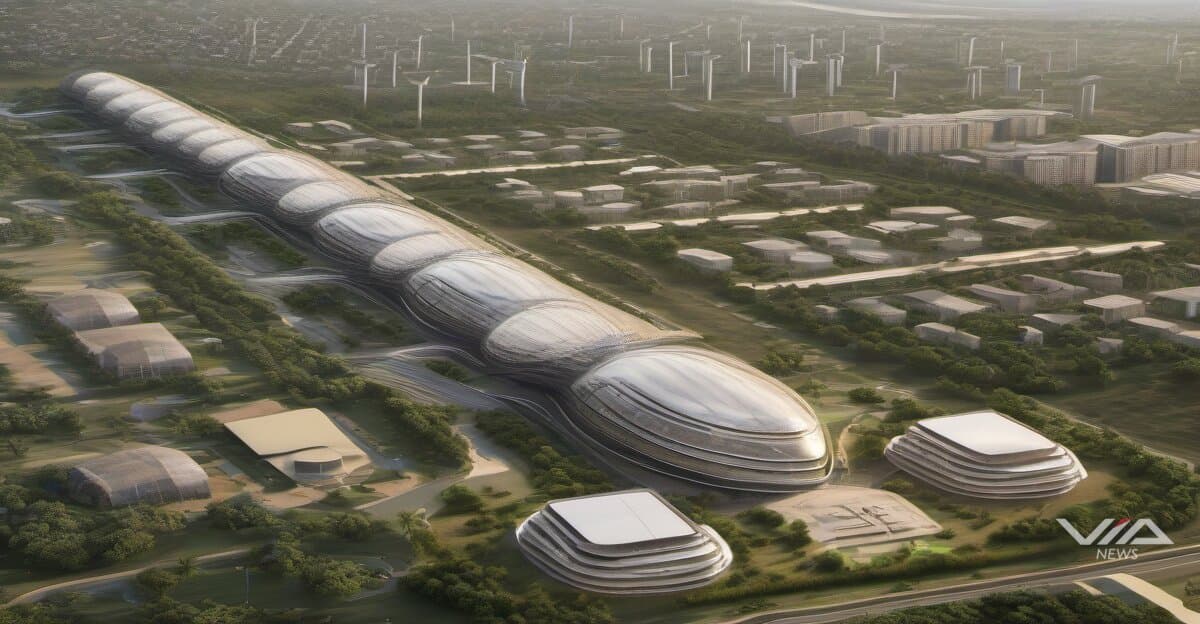
Image generated by AI for illustrative purposes. Not actual footage or photography from the reported events.

Nigeria has commissioned the Kasi LOS1 data center in Lagos.1 The Nigerian Sovereign Investment Authority has committed funding to the project simultaneously — the first time sovereign capital and hyperscale compute have aligned in West Africa.

African AI infrastructure has lagged Asia and the Middle East for more than a decade. Gulf states deployed sovereign-backed data centers in the 2010s. Southeast Asia followed. Sub-Saharan Africa is now entering that cycle.

Nigerian and West African fintech and AI companies currently route compute-heavy workloads to European or US cloud providers.1 LOS1 changes that equation. Local hyperscale access is expected within 6 to 18 months.1

Four factors converged at once: NSIA capital, LOS1 commissioning, Nigeria's National Cloud Policy 2025, and the Nigeria Data Protection Act 2023.1 Two subsea cable systems — 2Africa and Equiano — both land in Nigeria, providing the upstream bandwidth needed for at-scale data center operations.1

The Data Protection Act adds regulatory pressure to localization.1 Companies processing Nigerian user data now operate under a framework that favors domestic compute. Combined with sovereign funding, that regulatory weight sharpens the economic case for building AI products onshore.

Nigeria's population of approximately 200 million is the continent's largest single addressable base for AI services.1 B2B products targeting financial services, agriculture, and healthcare have historically absorbed latency and cost penalties from offshore compute. Local infrastructure eliminates both.

A wave of fintech AI product launches is expected once LOS1 reaches operational capacity.1 The 6-to-18-month window aligns with standard B2B AI development cycles.

The model is replicable. Kenya, South Africa, and Egypt — each with sovereign wealth or state development funds — are positioned to announce comparable infrastructure bets within 12 months.1 LOS1 sets the regional benchmark.

Sovereign capital entering the stack — rather than waiting on hyperscaler FDI — marks a structural shift in how Africa intends to own its digital infrastructure layer.

About this analysis

This is a Via News analysis. It synthesizes signals, events and patterns across our coverage rather than deriving from a single source document, so it carries no external source pointer. Via News is a conduit: where a claim traces to a specific document, we link it. How we source

LM Salvado
LM Salvado

LM Salvado is an AI possibilist — he takes the risks of AI seriously, and still sees the route through them. Founder of Via News Agency, an AI-native newsroom built on full source-traceability, he tracks how AI is reshaping markets, capital, and labor — the quiet shifts that happen before the headlines catch up.

What we know · the intelligence behind this page
Live from the substrate
What we're seeing
Vertical AI Agents Attract a Funding Wave Across Fintech-Adjacent Industries
A cluster of AI-native startups applying autonomous agents to narrow, operational problems — hotel front-desk staffing (Dextr AI), identity/fraud risk for financial institutions (Baselayer), insurance distribution (Napo, Connie Health, MGT Insurance) — closed seed-to-Series A rounds within days of each other in September 2026, with CB Insights running a coordinated CEO interview series to spotlight them. The pattern points to agentic AI maturing from generic chat tools into vertical, revenue-generating products, with identity verification for AI agents themselves (Baselayer) emerging as a new fintech infrastructure category responding directly to AI-driven fraud risk.
Our read on the data ›
Signals we're tracking
Satellite-Terrestrial Network Integration Acceleration
Increased investment and launches in hybrid satellite-cellular networks across telecom industry; competitive responses from other carriers; regulatory activity around satellite spectrum; expansion of emergency/rural connectivity use cases
Patterns we're watching ›
Where sources disagree
ING Group
Both facts record the same metric (shares_outstanding) for ING Group at the identical observation date (2025-12-31). FACT A states 2,902,437,688 shares; FACT B states 2,902 million shares (2,902,000,000). The difference is 437,688 shares (~0.015%). This is a genuine value conflict, though the discrepancy appears to result from FACT B rounding to the nearest million while FACT A provides the precise count.
We flag conflicts openly ›
Recently verified
✓ Checked against the original source
4,984
facts traced to their source — and we flag the ones that don't hold up.
101 entities tracked4,984 facts checked against source5,306 source documents archived
Query this data → isubstrate.com