
Sunday, September 27, 2026

Micron Crosses $1T as Global HBM Race Locks In Three Suppliers for AI Era

Micron's market cap crossed $1 trillion in 2026, with shares tripling year-to-date, as HBM shipments began for Nvidia's Vera Rubin platform. The global memory supply chain — controlled by US-based Micron, South Korea's SK Hynix, and Samsung — has structurally decoupled from consumer electronics cycles. An AI memory supercycle is now in confirmation, not anticipation.

LM Salvado
LM Salvado

June 19, 2026

Micron Crosses $1T as Global HBM Race Locks In Three Suppliers for AI Era
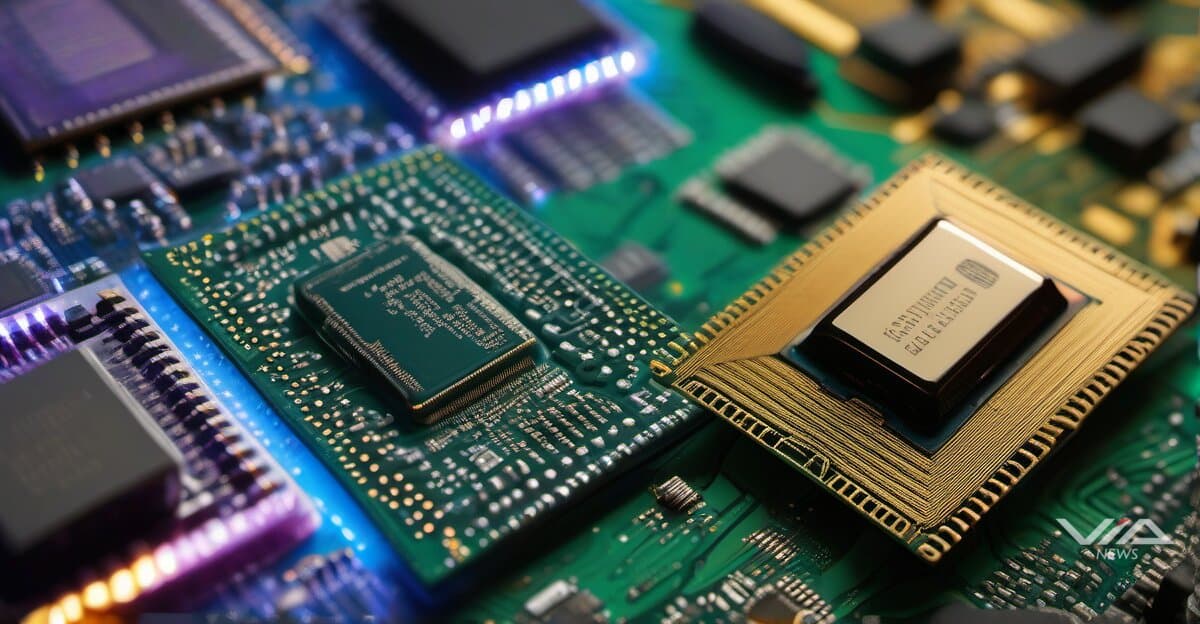
Image generated by AI for illustrative purposes. Not actual footage or photography from the reported events.

Micron's market cap crossed $1 trillion in 2026, with shares tripling year-to-date.1 Simultaneously, HBM shipments began for Nvidia's Vera Rubin platform — the operational signal global markets had been waiting for.1

These two events are not coincidence. They confirm what the global semiconductor industry has been positioning for: an AI memory supercycle has arrived.

Control of this supercycle sits with three companies across two countries. Micron (United States), SK Hynix (South Korea), and Samsung (South Korea) hold the world's HBM supply.1 No other manufacturers can produce at the volumes frontier AI accelerators require. That oligopoly now commands sustained pricing power over the next 12 to 24 months.1

HBM — high-bandwidth memory — is not a premium option for AI hardware. It is a prerequisite. Training and inference at scale demand memory bandwidth that conventional DRAM cannot deliver. Without HBM, platforms like Vera Rubin do not ship.1 A billions share buyback followed.1 Buybacks at these valuations indicate management projects demand exceeding what current prices already reflect. Capital return programs of this scale are not built on cyclical optimism.

The Vera Rubin ramp creates a global allocation problem. As HBM production shifts toward AI accelerators, non-AI buyers face tighter supply.1 Consumer electronics manufacturers in Asia, traditional server builders in Europe and North America, and automotive suppliers worldwide will see reduced memory availability. Pricing in those segments will reflect it.

For hyperscalers and AI labs — whether in the United States, China, Europe, or the Gulf — memory is now a strategic procurement variable. Forward contracting on HBM allocation is becoming standard practice ahead of platform releases. Vera Rubin accelerates that dynamic globally.1 The AI memory supercycle is no longer a projection. It is confirmed infrastructure.

In this story · Knowledge Files

About this analysis

This is a Via News analysis. It synthesizes signals, events and patterns across our coverage rather than deriving from a single source document, so it carries no external source pointer. Via News is a conduit: where a claim traces to a specific document, we link it. How we source

LM Salvado
LM Salvado

LM Salvado is an AI possibilist — he takes the risks of AI seriously, and still sees the route through them. Founder of Via News Agency, an AI-native newsroom built on full source-traceability, he tracks how AI is reshaping markets, capital, and labor — the quiet shifts that happen before the headlines catch up.

What we know · the intelligence behind this page
Live from the substrate
What we're seeing
Vertical AI Agents Attract a Funding Wave Across Fintech-Adjacent Industries
A cluster of AI-native startups applying autonomous agents to narrow, operational problems — hotel front-desk staffing (Dextr AI), identity/fraud risk for financial institutions (Baselayer), insurance distribution (Napo, Connie Health, MGT Insurance) — closed seed-to-Series A rounds within days of each other in September 2026, with CB Insights running a coordinated CEO interview series to spotlight them. The pattern points to agentic AI maturing from generic chat tools into vertical, revenue-generating products, with identity verification for AI agents themselves (Baselayer) emerging as a new fintech infrastructure category responding directly to AI-driven fraud risk.
Our read on the data ›
Signals we're tracking
Satellite-Terrestrial Network Integration Acceleration
Increased investment and launches in hybrid satellite-cellular networks across telecom industry; competitive responses from other carriers; regulatory activity around satellite spectrum; expansion of emergency/rural connectivity use cases
Patterns we're watching ›
Where sources disagree
ING Group
Both facts record the same metric (shares_outstanding) for ING Group at the identical observation date (2025-12-31). FACT A states 2,902,437,688 shares; FACT B states 2,902 million shares (2,902,000,000). The difference is 437,688 shares (~0.015%). This is a genuine value conflict, though the discrepancy appears to result from FACT B rounding to the nearest million while FACT A provides the precise count.
We flag conflicts openly ›
Recently verified
✓ Checked against the original source
4,984
facts traced to their source — and we flag the ones that don't hold up.
101 entities tracked4,984 facts checked against source5,306 source documents archived
Query this data → isubstrate.com