
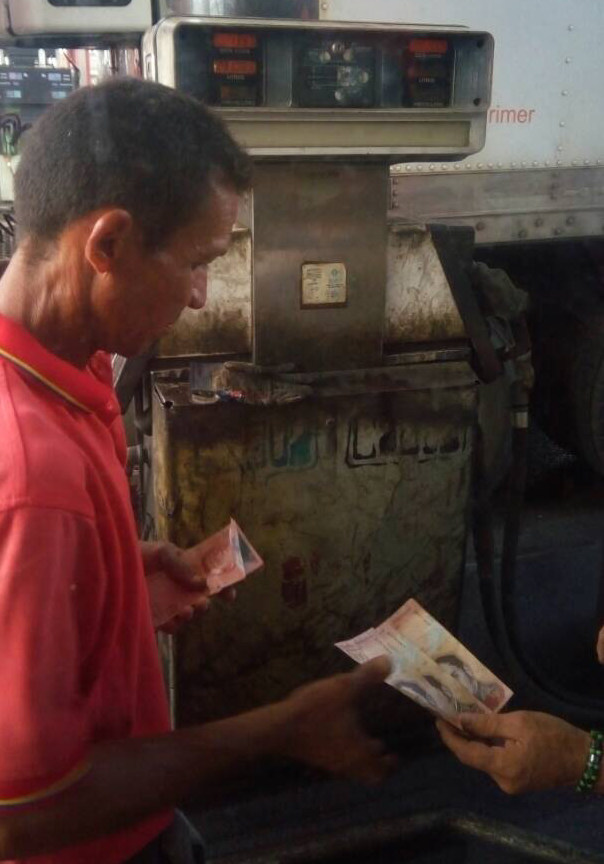
 Why has Venezuela the lowest gasoline prices in the world?[/caption]
Broadly speaking, Venezuela was to be worldwide recognized as the country with the lowest cost of gasoline in the world. Of course, there are economic particularities that would explain the phenomenon in greater depth.
In order to show a general overview, we have to make two types of comparisons: the first, in relation to gasoline prices in other Latin American countries; the second, in relation to the cost of food in the national basic basket.
Compared to other countries, the cost of a liter of petrol is unparalleled. Currently, an unofficial black market dollar (which paradoxically is what drives the economy today) rose up to 84,372 VEF (Venezuelan Bolívar) and filling a 50-liter tank cost no more than 200 VEF. According to the World Bank Group, the cost per liter in Venezuela corresponds to $0.01, while in Argentina and Chile it is $1.52, in Brazil $1.27, Bolivia $0.70, Ecuador $0.60, among others.
Comparatively, the basic basket of food, water, and basic necessities has a cost of 3 million FEV, as reported by El National, a Venezuelan publishing company, which makes it clear that the price of gasoline is completely out of context and it is very irregular with the cost of living. This makes the value of gasoline, merely symbolic.
The price has remained static for several decades, even though inflation is uncontrollable.
Currently, and due to the crisis in the country, it is impossible to increase the price of gasoline subsidized by the State. A price increase could generate social unrest related to the cost of living increase, but also repercussions associated with price increases in public transportation and food (which is mostly imported).
It's worth noting that the increase in gasoline and its consequences were one of the main factors triggering a strong tide of protests, disorders, shootings, and killings in the so-called "Caracazo" of 1989.
Why has Venezuela the lowest gasoline prices in the world?[/caption]
Broadly speaking, Venezuela was to be worldwide recognized as the country with the lowest cost of gasoline in the world. Of course, there are economic particularities that would explain the phenomenon in greater depth.
In order to show a general overview, we have to make two types of comparisons: the first, in relation to gasoline prices in other Latin American countries; the second, in relation to the cost of food in the national basic basket.
Compared to other countries, the cost of a liter of petrol is unparalleled. Currently, an unofficial black market dollar (which paradoxically is what drives the economy today) rose up to 84,372 VEF (Venezuelan Bolívar) and filling a 50-liter tank cost no more than 200 VEF. According to the World Bank Group, the cost per liter in Venezuela corresponds to $0.01, while in Argentina and Chile it is $1.52, in Brazil $1.27, Bolivia $0.70, Ecuador $0.60, among others.
Comparatively, the basic basket of food, water, and basic necessities has a cost of 3 million FEV, as reported by El National, a Venezuelan publishing company, which makes it clear that the price of gasoline is completely out of context and it is very irregular with the cost of living. This makes the value of gasoline, merely symbolic.
The price has remained static for several decades, even though inflation is uncontrollable.
Currently, and due to the crisis in the country, it is impossible to increase the price of gasoline subsidized by the State. A price increase could generate social unrest related to the cost of living increase, but also repercussions associated with price increases in public transportation and food (which is mostly imported).
It's worth noting that the increase in gasoline and its consequences were one of the main factors triggering a strong tide of protests, disorders, shootings, and killings in the so-called "Caracazo" of 1989.Why is Gas So Cheap in Venezuela?
Vera Sanoja Zerpa
November 24, 2017
CARACAS, Venezuela (ViaNews) - In 1914, the Zumaque I, or MG-1, (the first oil well in Venezuelan territory) marked the beginning of the oil production in Venezuela. It was the milestone from agricultural to an oil-based economy, completely changing Venezuela's contemporary history. Since then, oil has become a national symbol, associated with wealth-seeking, and strong cultural and ecological changes.
The establishment of International (North American and European) oil companies on national soil, at the beginning of the twentieth century, brought with it some deep changes to the Venezuelan identity and consumption habits. An example of this was the urban planning of motorways connecting oil fields with populated centers, making the use of vehicles an absolute necessity. This dominant way of life brought new food consumption, clothing, family organization and work patterns. So much so that it is known today as the "oil culture", a term popularized by the 1972 book by Rodolfo Quintero, "Antropología del petróleo".
Back in the 1960s, cities were designed for vehicles, not pedestrians. In addition to this, Venezuela became one of the top countries in the world with the most intensive exploitation and commercialization of oil. This led to the achievement of a high production of gasoline in national refineries.
In 1975, the Venezuelan oil industry, which had been owned by U.S. transnational companies, was nationalized and its name, Petróleos de Venezuela (PDVSA), appeared in every gasoline station in the country.
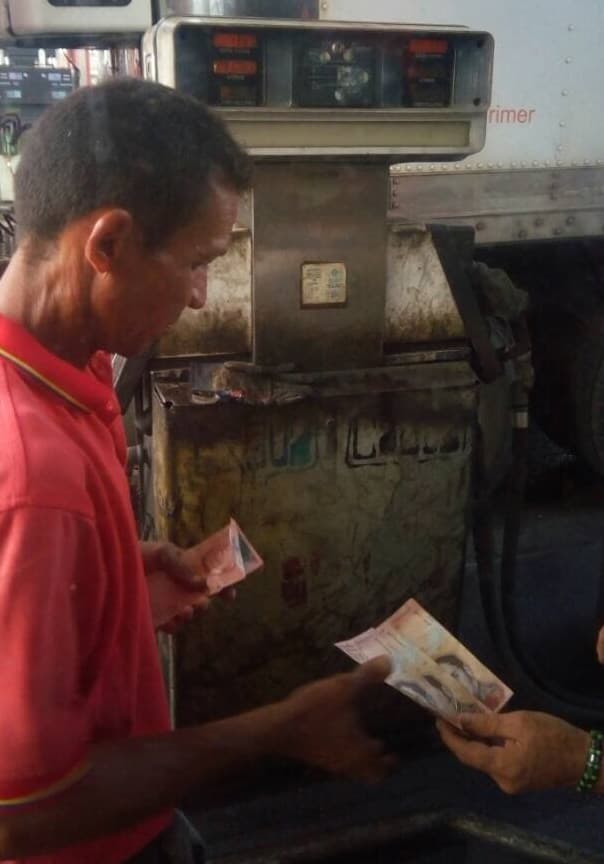
[caption id="attachment_3050" align="aligncenter" width="604"] Why has Venezuela the lowest gasoline prices in the world?[/caption]
Broadly speaking, Venezuela was to be worldwide recognized as the country with the lowest cost of gasoline in the world. Of course, there are economic particularities that would explain the phenomenon in greater depth.
In order to show a general overview, we have to make two types of comparisons: the first, in relation to gasoline prices in other Latin American countries; the second, in relation to the cost of food in the national basic basket.
Compared to other countries, the cost of a liter of petrol is unparalleled. Currently, an unofficial black market dollar (which paradoxically is what drives the economy today) rose up to 84,372 VEF (Venezuelan Bolívar) and filling a 50-liter tank cost no more than 200 VEF. According to the World Bank Group, the cost per liter in Venezuela corresponds to $0.01, while in Argentina and Chile it is $1.52, in Brazil $1.27, Bolivia $0.70, Ecuador $0.60, among others.
Comparatively, the basic basket of food, water, and basic necessities has a cost of 3 million FEV, as reported by El National, a Venezuelan publishing company, which makes it clear that the price of gasoline is completely out of context and it is very irregular with the cost of living. This makes the value of gasoline, merely symbolic.
The price has remained static for several decades, even though inflation is uncontrollable.
Currently, and due to the crisis in the country, it is impossible to increase the price of gasoline subsidized by the State. A price increase could generate social unrest related to the cost of living increase, but also repercussions associated with price increases in public transportation and food (which is mostly imported).
It's worth noting that the increase in gasoline and its consequences were one of the main factors triggering a strong tide of protests, disorders, shootings, and killings in the so-called "Caracazo" of 1989.
Why has Venezuela the lowest gasoline prices in the world?[/caption]
Broadly speaking, Venezuela was to be worldwide recognized as the country with the lowest cost of gasoline in the world. Of course, there are economic particularities that would explain the phenomenon in greater depth.
In order to show a general overview, we have to make two types of comparisons: the first, in relation to gasoline prices in other Latin American countries; the second, in relation to the cost of food in the national basic basket.
Compared to other countries, the cost of a liter of petrol is unparalleled. Currently, an unofficial black market dollar (which paradoxically is what drives the economy today) rose up to 84,372 VEF (Venezuelan Bolívar) and filling a 50-liter tank cost no more than 200 VEF. According to the World Bank Group, the cost per liter in Venezuela corresponds to $0.01, while in Argentina and Chile it is $1.52, in Brazil $1.27, Bolivia $0.70, Ecuador $0.60, among others.
Comparatively, the basic basket of food, water, and basic necessities has a cost of 3 million FEV, as reported by El National, a Venezuelan publishing company, which makes it clear that the price of gasoline is completely out of context and it is very irregular with the cost of living. This makes the value of gasoline, merely symbolic.
The price has remained static for several decades, even though inflation is uncontrollable.
Currently, and due to the crisis in the country, it is impossible to increase the price of gasoline subsidized by the State. A price increase could generate social unrest related to the cost of living increase, but also repercussions associated with price increases in public transportation and food (which is mostly imported).
It's worth noting that the increase in gasoline and its consequences were one of the main factors triggering a strong tide of protests, disorders, shootings, and killings in the so-called "Caracazo" of 1989.
Why has Venezuela the lowest gasoline prices in the world?[/caption]
Broadly speaking, Venezuela was to be worldwide recognized as the country with the lowest cost of gasoline in the world. Of course, there are economic particularities that would explain the phenomenon in greater depth.
In order to show a general overview, we have to make two types of comparisons: the first, in relation to gasoline prices in other Latin American countries; the second, in relation to the cost of food in the national basic basket.
Compared to other countries, the cost of a liter of petrol is unparalleled. Currently, an unofficial black market dollar (which paradoxically is what drives the economy today) rose up to 84,372 VEF (Venezuelan Bolívar) and filling a 50-liter tank cost no more than 200 VEF. According to the World Bank Group, the cost per liter in Venezuela corresponds to $0.01, while in Argentina and Chile it is $1.52, in Brazil $1.27, Bolivia $0.70, Ecuador $0.60, among others.
Comparatively, the basic basket of food, water, and basic necessities has a cost of 3 million FEV, as reported by El National, a Venezuelan publishing company, which makes it clear that the price of gasoline is completely out of context and it is very irregular with the cost of living. This makes the value of gasoline, merely symbolic.
The price has remained static for several decades, even though inflation is uncontrollable.
Currently, and due to the crisis in the country, it is impossible to increase the price of gasoline subsidized by the State. A price increase could generate social unrest related to the cost of living increase, but also repercussions associated with price increases in public transportation and food (which is mostly imported).
It's worth noting that the increase in gasoline and its consequences were one of the main factors triggering a strong tide of protests, disorders, shootings, and killings in the so-called "Caracazo" of 1989.