
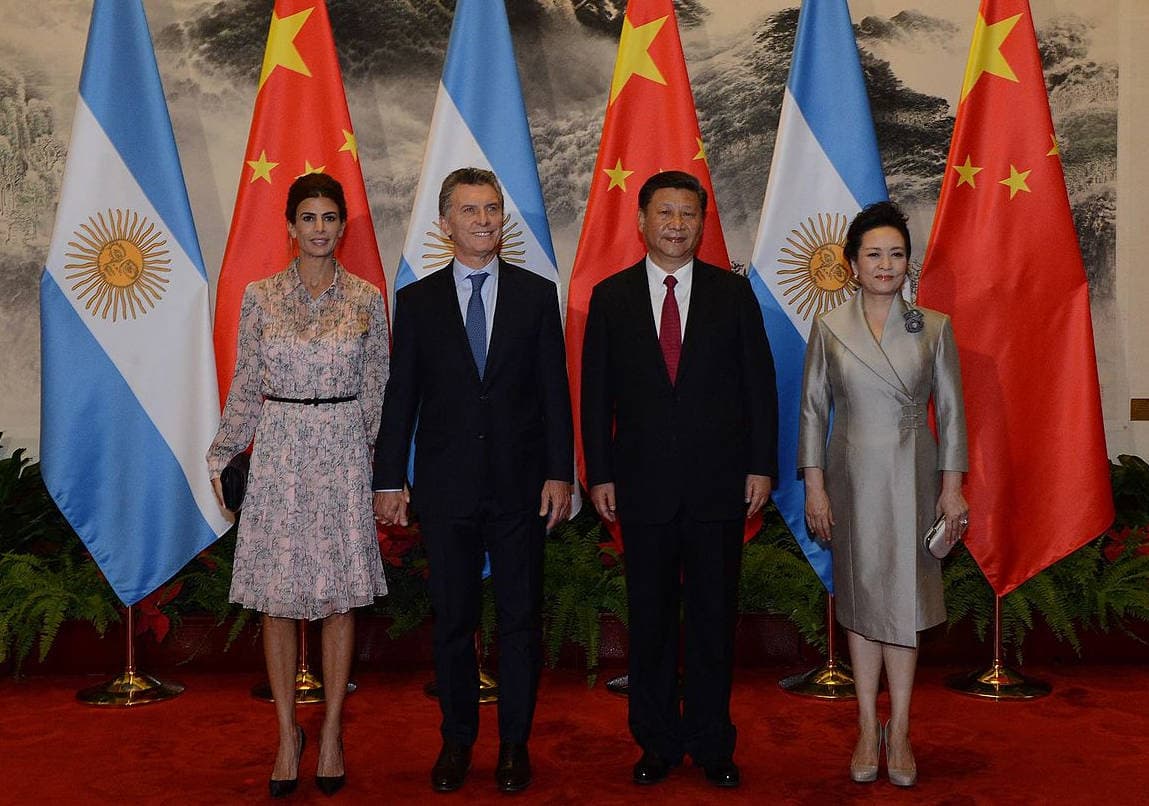
 Mauricio Macri, President, and spouse, Juliana Awada, met Xi Jinping, President, and spouse, Peng Liyuan, at the Great Hall of the People in Beijing on 17 May 2017. Photo by: Casa Rosada.[/caption]
Back in January, this year, the Chinese Foreign Minister Wang Yi arrived in Montevideo, Uruguay for an official three-day visit to the country.
At the occasion, the second largest world´s economy Foreign Minister met with President Tabaré Vázquez for an hour (twice the scheduled time).
"We have kept an open mind about the possibility of signing a bilateral free trade agreement with Uruguay and signing a free trade agreement with the Mercosur as a whole," said Wang Yi.
"Today I had a fruitful, productive and very profound conversation with President Tabaré Vázquez and Chancellor Rodolfo Nin Novoa about the deepening of our strategic partnership and cooperation over the next 30 years, reaching a broad consensus," he added.
In December 2017, the 11th China-Latin America and the Caribbean (China-LAC) Business Summit took place in Punta del Este, Uruguay.
At the time, the Chinese automaker Lifan – which opened its first factory in Uruguay in 2012 – expressed interest in establishing a plant to produce electric vehicles in the country.
Later that month, Uruguay launched the first electric route in Latin America, becoming a pioneer in the region.
Last year, President Tabaré Vázquez made an official visit to Beijing. Both countries have strengthened their diplomatic, cultural, and commercial relations working towards a free trade agreement.
Through the bilateral partnership, "we are working to further perfect" the relationship "in all its facets: trade, cooperation, and culture," Uruguay Foreign Affairs Minister Ariel Bergamino said at the gala venue this weekend.
"Chinese Foreign Affairs Minister Wang Yi's recent visit to Uruguay was an excellent opportunity to fine tune relations and outline a pathway for (joint) work for the rest of the year," he added.
Today, China has become Uruguay main trade partner. According to the Department of International Business and Integration, the country exported the US$ 897 million worth of goods to China during the first half of 2017, representing an increase of 44 percent compared to the same period in 2016.
[caption id="attachment_3749" align="aligncenter" width="640"]
Mauricio Macri, President, and spouse, Juliana Awada, met Xi Jinping, President, and spouse, Peng Liyuan, at the Great Hall of the People in Beijing on 17 May 2017. Photo by: Casa Rosada.[/caption]
Back in January, this year, the Chinese Foreign Minister Wang Yi arrived in Montevideo, Uruguay for an official three-day visit to the country.
At the occasion, the second largest world´s economy Foreign Minister met with President Tabaré Vázquez for an hour (twice the scheduled time).
"We have kept an open mind about the possibility of signing a bilateral free trade agreement with Uruguay and signing a free trade agreement with the Mercosur as a whole," said Wang Yi.
"Today I had a fruitful, productive and very profound conversation with President Tabaré Vázquez and Chancellor Rodolfo Nin Novoa about the deepening of our strategic partnership and cooperation over the next 30 years, reaching a broad consensus," he added.
In December 2017, the 11th China-Latin America and the Caribbean (China-LAC) Business Summit took place in Punta del Este, Uruguay.
At the time, the Chinese automaker Lifan – which opened its first factory in Uruguay in 2012 – expressed interest in establishing a plant to produce electric vehicles in the country.
Later that month, Uruguay launched the first electric route in Latin America, becoming a pioneer in the region.
Last year, President Tabaré Vázquez made an official visit to Beijing. Both countries have strengthened their diplomatic, cultural, and commercial relations working towards a free trade agreement.
Through the bilateral partnership, "we are working to further perfect" the relationship "in all its facets: trade, cooperation, and culture," Uruguay Foreign Affairs Minister Ariel Bergamino said at the gala venue this weekend.
"Chinese Foreign Affairs Minister Wang Yi's recent visit to Uruguay was an excellent opportunity to fine tune relations and outline a pathway for (joint) work for the rest of the year," he added.
Today, China has become Uruguay main trade partner. According to the Department of International Business and Integration, the country exported the US$ 897 million worth of goods to China during the first half of 2017, representing an increase of 44 percent compared to the same period in 2016.
[caption id="attachment_3749" align="aligncenter" width="640"] Uruguay's Embassy in China. Photo by: TSVC1190.[/caption]
Recently, US Secretary of State Rex Tillerson began an official tour through Latin America, which includes six countries in the region making some controversial remarks, which he referred to as “potential predatory actors” and the “unfair trading practices” of many Chinese (today he´ll meet with Argentinian President Mauricio Macri).
In reply, China Foreign Ministry issued a statement saying: “The development of China-Latin America ties does not target or reject any third party, nor does it affect the interests of third parties in Latin America,”
[caption id="attachment_3751" align="aligncenter" width="640"]
Uruguay's Embassy in China. Photo by: TSVC1190.[/caption]
Recently, US Secretary of State Rex Tillerson began an official tour through Latin America, which includes six countries in the region making some controversial remarks, which he referred to as “potential predatory actors” and the “unfair trading practices” of many Chinese (today he´ll meet with Argentinian President Mauricio Macri).
In reply, China Foreign Ministry issued a statement saying: “The development of China-Latin America ties does not target or reject any third party, nor does it affect the interests of third parties in Latin America,”
[caption id="attachment_3751" align="aligncenter" width="640"] Chinese Foreign Minister Wang Yi addresses reporters, following a U.S. bilateral meeting on May 16, 2015.
Photo by: U.S. State Department/Public Domain[/caption] “China is a major international buyer of Latin American bulk commodities, and imports more and more agricultural and high-value-added products from the region.” “What the United States said is entirely against the truth and displayed disrespect to the vast number of Latin American countries,” China’s Foreign Ministry added.