
Global internet use is growing with over 1 million new users coming online daily. This implies many more people share their data today than ever before. To cybercriminals, increased internet use is just an enlarging loot for them to plunder. Cybercriminals target private data that they can exploit to commit more sophisticated crimes.
By June 2019, there was no change in computer misuse crimes committed in England and Wales compared to the previous year. During the same period, there was a decrease in the number of computer viruses deployed by criminals. Notably, only 442,000 computer virus offenses (a 27% decrease) were reported by the Crime Survey for England and Wales (CSEW).
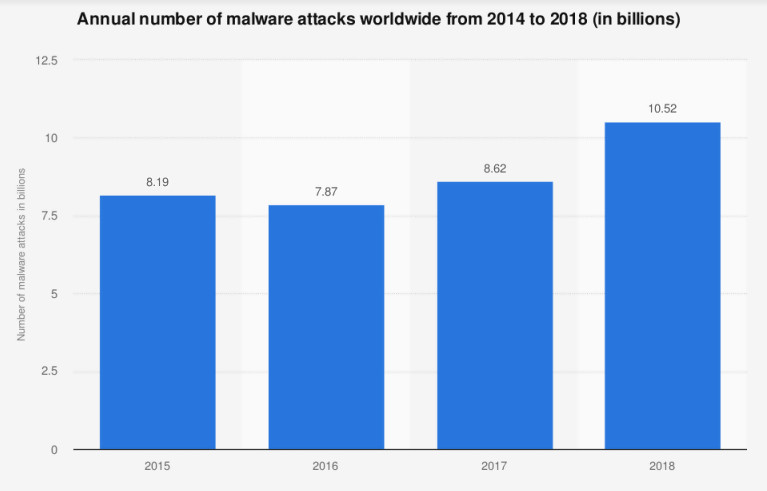
In the US, the number of data breaches reduced by over 388 million between 2017 and 2018. Nonetheless, the number of malware across the globe attacks jumped from 8.62 billion in 2017 to 10.52 in 2018. This is evidence that while there is a lull in data breaches, attackers are shifting to malware attacks.
A 2019 State of Malware report shows that internet users in the US face the highest number of malware threats worldwide. Notably, most of the malware threats detected focus on stealing information from both consumers and businesses.
As such, industry players are working towards defending consumers and businesses against cybercriminals. Grand View Research valued the global cybersecurity market at $116.5 billion in 2018. However, the market will continue to expand as malware attacks against mobile devices increase.
Which countries/regions are pursuing cybersecurity aggressively?
The US and Canada collectively as North America make up the leading countries in cybersecurity. In 2018, North America made up 38.3% of the global cybersecurity market in terms of revenue. Notably, cybersecurity companies in North America offer advanced solutions to clients worldwide. Further, consumers and businesses in this region have a higher awareness of cybersecurity threats compared to others.
The Asia Pacific region is growing rapidly in significance in the cybersecurity industry. Particularly, this is due to the increased significance of the internet in people’s lives and businesses’ operations. However, the region accounts for 20% of the industry by revenue behind Europe, which takes up 25% of the market. In the Asia Pacific, China, India, and Japan are the leading countries in pursuit of cybersecurity solutions. On the other hand, the UK and Germany are the leading countries in cybersecurity solutions in Europe.
What sectors are applying cybersecurity the most?
The personal computer sector is the largest user of cybersecurity products and solutions. In 2015, the PC sector took up more than 50% of the cybersecurity market share. Nonetheless, new applications of the internet have seen the Internet of Things (IoT) sector continue to eat into the global cybersecurity market share. By the end of 2019, the IoT sector should consist of approximately a third of the industry’s source of revenue.
The leading companies that provide products and solutions in the global cybersecurity industry include Microsoft, IBM, and Fortinet among many others. Microsoft is the largest cybersecurity solutions vendor with an annual revenue of $110.36 billion. The company offers products and services focused on identity and access management, threat protection, DDoS, application gateways among others.
Industry outlook
Demand for cybersecurity solutions is growing hence fueling the expansion of the industry. Reportbuyer research estimates that the industry will clock approximately $165.2 billion by 2023 at 10.7% CAGR. Notably, the Asia Pacific region is the most significant source of this growth. The region is experiencing the largest adoption rate of cybersecurity. Further, the report noted that increased “partnerships and acquisitions” will lead to the consolidation of the cybersecurity industry.