
Sunday, September 27, 2026

US Middle-Class Buyers Priced Out: Only 21% of Homes Affordable as Market Hits $412,500 Median

Middle-income Americans can afford just 21% of homes on the market—down from 50% pre-pandemic—as the median price reaches a record $412,500. The affordability crisis mirrors housing squeezes in Canada, UK, and Australia, where pandemic-era price spikes locked out first-time buyers. US economists forecast modest recovery in 2026 as inventory improves and wage growth outpaces price appreciation.

Source Trace Score4 source documents4 with a live linkVerifiability: High
US Middle-Class Buyers Priced Out: Only 21% of Homes Affordable as Market Hits $412,500 Median
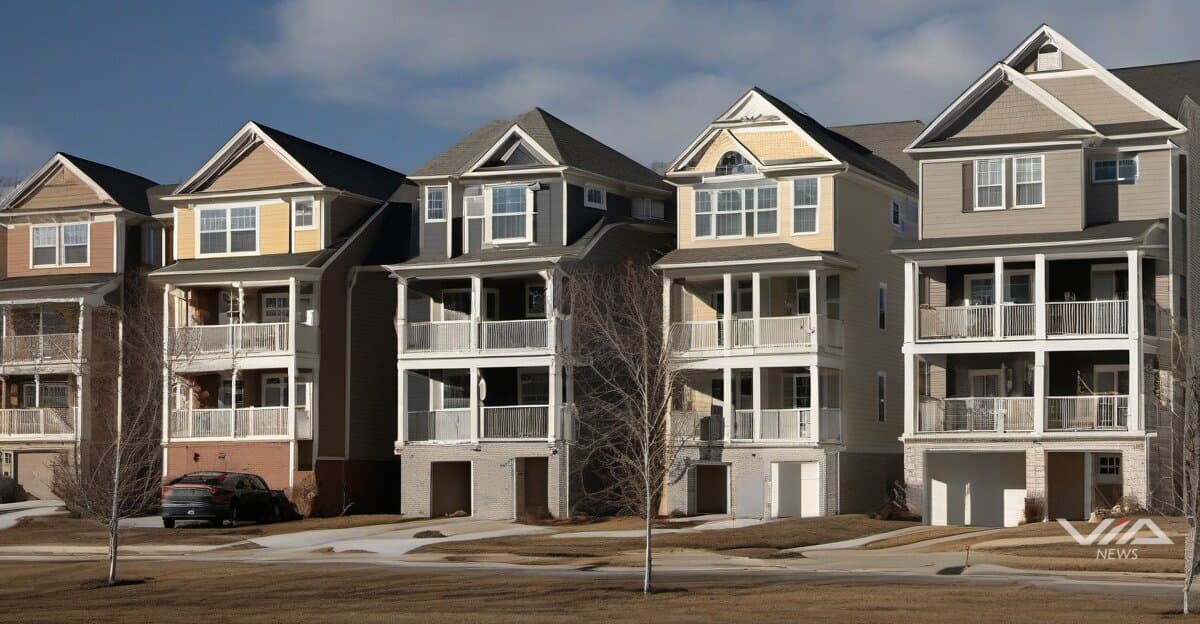
Image generated by AI for illustrative purposes. Not actual footage or photography from the reported events.

Middle-income homebuyers in the United States can afford just 21% of homes currently listed, down from approximately 50% before the pandemic, according to the National Association of Realtors. The median home price has hit a record $412,500, reflecting affordability pressures seen across developed economies from Canada to Australia.

"The historically low share of first-time buyers underscores the real-world consequences of a housing market starved for affordable inventory," said Jessica Lautz, NAR economist. The percentage of middle-income households meeting lending criteria for median-priced homes has fallen by more than half since 2019.

Market conditions show signs of easing. Economists project 14% growth in home sales for 2026 as inventory levels improve and the mortgage lock-in effect diminishes. "We are seeing better conditions for more home sales with more inventory and the lock-in effect steadily disappearing because life-changing events are making more people list their property," said Lawrence Yun, NAR chief economist.

Price appreciation is expected to moderate to 2-3% in 2026, down from recent double-digit gains. Wage growth is forecast to outpace both inflation and home price increases, gradually restoring affordability metrics—a pattern not yet evident in markets like Toronto, Sydney, or London where housing costs continue outstripping incomes.

First-time buyers remain largely sidelined despite stabilization signals. Down payment requirements and debt-to-income ratios keep entry-level buyers out even as conditions improve marginally for existing homeowners trading up. The challenge reflects a global phenomenon: OECD data shows housing affordability at multi-decade lows across member nations.

The lock-in effect—homeowners reluctant to sell and lose low mortgage rates—has kept US supply constrained since 2022. Life events including job relocations, family changes, and retirements are forcing more listings despite rate differentials. Regional variations remain significant, with affordability recovering faster in markets that saw the largest pandemic-era price spikes.

"Even with progress in affordability, middle-income buyers can afford to buy just 21% of the homes currently available for sale," said Nadia Evangelou, NAR senior economist. The metric underscores persistent challenges for mortgage lenders and signals continued headwinds for household formation rates—a demographic concern shared by policymakers worldwide.

Source documents

Via News is a conduit. We point to the source documents behind this report — we don't replace them. Trace any claim to its source and decide what to trust. How we source

Source Trace Score4 source documents4 with a live linkVerifiability: High
  1. [1]News articleYahoo Finance· March 10, 2026
    $30K Boost in Buying Power Reshapes Home Market for Aspiring Buyers
  2. [2]Earnings callYahoo Finance· February 28, 2026
    St. Joe Q4 Earnings Call Highlights
  3. [3]News articleYahoo Finance· March 8, 2026
    The 10 ZIP Codes Where $1M Is Chump Change
  4. [4]News articleNasdaq· February 23, 2026
    Stocks Finish Sharply Lower on Trade Uncertainty and AI-Disruption Fears

In this story · Knowledge Files

What we know · the intelligence behind this page
Live from the substrate
What we're seeing
Vertical AI Agents Attract a Funding Wave Across Fintech-Adjacent Industries
A cluster of AI-native startups applying autonomous agents to narrow, operational problems — hotel front-desk staffing (Dextr AI), identity/fraud risk for financial institutions (Baselayer), insurance distribution (Napo, Connie Health, MGT Insurance) — closed seed-to-Series A rounds within days of each other in September 2026, with CB Insights running a coordinated CEO interview series to spotlight them. The pattern points to agentic AI maturing from generic chat tools into vertical, revenue-generating products, with identity verification for AI agents themselves (Baselayer) emerging as a new fintech infrastructure category responding directly to AI-driven fraud risk.
Our read on the data ›
Signals we're tracking
Satellite-Terrestrial Network Integration Acceleration
Increased investment and launches in hybrid satellite-cellular networks across telecom industry; competitive responses from other carriers; regulatory activity around satellite spectrum; expansion of emergency/rural connectivity use cases
Patterns we're watching ›
Where sources disagree
ING Group
Both facts record the same metric (shares_outstanding) for ING Group at the identical observation date (2025-12-31). FACT A states 2,902,437,688 shares; FACT B states 2,902 million shares (2,902,000,000). The difference is 437,688 shares (~0.015%). This is a genuine value conflict, though the discrepancy appears to result from FACT B rounding to the nearest million while FACT A provides the precise count.
We flag conflicts openly ›
Recently verified
✓ Checked against the original source
4,984
facts traced to their source — and we flag the ones that don't hold up.
101 entities tracked4,984 facts checked against source5,306 source documents archived
Query this data → isubstrate.com