
Sunday, September 27, 2026

Global Chip Rally Leaves Software Behind as Investors Bet on AI Hardware

Micron and Dell each surged 5% on June 25 as investors rotated out of AI software into semiconductor and HPC hardware worldwide. Intel gained 3.8%, SanDisk 4%, while enterprise software stocks fell — a divergence playing out across U.S., Asian, and European markets. The shift signals a global repricing of where AI value is created: in silicon and servers, not applications.

LM Salvado
LM Salvado

June 25, 2026

Global Chip Rally Leaves Software Behind as Investors Bet on AI Hardware
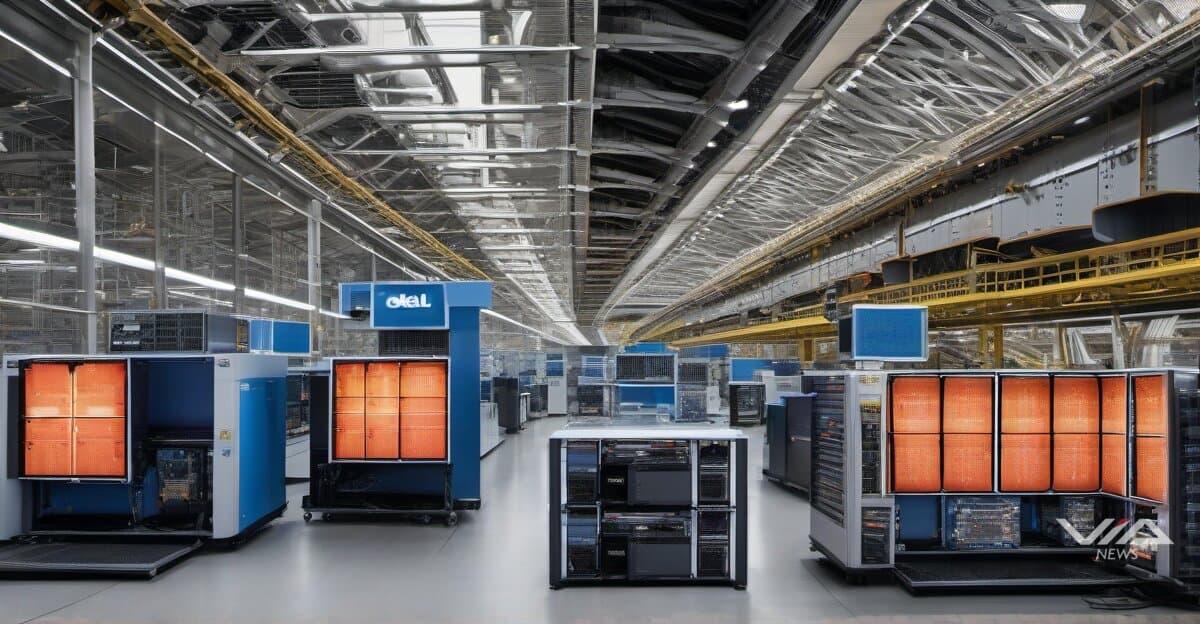
Image generated by AI for illustrative purposes. Not actual footage or photography from the reported events.

Micron and Dell each jumped 5% on June 25 as investors globally pivoted from AI software into semiconductor and computing hardware.SanDisk added 4%.1

The Nasdaq Composite fell on the same day — confirming this is a reallocation, not a broad rally.

A Worldwide Infrastructure Bet

The rotation reflects a global consensus: physical AI infrastructure — chips, memory, servers, storage — is the safer bet as the AI application layer matures. This mirrors trends in Asian markets, where chipmakers like Samsung and SK Hynix have outpaced Korean software peers, and in Europe, where semiconductor equipment stocks have held firm.

Taiwan's TSMC remains the linchpin. Demand from U.S. hyperscalers for advanced nodes continues to drive Asian foundry capacity investment, reinforcing the hardware-over-software thesis.

Winners and Losers Across the Stack

Memory leads the winners: Micron and SanDisk both surged on sustained HPC and data centre demand.1 Dell's gains reflect enterprise server orders that cross borders — from U.S. cloud builders to Middle Eastern sovereign AI projects. KLA benefits as semiconductor equipment spending holds globally. Penguin Solutions rose as HPC infrastructure demand expands beyond North America.

Losers: enterprise software vendors and AI services firms dependent on corporate IT budgets. Spending remains constrained in both the U.S. and Europe, squeezing companies monetising AI at the application layer.

Outlook

The rotation is projected to persist three to six months.1 Semiconductor ETFs and AI data centre REITs are positioned to outperform. Fintech and enterprise AI vendors face continued pressure until corporate spending cycles — globally — improve.

For international investors, the signal is consistent: hardware-adjacent positions outperform across markets while enterprise software waits for a budget cycle recovery.

In this story · Knowledge Files

About this analysis

This is a Via News analysis. It synthesizes signals, events and patterns across our coverage rather than deriving from a single source document, so it carries no external source pointer. Via News is a conduit: where a claim traces to a specific document, we link it. How we source

LM Salvado
LM Salvado

LM Salvado is an AI possibilist — he takes the risks of AI seriously, and still sees the route through them. Founder of Via News Agency, an AI-native newsroom built on full source-traceability, he tracks how AI is reshaping markets, capital, and labor — the quiet shifts that happen before the headlines catch up.

What we know · the intelligence behind this page
Live from the substrate
What we're seeing
Vertical AI Agents Attract a Funding Wave Across Fintech-Adjacent Industries
A cluster of AI-native startups applying autonomous agents to narrow, operational problems — hotel front-desk staffing (Dextr AI), identity/fraud risk for financial institutions (Baselayer), insurance distribution (Napo, Connie Health, MGT Insurance) — closed seed-to-Series A rounds within days of each other in September 2026, with CB Insights running a coordinated CEO interview series to spotlight them. The pattern points to agentic AI maturing from generic chat tools into vertical, revenue-generating products, with identity verification for AI agents themselves (Baselayer) emerging as a new fintech infrastructure category responding directly to AI-driven fraud risk.
Our read on the data ›
Signals we're tracking
Satellite-Terrestrial Network Integration Acceleration
Increased investment and launches in hybrid satellite-cellular networks across telecom industry; competitive responses from other carriers; regulatory activity around satellite spectrum; expansion of emergency/rural connectivity use cases
Patterns we're watching ›
Where sources disagree
ING Group
Both facts record the same metric (shares_outstanding) for ING Group at the identical observation date (2025-12-31). FACT A states 2,902,437,688 shares; FACT B states 2,902 million shares (2,902,000,000). The difference is 437,688 shares (~0.015%). This is a genuine value conflict, though the discrepancy appears to result from FACT B rounding to the nearest million while FACT A provides the precise count.
We flag conflicts openly ›
Recently verified
✓ Checked against the original source
4,984
facts traced to their source — and we flag the ones that don't hold up.
101 entities tracked4,984 facts checked against source5,306 source documents archived
Query this data → isubstrate.com