
Sunday, September 27, 2026

Great Vision HK Express revenue collapses as transpacific e-commerce volumes fall 50% amid air cargo crisis

Great Vision HK Express faces a dual revenue crisis as transpacific shipping volumes plunge 50% while air cargo capacity evaporates. The Hong Kong-based logistics provider, focused on China-North America e-commerce routes, is caught between deteriorating US-China trade flows and global air freight constraints that are reshaping cross-border commerce.

Great Vision HK Express revenue collapses as transpacific e-commerce volumes fall 50% amid air cargo crisis
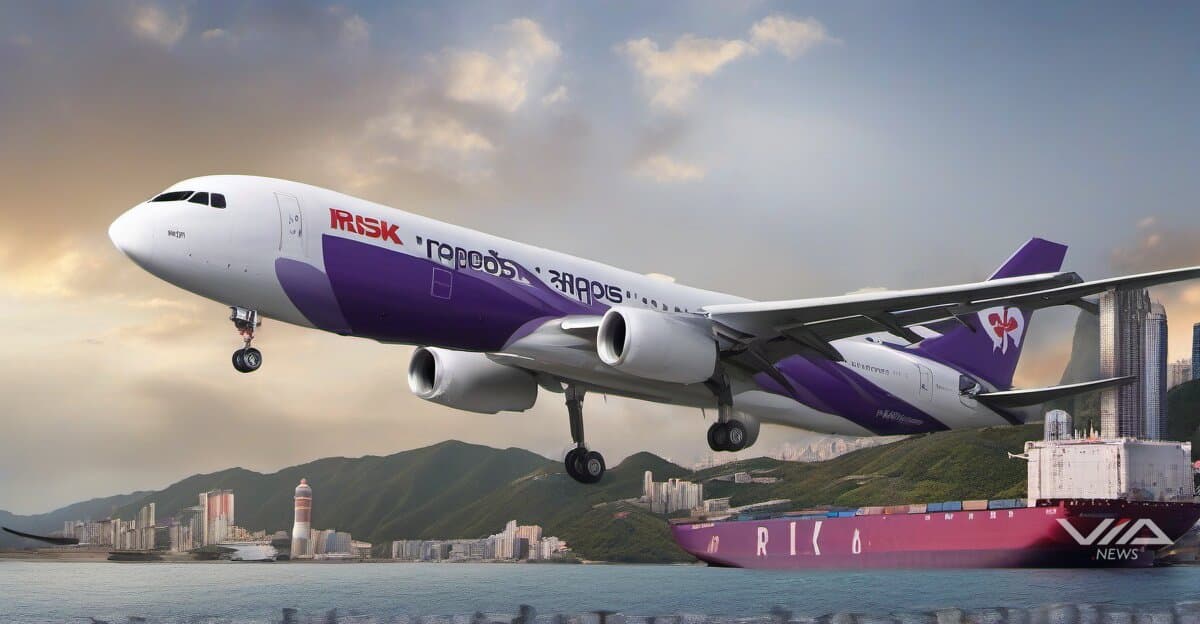
Image generated by AI for illustrative purposes. Not actual footage or photography from the reported events.

Great Vision HK Express is experiencing a catastrophic revenue collapse driven by a 50% decline in transpacific shipping volumes and simultaneous loss of air cargo capacity. The Hong Kong-based e-commerce logistics provider specializes in China-North America trade routes, a corridor now suffering from deteriorating trade conditions and shifting global supply chains.

Transpacific e-commerce flows are cratering across Asia. Chinese logistics firms serving cross-border merchants face collapsing demand as US-China trade tensions escalate and American consumer behavior shifts away from Chinese discretionary goods. Great Vision's concentrated exposure to this single corridor leaves minimal room to pivot, unlike European or Southeast Asian competitors with diversified route networks.

Air cargo capacity loss compounds the crisis globally. Freight forwarders worldwide depend on reliable air cargo access for time-sensitive e-commerce shipments, but capacity constraints driven by aircraft shortages, route reductions, and surging freight rates have squeezed margins from Shanghai to Frankfurt. Great Vision's loss of air cargo access eliminates its higher-margin express services precisely when ocean freight alone cannot sustain profitability.

The combined impact creates a revenue vise familiar to logistics providers in volatile trade corridors. Lower volumes reduce top-line sales while lost air cargo capacity eliminates premium services. Fixed costs for warehousing, staff, and infrastructure remain constant even as revenue falls, accelerating cash burn in a pattern that has claimed smaller freight forwarders from Singapore to Rotterdam.

Great Vision's business model assumed steady transpacific e-commerce growth. That assumption now appears broken. Chinese cross-border sellers face headwinds from US tariff policies, regulatory scrutiny of platforms like Temu and Shein, and consumer pullback. North American importers are diversifying supply chains toward Vietnam, Mexico, India, and nearshoring options, mirroring global reshoring trends affecting logistics providers worldwide.

The freight forwarding sector is consolidating internationally. Smaller players without geographic diversification or multimodal capabilities face existential pressure. Competitors with ocean freight networks, European or Latin American routes, or domestic logistics operations can offset transpacific weakness. Great Vision's niche focus leaves few strategic options beyond asset sales, merger negotiations, or restructuring.


Sources:
1 Yahoo Finance, "New UPS revenue helps Cargojet overcome loss of China e-commerce volume" (March 02, 2026)

What we know · the intelligence behind this page
Live from the substrate
What we're seeing
Vertical AI Agents Attract a Funding Wave Across Fintech-Adjacent Industries
A cluster of AI-native startups applying autonomous agents to narrow, operational problems — hotel front-desk staffing (Dextr AI), identity/fraud risk for financial institutions (Baselayer), insurance distribution (Napo, Connie Health, MGT Insurance) — closed seed-to-Series A rounds within days of each other in September 2026, with CB Insights running a coordinated CEO interview series to spotlight them. The pattern points to agentic AI maturing from generic chat tools into vertical, revenue-generating products, with identity verification for AI agents themselves (Baselayer) emerging as a new fintech infrastructure category responding directly to AI-driven fraud risk.
Our read on the data ›
Signals we're tracking
Satellite-Terrestrial Network Integration Acceleration
Increased investment and launches in hybrid satellite-cellular networks across telecom industry; competitive responses from other carriers; regulatory activity around satellite spectrum; expansion of emergency/rural connectivity use cases
Patterns we're watching ›
Where sources disagree
ING Group
Both facts record the same metric (shares_outstanding) for ING Group at the identical observation date (2025-12-31). FACT A states 2,902,437,688 shares; FACT B states 2,902 million shares (2,902,000,000). The difference is 437,688 shares (~0.015%). This is a genuine value conflict, though the discrepancy appears to result from FACT B rounding to the nearest million while FACT A provides the precise count.
We flag conflicts openly ›
Recently verified
✓ Checked against the original source
4,984
facts traced to their source — and we flag the ones that don't hold up.
101 entities tracked4,984 facts checked against source5,306 source documents archived
Query this data → isubstrate.com