
Sunday, September 27, 2026

NVIDIA BioNeMo Platform Adopted by Eli Lilly and Thermo Fisher for AI Drug Discovery

Eli Lilly and Thermo Fisher Scientific have integrated NVIDIA's BioNeMo platform into drug discovery workflows, marking a shift in how pharmaceutical companies automate research. The platform provides pre-trained AI models for molecular biology tasks, positioning NVIDIA beyond hardware sales into software infrastructure. The adoption spans established pharmaceutical giants and emerging biotech firms across global markets.

LM Salvado
LM Salvado

March 23, 2026

Source Trace Score1 source document1 with a live linkVerifiability: Basic
NVIDIA BioNeMo Platform Adopted by Eli Lilly and Thermo Fisher for AI Drug Discovery
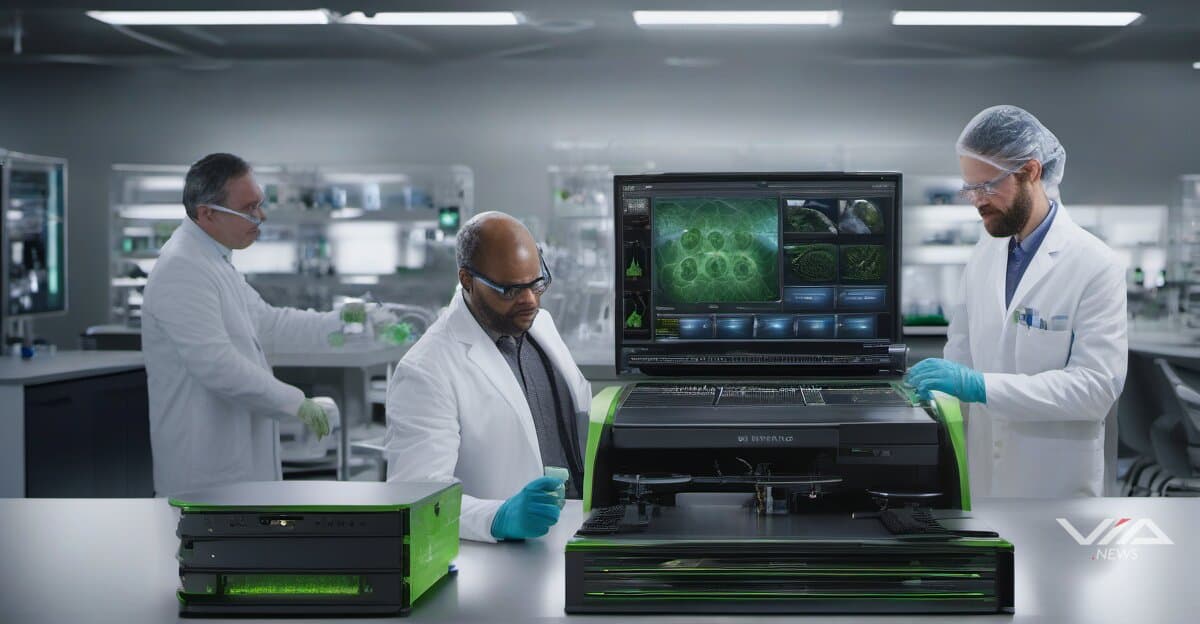
Image generated by AI for illustrative purposes. Not actual footage or photography from the reported events.

Eli Lilly and Thermo Fisher Scientific have adopted NVIDIA's BioNeMo platform to automate AI-driven drug discovery workflows. The platform delivers pre-trained models for protein structure prediction, small molecule generation, and genomic sequence analysis, replacing manual scientific processes with automated experimental design.

Eli Lilly is integrating BioNeMo's molecular AI capabilities into internal discovery pipelines. Thermo Fisher is embedding the platform within laboratory equipment and software systems, enabling researchers to deploy AI models alongside physical instruments. This positions NVIDIA as middleware infrastructure rather than solely a chip supplier to pharmaceutical operations.

The approach creates recurring software dependencies beyond one-time GPU purchases. As pharmaceutical companies automate research processes globally, BioNeMo becomes embedded in core operations with switching costs. The platform targets both established pharmaceutical companies digitizing legacy research and startups building AI-native discovery models.

BioNeMo provides pre-built components that reduce specialized expertise requirements for deploying AI in laboratory settings. This lowers barriers for smaller biotech firms in emerging markets while offering enterprise-grade tools for multinational pharmaceutical operations. The platform handles adaptation of general AI models to biological data formats and scientific workflows.

NVIDIA's move into domain-specific scientific tooling reflects broader industry patterns where AI infrastructure providers extend beyond general-purpose compute into specialized application layers. These vertical integrations command higher margins and stickier customer relationships across global pharmaceutical and biotech sectors. The biotech AI market spans North American pharmaceutical giants, European research institutions, and Asian biotech startups competing in drug development timelines.

Source documents

Via News is a conduit. We point to the source documents behind this report — we don't replace them. Trace any claim to its source and decide what to trust. How we source

Source Trace Score1 source document1 with a live linkVerifiability: Basic
  1. [1]News articleYahoo Finance· January 12, 2026
    NVIDIA BioNeMo Platform Adopted by Life Sciences Leaders to Accelerate AI-Driven Drug Discovery

In this story · Knowledge Files

LM Salvado
LM Salvado

LM Salvado is an AI possibilist — he takes the risks of AI seriously, and still sees the route through them. Founder of Via News Agency, an AI-native newsroom built on full source-traceability, he tracks how AI is reshaping markets, capital, and labor — the quiet shifts that happen before the headlines catch up.

What we know · the intelligence behind this page
Live from the substrate
What we're seeing
Enterprise AI Agents Scale Up Through Partnerships and Funding, But Data Readiness Lags Ambition
A wave of vertical AI-agent startups (Swarm, Veridox, Avallon AI, DA2, F2, Earthian, Meanwhile, Covecta, Penguin AI, Maisa AI) is being funded and profiled just as major infrastructure players — Microsoft/Mistral, Siemens/NVIDIA, and Manulife/Microsoft — cement enterprise AI governance and compute partnerships. Yet a Google Cloud report shows AI agents still lack access to the majority of company data (only 45% on average), and insider selling at incumbent C3.ai signals investor caution even as adoption intent (100% planned agentic AI use within two years) races ahead of actual data infrastructure.
Our read on the data ›
Signals we're tracking
Satellite-Terrestrial Network Integration Acceleration
Increased investment and launches in hybrid satellite-cellular networks across telecom industry; competitive responses from other carriers; regulatory activity around satellite spectrum; expansion of emergency/rural connectivity use cases
Patterns we're watching ›
Where sources disagree
Berkshire Hathaway
Both facts report Berkshire Hathaway's cash position on 2026-01-01 with identical observation timestamps, but claim vastly different values: 380 billion USD vs 400 USD. These cannot both be true for the same entity at the same point in time. The magnitude of the discrepancy (a factor of ~10^9) rules out rounding, unit conversion, or methodological differences.
We flag conflicts openly ›
Recently verified
✓ Checked against the original source
4,984
facts traced to their source — and we flag the ones that don't hold up.
101 entities tracked4,984 facts checked against source5,306 source documents archived
Query this data → isubstrate.com