
Sunday, September 27, 2026

U.S. Radiology Giant Posts 36% EBITDA Jump, Offering AI Benchmark for Global Health Systems

RadNet's adjusted EBITDA rose 36.3% year-over-year in Q1 2026, well ahead of its 22.1% revenue growth, driven by AI scheduling and diagnostic tools across its U.S. network. Advanced imaging volumes surged, with PET/CT up 35.2% and MRI same-center volume up 10.1%. The margin expansion offers a concrete financial reference point for hospital systems worldwide evaluating AI investment in radiology.

LM Salvado
LM Salvado

May 15, 2026

U.S. Radiology Giant Posts 36% EBITDA Jump, Offering AI Benchmark for Global Health Systems
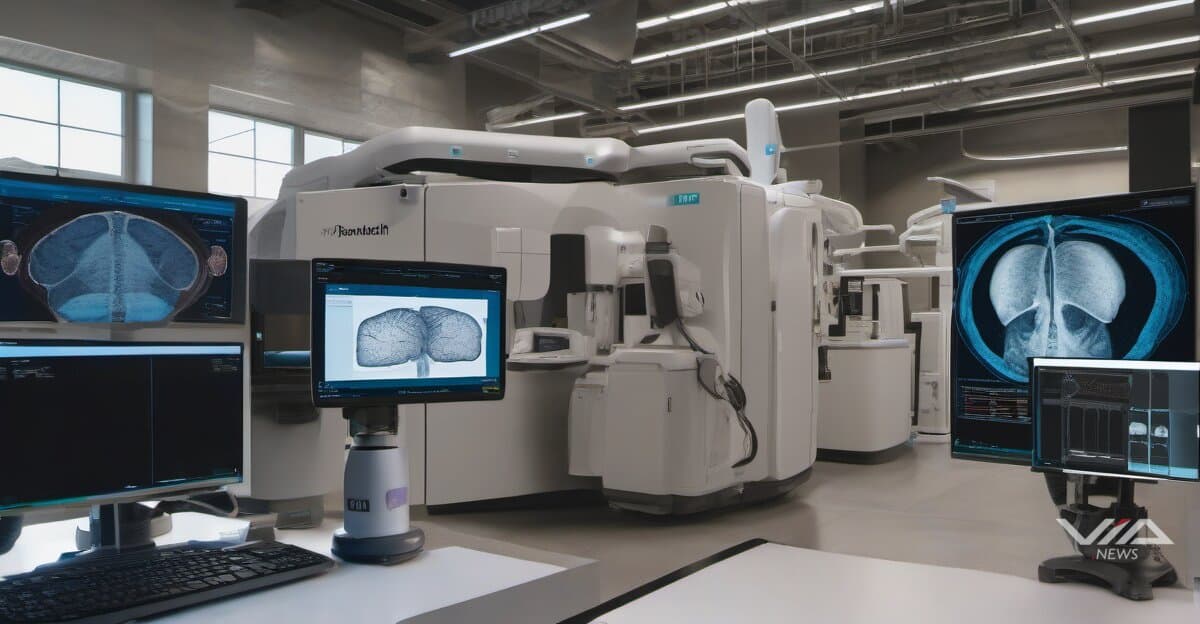
Image generated by AI for illustrative purposes. Not actual footage or photography from the reported events.

RadNet's adjusted EBITDA grew 36.3% year-over-year in Q1 2026, outpacing revenue growth of 22.1%.1 The gap is a margin story, not just a volume one — and it is drawing attention beyond the United States.

Advanced imaging's share of procedural volume rose from 26.9% to 29.3%.1 PET/CT volume climbed 35.2%. MRI same-center volume increased 10.1%, well above the industry baseline.

RadNet credited TechLive, its AI scheduling platform, as a direct driver of MRI utilization gains.1 TechLive fills appointment gaps and reduces scanner downtime, converting idle capacity into billable procedures. Imaging center EBITDA margin improved 188 basis points year-over-year.1

DeepHealth, RadNet's AI diagnostic suite, assists radiologists by flagging findings and prioritizing worklists.1 The two platforms address opposite ends of the workflow: TechLive handles scheduling, DeepHealth handles reading and reporting.

The results arrive as health systems globally struggle with imaging backlogs. The UK's NHS faces radiology wait times exceeding six weeks for many scans. Germany, Japan, and Australia are each investing in AI-assisted diagnostics to address radiologist shortages. RadNet's Q1 data gives those conversations a financial reference point.

The pattern is consistent with what AI deployment looks like at scale: scheduling optimization cuts per-scan overhead; diagnostic AI compresses read times. Both effects compound across a large multi-site network.

Whether TechLive and DeepHealth are the primary causal drivers — rather than volume mix or favorable market conditions — has not been formally isolated.1 A center-by-center comparison of fully deployed versus rollout-phase locations would clarify the contribution. RadNet has not published that breakdown.

What Q1 2026 does establish: a large radiology operator running AI across scheduling and diagnostics is producing margin expansion that volume growth alone does not explain. For hospital networks from London to Tokyo evaluating AI investment, that is a concrete benchmark.

About this analysis

This is a Via News analysis. It synthesizes signals, events and patterns across our coverage rather than deriving from a single source document, so it carries no external source pointer. Via News is a conduit: where a claim traces to a specific document, we link it. How we source

LM Salvado
LM Salvado

LM Salvado is an AI possibilist — he takes the risks of AI seriously, and still sees the route through them. Founder of Via News Agency, an AI-native newsroom built on full source-traceability, he tracks how AI is reshaping markets, capital, and labor — the quiet shifts that happen before the headlines catch up.

What we know · the intelligence behind this page
Live from the substrate
What we're seeing
Vertical AI Agents Attract a Funding Wave Across Fintech-Adjacent Industries
A cluster of AI-native startups applying autonomous agents to narrow, operational problems — hotel front-desk staffing (Dextr AI), identity/fraud risk for financial institutions (Baselayer), insurance distribution (Napo, Connie Health, MGT Insurance) — closed seed-to-Series A rounds within days of each other in September 2026, with CB Insights running a coordinated CEO interview series to spotlight them. The pattern points to agentic AI maturing from generic chat tools into vertical, revenue-generating products, with identity verification for AI agents themselves (Baselayer) emerging as a new fintech infrastructure category responding directly to AI-driven fraud risk.
Our read on the data ›
Signals we're tracking
Satellite-Terrestrial Network Integration Acceleration
Increased investment and launches in hybrid satellite-cellular networks across telecom industry; competitive responses from other carriers; regulatory activity around satellite spectrum; expansion of emergency/rural connectivity use cases
Patterns we're watching ›
Where sources disagree
ING Group
Both facts record the same metric (shares_outstanding) for ING Group at the identical observation date (2025-12-31). FACT A states 2,902,437,688 shares; FACT B states 2,902 million shares (2,902,000,000). The difference is 437,688 shares (~0.015%). This is a genuine value conflict, though the discrepancy appears to result from FACT B rounding to the nearest million while FACT A provides the precise count.
We flag conflicts openly ›
Recently verified
✓ Checked against the original source
4,984
facts traced to their source — and we flag the ones that don't hold up.
101 entities tracked4,984 facts checked against source5,306 source documents archived
Query this data → isubstrate.com