
Sunday, September 27, 2026

Western Union Buys Three Fintech Rivals Across US, Mexico, and Singapore in Simultaneous Rollup

Western Union closed three acquisitions at once — Intermex, Lana, and Dash — spanning the world's largest bilateral remittance corridor (US-Mexico) and Southeast Asia's high-volume intra-regional payment lanes. The deals signal an acceleration phase in global cross-border payments consolidation, with established incumbents absorbing digital-native challengers rather than competing organically.

LM Salvado
LM Salvado

April 29, 2026

Western Union Buys Three Fintech Rivals Across US, Mexico, and Singapore in Simultaneous Rollup
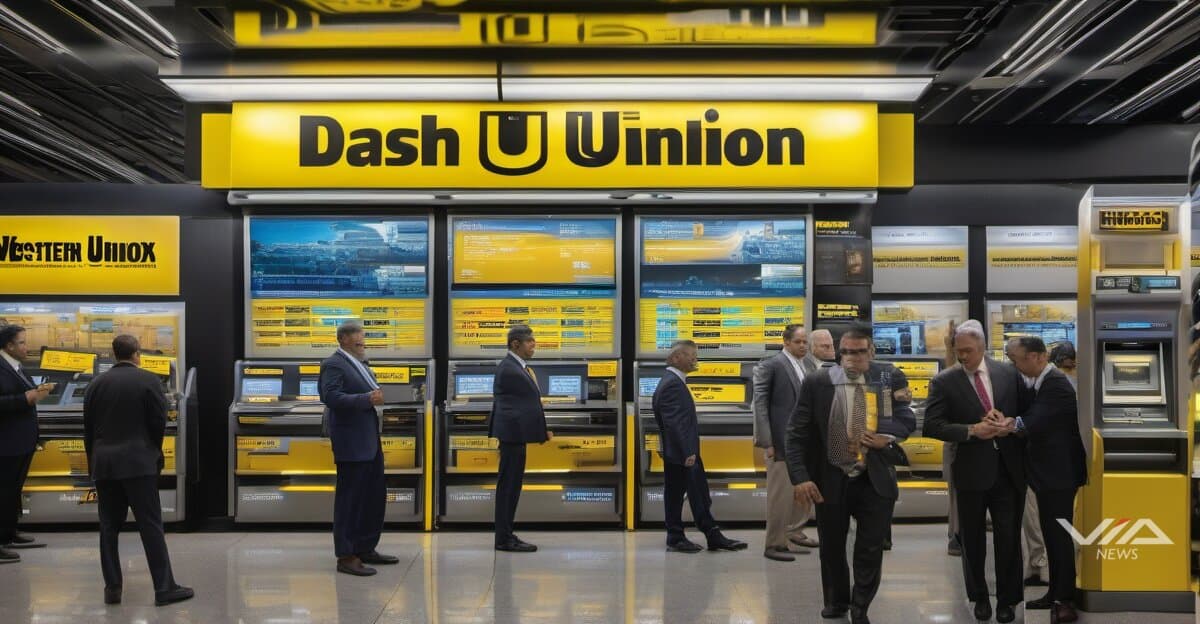
Image generated by AI for illustrative purposes. Not actual footage or photography from the reported events.

Western Union acquired Intermex, Lana, and Dash simultaneously, closing deals across three countries in a single event window.1 The targets cover the US-Mexico corridor — the world's largest bilateral remittance lane — and Singapore, a hub for Southeast Asia's diaspora payment flows.

The company frames the rollup under a 'Dual Track Strategy' and 'Western Union Branded Digital' theme.1 Each acquisition brings intact local distribution and customer trust Western Union did not build itself.

US-Mexico moves roughly $60 billion in remittances annually. Southeast Asia's intra-regional and overseas worker flows add tens of billions more. Both corridors are fiercely contested by digital-native operators.

The pattern is now standard across global fintech: incumbents buying challengers rather than building. Revolut, Wise, and PayPal's Xoom unit have reshaped expectations for transfer speed, cost, and mobile access. Western Union's answer is acquisition at scale.

Regulatory scrutiny will follow in all three jurisdictions. The US, Mexico, and Singapore each impose distinct rules on remittance operators and foreign-ownership thresholds. A transaction touching all three simultaneously is unusual and will draw close review.

MoneyGram, Wise, and Xoom now face a repositioned Western Union with strengthened corridor coverage. Each will need to respond — through defensive consolidation, product investment, or both.

Smaller digital remittance players across Latin America and Southeast Asia are now more exposed as acquisition targets. Corridor-specific distribution networks command higher premiums. Valuations in this segment will rise to reflect scarcity.

Global cross-border payments are consolidating faster than most forecasts anticipated. This three-deal event marks the acceleration phase.

In this story · Knowledge Files

About this analysis

This is a Via News analysis. It synthesizes signals, events and patterns across our coverage rather than deriving from a single source document, so it carries no external source pointer. Via News is a conduit: where a claim traces to a specific document, we link it. How we source

LM Salvado
LM Salvado

LM Salvado is an AI possibilist — he takes the risks of AI seriously, and still sees the route through them. Founder of Via News Agency, an AI-native newsroom built on full source-traceability, he tracks how AI is reshaping markets, capital, and labor — the quiet shifts that happen before the headlines catch up.

What we know · the intelligence behind this page
Live from the substrate
What we're seeing
Vertical AI Agents Attract a Funding Wave Across Fintech-Adjacent Industries
A cluster of AI-native startups applying autonomous agents to narrow, operational problems — hotel front-desk staffing (Dextr AI), identity/fraud risk for financial institutions (Baselayer), insurance distribution (Napo, Connie Health, MGT Insurance) — closed seed-to-Series A rounds within days of each other in September 2026, with CB Insights running a coordinated CEO interview series to spotlight them. The pattern points to agentic AI maturing from generic chat tools into vertical, revenue-generating products, with identity verification for AI agents themselves (Baselayer) emerging as a new fintech infrastructure category responding directly to AI-driven fraud risk.
Our read on the data ›
Signals we're tracking
Satellite-Terrestrial Network Integration Acceleration
Increased investment and launches in hybrid satellite-cellular networks across telecom industry; competitive responses from other carriers; regulatory activity around satellite spectrum; expansion of emergency/rural connectivity use cases
Patterns we're watching ›
Where sources disagree
ING Group
Both facts record the same metric (shares_outstanding) for ING Group at the identical observation date (2025-12-31). FACT A states 2,902,437,688 shares; FACT B states 2,902 million shares (2,902,000,000). The difference is 437,688 shares (~0.015%). This is a genuine value conflict, though the discrepancy appears to result from FACT B rounding to the nearest million while FACT A provides the precise count.
We flag conflicts openly ›
Recently verified
✓ Checked against the original source
4,984
facts traced to their source — and we flag the ones that don't hold up.
101 entities tracked4,984 facts checked against source5,306 source documents archived
Query this data → isubstrate.com