
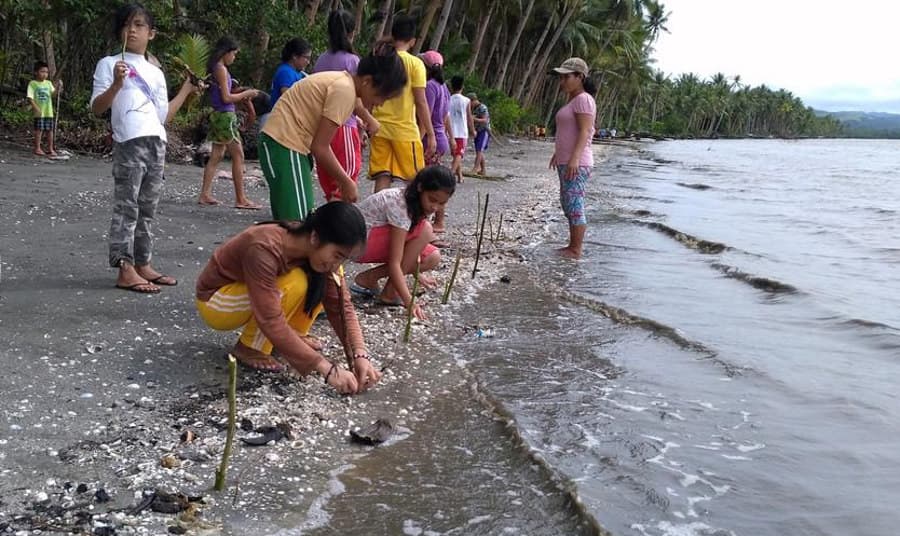
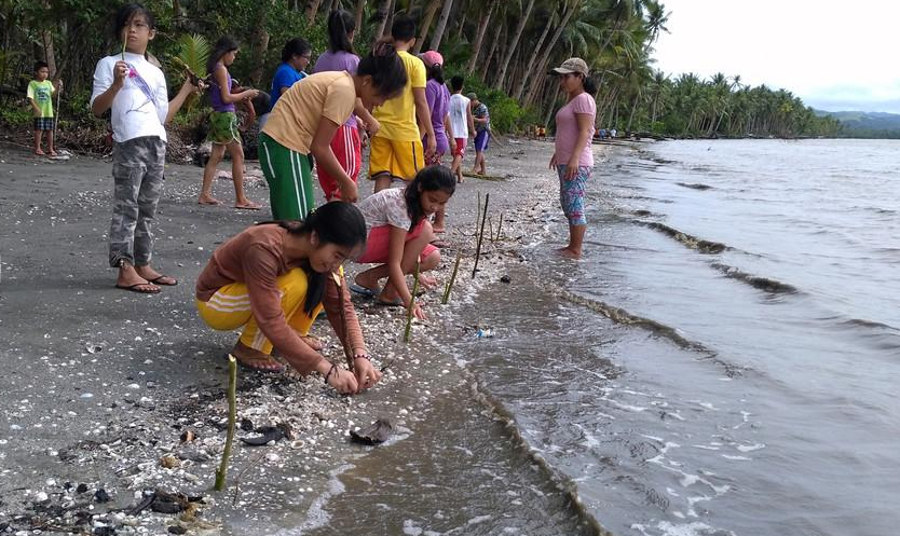
 Plan International Filipino activist, Louisa (in brown) planting mangrove seedlings on a beach to disaster-proof her communities. Photo by: courtesy Plan International.[/caption]
One big feminist debate revolves around reproductive rights – giving women the rights to control their own bodies. A fragile freedom which isn’t a reality in many countries, and is slowly disappearing in others. It goes much further than many believe – in places where women have sufficient access to education, contraception, reproductive control and the right to work, birth rates plunge. How does this affect climate change? Well, if the world’s population continues to grow at the rate it currently is, the earth just simply won’t have the resources to sustain it...this combined with the already warming planet starts to create quite the apocalyptic picture.
Women are active contributors to the community and society as a whole, successfully influencing useful schemes all over the world. Yet, they are not sufficiently considered or allowed to engage in decisions about climate change.
Plan International, a humanitarian organisation that strives for equality for girls and children, is serving to make significant action to change this.
Jessica Cooke, the Resilience and Climate Change Policy Officer at Plan International, told ViaNews: “I believe that climate change is a gender equality issue...girls, and especially adolescent girls, face unique needs.” Issues that young girls face, all over the world, from obstacles accessing education, violence, exploitation, unfair disadvantages in the workplace and the gender pay gap mean that women are completely disadvantaged in disaster scenarios.
[caption id="attachment_5453" align="aligncenter" width="450"]
Plan International Filipino activist, Louisa (in brown) planting mangrove seedlings on a beach to disaster-proof her communities. Photo by: courtesy Plan International.[/caption]
One big feminist debate revolves around reproductive rights – giving women the rights to control their own bodies. A fragile freedom which isn’t a reality in many countries, and is slowly disappearing in others. It goes much further than many believe – in places where women have sufficient access to education, contraception, reproductive control and the right to work, birth rates plunge. How does this affect climate change? Well, if the world’s population continues to grow at the rate it currently is, the earth just simply won’t have the resources to sustain it...this combined with the already warming planet starts to create quite the apocalyptic picture.
Women are active contributors to the community and society as a whole, successfully influencing useful schemes all over the world. Yet, they are not sufficiently considered or allowed to engage in decisions about climate change.
Plan International, a humanitarian organisation that strives for equality for girls and children, is serving to make significant action to change this.
Jessica Cooke, the Resilience and Climate Change Policy Officer at Plan International, told ViaNews: “I believe that climate change is a gender equality issue...girls, and especially adolescent girls, face unique needs.” Issues that young girls face, all over the world, from obstacles accessing education, violence, exploitation, unfair disadvantages in the workplace and the gender pay gap mean that women are completely disadvantaged in disaster scenarios.
[caption id="attachment_5453" align="aligncenter" width="450"] Jessica Cooke, Resilience and Climate Change Policy Officer at Plan International. Photo by: courtesy Jessica Cooke.[/caption]
Cooke explains, “Girls, in particular, are often excluded from participation in policy making, decision making and political processes due to entrenched gender norms and stereotypes dictating behaviour, mobility, and receptivity”. When women are excluded from important decision making, critical factors are often ignored. In fact, women’s participation in the past has meant that policymaking has resulted in much more sustainable peace. In comparison, when policies are made without female input, it’s proved to increase the already existing inequalities and ultimately limits the effectiveness of the policies.
Jessica Cooke, Resilience and Climate Change Policy Officer at Plan International. Photo by: courtesy Jessica Cooke.[/caption]
Cooke explains, “Girls, in particular, are often excluded from participation in policy making, decision making and political processes due to entrenched gender norms and stereotypes dictating behaviour, mobility, and receptivity”. When women are excluded from important decision making, critical factors are often ignored. In fact, women’s participation in the past has meant that policymaking has resulted in much more sustainable peace. In comparison, when policies are made without female input, it’s proved to increase the already existing inequalities and ultimately limits the effectiveness of the policies.
Plan International has a direct aim to help another, often ignored section of society – children. “Girls and boys should not be seen as passive victims. They are active agents of change within their families and communities, and are contributors to successful adaption”. From this, they work with and for girls and boys, to act on issues relating to climate change. [caption id="attachment_5454" align="aligncenter" width="500"]Girls & young women are bearing the brunt of #climatechange
Supporting @PlanGlobal's work on #equality for girls,a new report highlights differential vulnerabilities to climate change in #Thailand But girls are also active agents of change!#DayOfTheGirlhttps://t.co/OPCr57le0r pic.twitter.com/jvZNbvQvWK — Jess Cooke ? (@JessCooke21) October 11, 2018
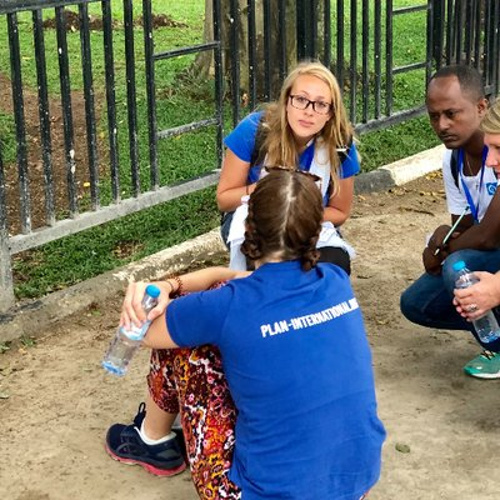 Jessica Cooke with Plan International activists. Photo by: courtesy twitter.com/JessCooke21(@JessCooke21).[/caption]
Their research from Thailand, with the Stockholm Environment Institute in Asia, discovered a serious research gap with specific vulnerabilities that young women and girls face they have, in turn, adapted strategies to ensure that girls not only have equal rights in a changing climate but are resilient to the impacts of it.
Other feminist approaches to climate change include guaranteeing women are involved in major climate-change decision making, worldwide. Alongside giving women rights to control their own reproductive systems – making sure they have access to the education and resources which they should, but aren’t allowed to have; The UN stated that there are more than 200 million women worldwide, right now, that want but are unable to get contraception. The earth can’t sustain more people, but we can “control” the population by providing women with basic rights.
Now, these things, if not anything else, should be implemented out of self-interest, but many drawbacks with progress occur. This isn’t surprising, anything regarding women and feminism usually is met with a mixture of aggression and apathy. Cooke says; “It can be an incredibly depressing area to work in when you see politicians not taking this important issue, this existential threat, seriously”.
It’s not all doom and gloom, with organisations like Plan International, progress is being made to make sure that women and girls are, at the very least, considered. You don’t even have to believe that the temperature of this planet is warming up to acknowledge that marginalised sections of society should be considered and given equal rights.
Jessica Cooke with Plan International activists. Photo by: courtesy twitter.com/JessCooke21(@JessCooke21).[/caption]
Their research from Thailand, with the Stockholm Environment Institute in Asia, discovered a serious research gap with specific vulnerabilities that young women and girls face they have, in turn, adapted strategies to ensure that girls not only have equal rights in a changing climate but are resilient to the impacts of it.
Other feminist approaches to climate change include guaranteeing women are involved in major climate-change decision making, worldwide. Alongside giving women rights to control their own reproductive systems – making sure they have access to the education and resources which they should, but aren’t allowed to have; The UN stated that there are more than 200 million women worldwide, right now, that want but are unable to get contraception. The earth can’t sustain more people, but we can “control” the population by providing women with basic rights.
Now, these things, if not anything else, should be implemented out of self-interest, but many drawbacks with progress occur. This isn’t surprising, anything regarding women and feminism usually is met with a mixture of aggression and apathy. Cooke says; “It can be an incredibly depressing area to work in when you see politicians not taking this important issue, this existential threat, seriously”.
It’s not all doom and gloom, with organisations like Plan International, progress is being made to make sure that women and girls are, at the very least, considered. You don’t even have to believe that the temperature of this planet is warming up to acknowledge that marginalised sections of society should be considered and given equal rights.