
Sunday, September 27, 2026

MPLX to Add 500 MMcf/d Gas Processing Capacity in Permian Basin by 2028

MPLX LP will bring two natural gas processing plants online in the Permian Basin between late 2026 and 2028, adding 500 million cubic feet per day of capacity. The expansion targets America's fastest-growing shale region as global gas markets face oversupply and weakening prices. The facilities will process raw gas and extract natural gas liquids as U.S. production reshapes international energy trade flows.

ViaNews Editorial Team

February 21, 2026

Source Trace Score1 source document1 with a live linkVerifiability: Basic
MPLX to Add 500 MMcf/d Gas Processing Capacity in Permian Basin by 2028
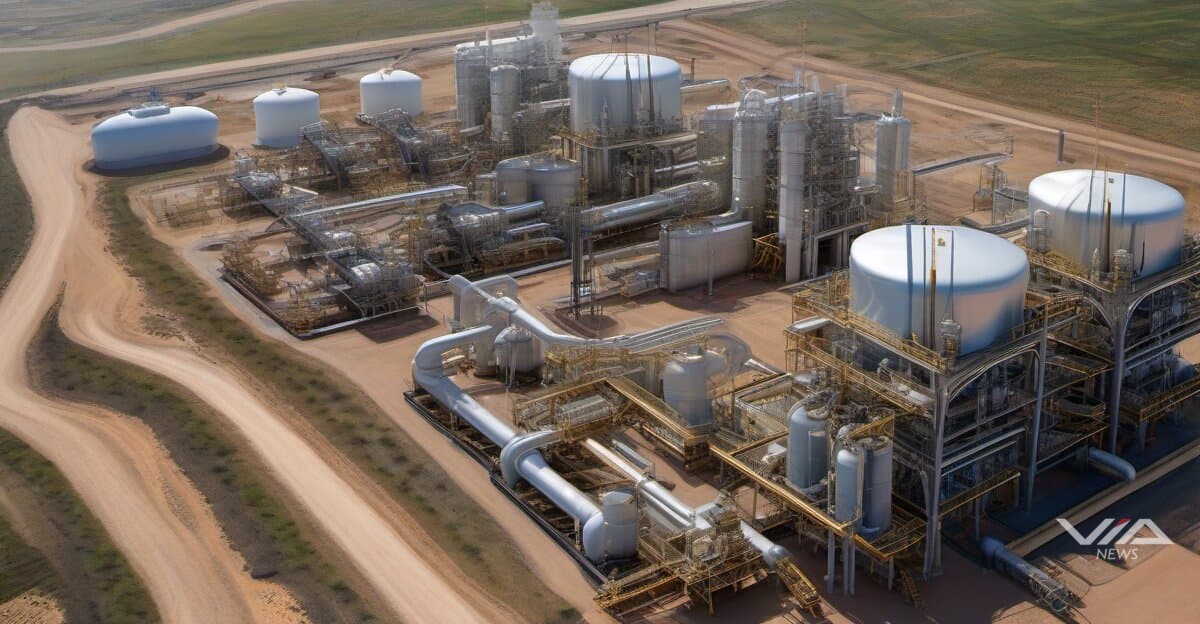
Image generated by AI for illustrative purposes. Not actual footage or photography from the reported events.

MPLX LP plans to launch Secretariat I and II natural gas processing plants in the Permian Basin, adding 500 million cubic feet per day (MMcf/d) of capacity between late 2026 and 2028. The expansion comes as U.S. shale production reshapes global gas markets, with American exports now competing directly with Russian pipeline gas and Qatari LNG.

The Permian Basin produced 22 billion cubic feet per day in late 2024, representing one-fifth of total U.S. output. Associated gas from oil drilling has outpaced pipeline capacity, creating regional price discounts of $1-2 per million BTU below the Henry Hub benchmark—a pattern seen in other landlocked production zones from Kazakhstan to Australia's Cooper Basin.

Natural gas prices face downward pressure globally. Henry Hub futures traded near $3.50 per million BTU in early 2026, down from above $9 in 2022. European TTF prices followed similar declines as LNG supply growth outstripped demand. New U.S. processing capacity entering oversupplied markets may limit price recovery through 2028.

MPLX, Marathon Petroleum's midstream arm, operates gathering, processing, and pipeline assets across major U.S. shale plays. The company reported $2.8 billion in operating revenue for Q3 2024, with gathering and processing generating 40% of segment income. The Secretariat plants will extract natural gas liquids including ethane, propane, and butane—commodities that also face weak international pricing.

Propane averaged $0.80 per gallon in early 2026 versus $1.20 in 2022, reflecting global oversupply as U.S., Middle Eastern, and Russian producers compete for Asian and European market share. Midstream companies face margin pressure as percentage-of-proceeds contracts expose them to commodity volatility, while fixed-fee arrangements provide stability for only 60% of MPLX's processing contracts.

The 2026-2028 timeline assumes regulatory approvals and construction stay on schedule. Supply chain delays have pushed similar projects back 6-12 months globally. Demand growth from U.S. LNG exports to Europe and Asia will determine whether new capacity tightens regional markets or adds to global oversupply pressures.

Source documents

Via News is a conduit. We point to the source documents behind this report — we don't replace them. Trace any claim to its source and decide what to trust. How we source

Source Trace Score1 source document1 with a live linkVerifiability: Basic
  1. [1]News articleYahoo Finance· February 20, 2026
    MPLX LP: Why This Midstream MLP Deserves a Premium Valuation
What we know · the intelligence behind this page
Live from the substrate
What we're seeing
Vertical AI Agents Attract a Funding Wave Across Fintech-Adjacent Industries
A cluster of AI-native startups applying autonomous agents to narrow, operational problems — hotel front-desk staffing (Dextr AI), identity/fraud risk for financial institutions (Baselayer), insurance distribution (Napo, Connie Health, MGT Insurance) — closed seed-to-Series A rounds within days of each other in September 2026, with CB Insights running a coordinated CEO interview series to spotlight them. The pattern points to agentic AI maturing from generic chat tools into vertical, revenue-generating products, with identity verification for AI agents themselves (Baselayer) emerging as a new fintech infrastructure category responding directly to AI-driven fraud risk.
Our read on the data ›
Signals we're tracking
Satellite-Terrestrial Network Integration Acceleration
Increased investment and launches in hybrid satellite-cellular networks across telecom industry; competitive responses from other carriers; regulatory activity around satellite spectrum; expansion of emergency/rural connectivity use cases
Patterns we're watching ›
Where sources disagree
ING Group
Both facts record the same metric (shares_outstanding) for ING Group at the identical observation date (2025-12-31). FACT A states 2,902,437,688 shares; FACT B states 2,902 million shares (2,902,000,000). The difference is 437,688 shares (~0.015%). This is a genuine value conflict, though the discrepancy appears to result from FACT B rounding to the nearest million while FACT A provides the precise count.
We flag conflicts openly ›
Recently verified
✓ Checked against the original source
4,984
facts traced to their source — and we flag the ones that don't hold up.
101 entities tracked4,984 facts checked against source5,306 source documents archived
Query this data → isubstrate.com