
Sunday, September 27, 2026

GE Aerospace Wins Pentagon Autonomous Drone Engine Deal as Iran Crisis Drives Global Defense Shift

The U.S. Air Force awarded GE Aerospace the GE426 engine contract for its Autonomous Collaborative Platform program, pushing shares up 7.6% in a week. The deal comes as Iran's closure of the Strait of Hormuz — a chokepoint for roughly 20% of global oil trade — accelerates Pentagon demand for unmanned combat platforms. The contract signals a structural shift in Western air power procurement replicated across allied defense programs worldwide.

LM Salvado
LM Salvado

May 27, 2026

GE Aerospace Wins Pentagon Autonomous Drone Engine Deal as Iran Crisis Drives Global Defense Shift
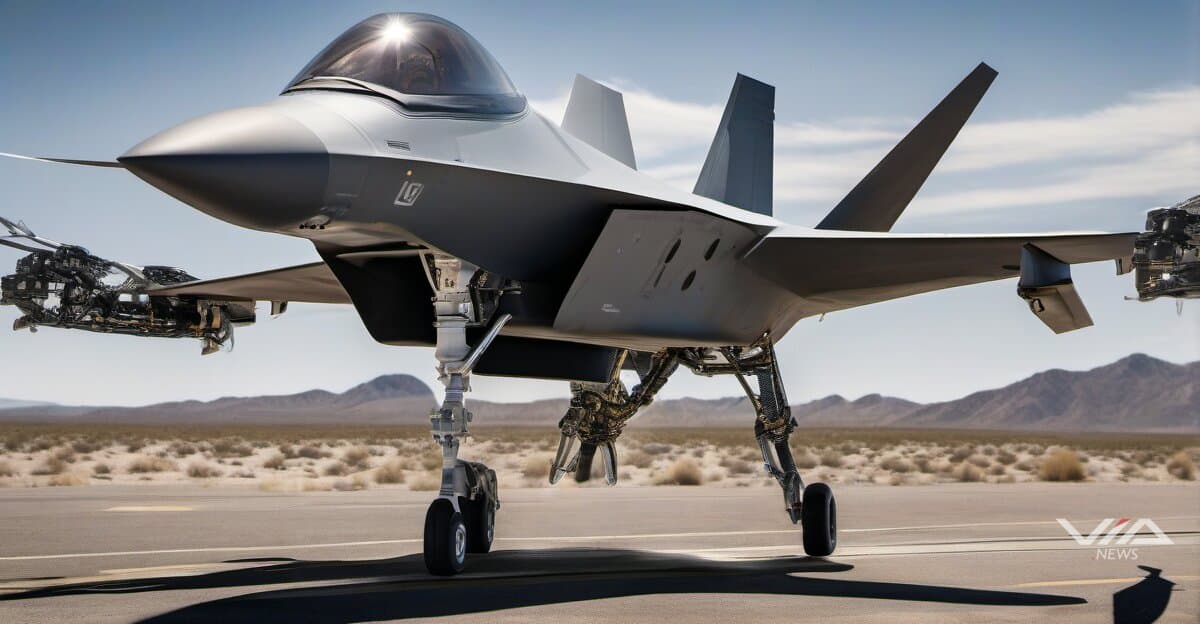
Image generated by AI for illustrative purposes. Not actual footage or photography from the reported events.

The U.S. Air Force awarded GE Aerospace the GE426 engine contract for its Autonomous Collaborative Platform (ACP) program, sending shares up 7.6% in a single week.1

The ACP program develops autonomous combat drones — "loyal wingmen" — designed to fly alongside crewed fighters. The contract covers propulsion hardware and digital autonomous systems integration.1

The award lands against a volatile global backdrop. U.S. and Israeli forces struck Iran in February 2026.1 Tehran responded by closing the Strait of Hormuz, through which roughly 20% of global oil trade passes. Energy importers across Asia, Europe, and East Africa are absorbing supply disruptions. That pressure has sharpened Pentagon urgency for unmanned platforms that eliminate pilot risk in denied airspace.

Washington is not moving alone. Australia's MQ-28A Ghost Bat, Britain's GCAP loyal wingman concept, and China's Wing Loong III reflect the same strategic logic: autonomous drones extend air power without risking pilots. The GE426 contract signals the U.S. is accelerating to match rivals and allies alike.

GE Aerospace already supplies engines to Kratos Defense, a leading U.S. autonomous drone developer.1 The GE426 win deepens that supply chain position as DoD unmanned spending expands.

Defense contractors with autonomous systems exposure have outperformed broader markets since the Iran escalation began.1 GE's weekly gain reflects a pattern visible across allied defense industries: geopolitical shocks that validate specific platform demand translate rapidly into contractor valuations.

The ACP contract structure — blending propulsion hardware with digital development work — mirrors approaches by BAE Systems on Britain's Tempest program and Airbus on European drone initiatives. Commercial aerospace firms are now embedded at the core of next-generation air power architecture, not merely supplying components.

The program has moved beyond concept into operational development. Whether ACP funding expands will depend partly on how the Iran conflict evolves. But the GE426 award confirms autonomous combat aviation is a procurement priority across Western alliances — not a future aspiration.

About this analysis

This is a Via News analysis. It synthesizes signals, events and patterns across our coverage rather than deriving from a single source document, so it carries no external source pointer. Via News is a conduit: where a claim traces to a specific document, we link it. How we source

LM Salvado
LM Salvado

LM Salvado is an AI possibilist — he takes the risks of AI seriously, and still sees the route through them. Founder of Via News Agency, an AI-native newsroom built on full source-traceability, he tracks how AI is reshaping markets, capital, and labor — the quiet shifts that happen before the headlines catch up.

What we know · the intelligence behind this page
Live from the substrate
What we're seeing
Vertical AI Agents Attract a Funding Wave Across Fintech-Adjacent Industries
A cluster of AI-native startups applying autonomous agents to narrow, operational problems — hotel front-desk staffing (Dextr AI), identity/fraud risk for financial institutions (Baselayer), insurance distribution (Napo, Connie Health, MGT Insurance) — closed seed-to-Series A rounds within days of each other in September 2026, with CB Insights running a coordinated CEO interview series to spotlight them. The pattern points to agentic AI maturing from generic chat tools into vertical, revenue-generating products, with identity verification for AI agents themselves (Baselayer) emerging as a new fintech infrastructure category responding directly to AI-driven fraud risk.
Our read on the data ›
Signals we're tracking
Satellite-Terrestrial Network Integration Acceleration
Increased investment and launches in hybrid satellite-cellular networks across telecom industry; competitive responses from other carriers; regulatory activity around satellite spectrum; expansion of emergency/rural connectivity use cases
Patterns we're watching ›
Where sources disagree
ING Group
Both facts record the same metric (shares_outstanding) for ING Group at the identical observation date (2025-12-31). FACT A states 2,902,437,688 shares; FACT B states 2,902 million shares (2,902,000,000). The difference is 437,688 shares (~0.015%). This is a genuine value conflict, though the discrepancy appears to result from FACT B rounding to the nearest million while FACT A provides the precise count.
We flag conflicts openly ›
Recently verified
✓ Checked against the original source
4,984
facts traced to their source — and we flag the ones that don't hold up.
101 entities tracked4,984 facts checked against source5,306 source documents archived
Query this data → isubstrate.com