
Sunday, September 27, 2026

Gold Falls 10% in March 2026 as China and Emerging Markets End 15-Month Buying Streak

Gold posted its worst monthly decline in over a decade in March 2026, falling sharply after China's central bank halted purchases following a 15-month buying streak. The reversal ended a global rally driven by emerging market monetary authorities diversifying away from dollar reserves, leaving the precious metal without its primary demand driver.

LM Salvado
LM Salvado

April 9, 2026

Source Trace Score1 source document1 with a live linkVerifiability: Basic
Gold Falls 10% in March 2026 as China and Emerging Markets End 15-Month Buying Streak
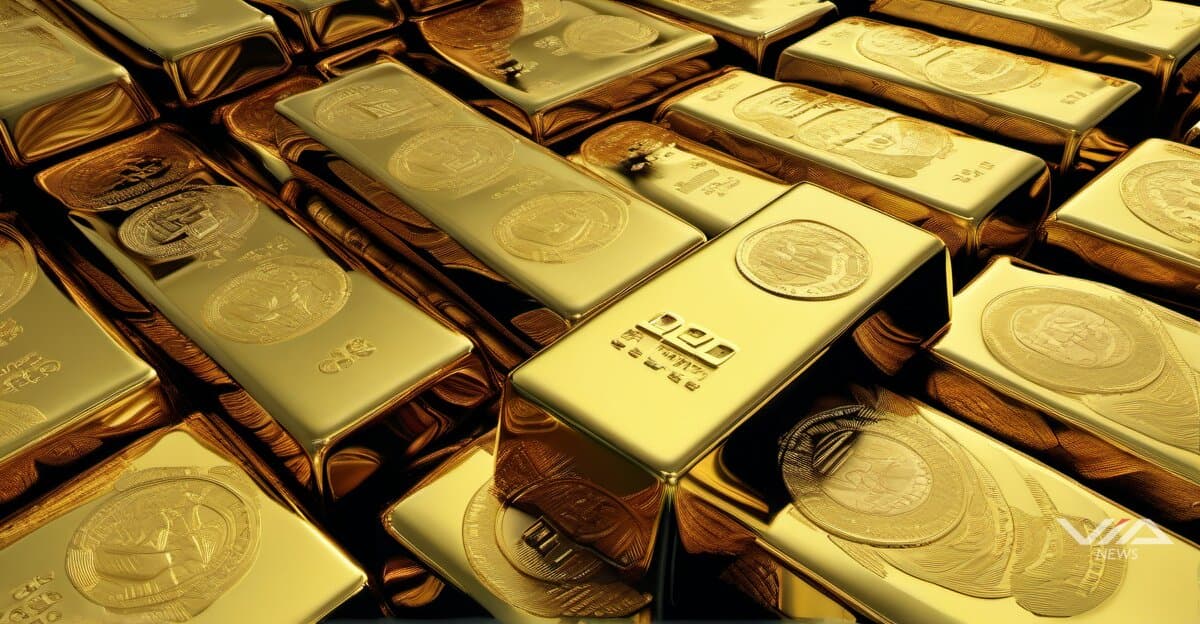
Image generated by AI for illustrative purposes. Not actual footage or photography from the reported events.

Gold fell by its steepest monthly margin in more than a decade during March 2026, breaking a rally sustained by 15 consecutive months of Chinese central bank purchases through January.1

China's buying campaign formed part of a coordinated diversification strategy among emerging market central banks seeking alternatives to U.S. dollar reserves.1 This wave of official sector demand from developing economies pushed gold to record highs in early 2026, reshaping global reserve management patterns.

The abrupt March halt represents a fundamental shift in international gold markets. Central banks in emerging economies had replaced Western investors as the dominant price force, making their reserve decisions the critical variable in gold's valuation. The sudden pause signals either tactical repositioning or a strategic reassessment across multiple monetary authorities.

Goldman Sachs continued projecting elevated gold prices even as the March selloff accelerated, creating a notable gap between Wall Street forecasts and actual central bank behavior.1 This divergence suggests analysts may be underestimating the impact of changing official sector demand from developing nations.

The timing carries global monetary implications. March 2026 coincides with shifting rate expectations across major economies, potentially altering currency dynamics for emerging markets. If central banks are responding to interest rate differentials or local currency pressures, their pause in gold accumulation could extend beyond short-term tactical adjustments.

Without sustained buying from emerging market monetary authorities, gold must attract new sources of international demand. Traditional drivers like inflation hedging or dollar weakness have taken secondary roles to central bank narratives since 2024.

Markets now confront whether March marked temporary cooling or the conclusion of a multi-year cycle in official sector gold accumulation. The answer will shape precious metal valuations across global exchanges through 2026.

Source documents

Via News is a conduit. We point to the source documents behind this report — we don't replace them. Trace any claim to its source and decide what to trust. How we source

Source Trace Score1 source document1 with a live linkVerifiability: Basic
  1. [1]News articleYahoo Finance· April 4, 2026
    Goldman Sachs has blunt message on gold price for rest of 2026

In this story · Knowledge Files

LM Salvado
LM Salvado

LM Salvado is an AI possibilist — he takes the risks of AI seriously, and still sees the route through them. Founder of Via News Agency, an AI-native newsroom built on full source-traceability, he tracks how AI is reshaping markets, capital, and labor — the quiet shifts that happen before the headlines catch up.

What we know · the intelligence behind this page
Live from the substrate
What we're seeing
Enterprise AI Agents Scale Up Through Partnerships and Funding, But Data Readiness Lags Ambition
A wave of vertical AI-agent startups (Swarm, Veridox, Avallon AI, DA2, F2, Earthian, Meanwhile, Covecta, Penguin AI, Maisa AI) is being funded and profiled just as major infrastructure players — Microsoft/Mistral, Siemens/NVIDIA, and Manulife/Microsoft — cement enterprise AI governance and compute partnerships. Yet a Google Cloud report shows AI agents still lack access to the majority of company data (only 45% on average), and insider selling at incumbent C3.ai signals investor caution even as adoption intent (100% planned agentic AI use within two years) races ahead of actual data infrastructure.
Our read on the data ›
Signals we're tracking
Satellite-Terrestrial Network Integration Acceleration
Increased investment and launches in hybrid satellite-cellular networks across telecom industry; competitive responses from other carriers; regulatory activity around satellite spectrum; expansion of emergency/rural connectivity use cases
Patterns we're watching ›
Where sources disagree
Berkshire Hathaway
Both facts report Berkshire Hathaway's cash position on 2026-01-01 with identical observation timestamps, but claim vastly different values: 380 billion USD vs 400 USD. These cannot both be true for the same entity at the same point in time. The magnitude of the discrepancy (a factor of ~10^9) rules out rounding, unit conversion, or methodological differences.
We flag conflicts openly ›
Recently verified
✓ Checked against the original source
4,984
facts traced to their source — and we flag the ones that don't hold up.
101 entities tracked4,984 facts checked against source5,306 source documents archived
Query this data → isubstrate.com