
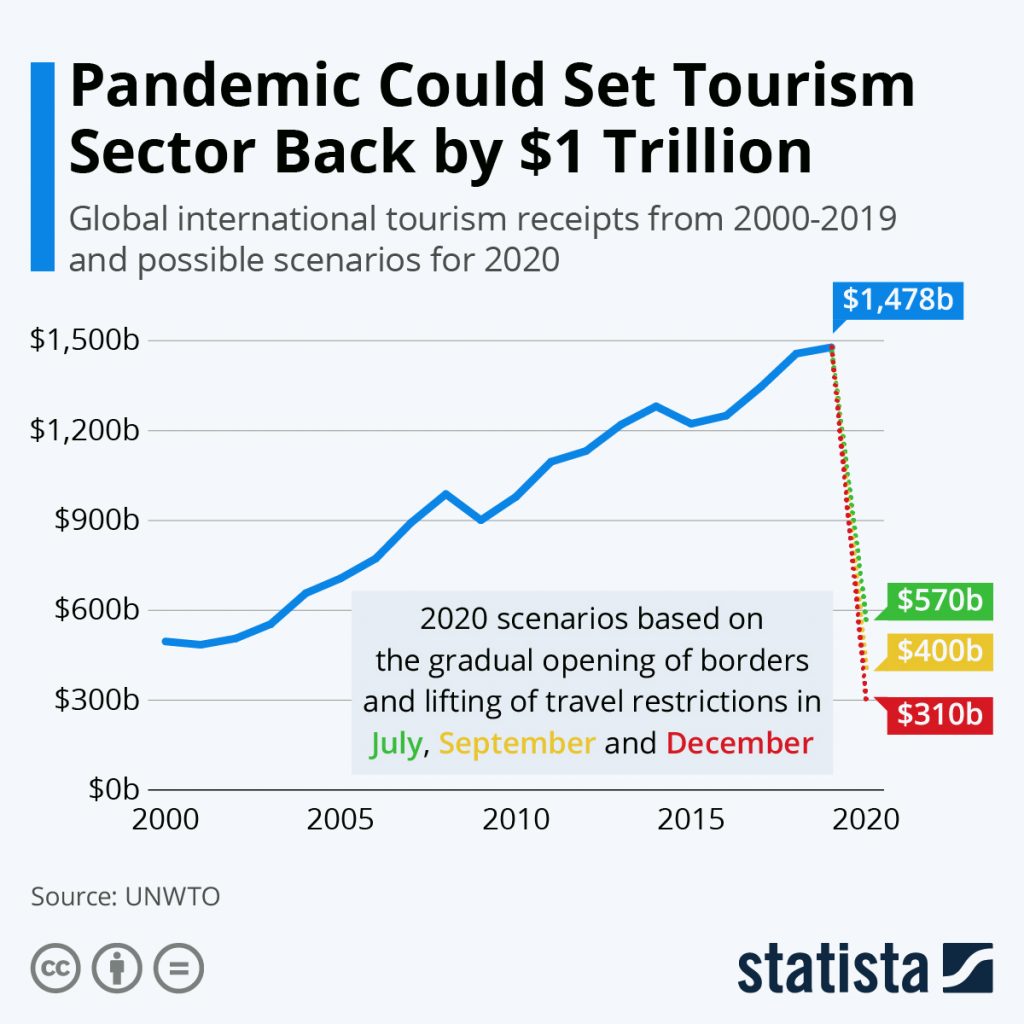
The economic damage to the global tourism sector as a result of the coronavirus pandemic is likely to exceed $1 trillion this year, which would set the industry back two decades, according to a new report from the United Nations.
"Depending on when travel restrictions will be fully lifted, the World Tourism Organization expects international tourism receipts (i.e. spending by international tourists) to drop between $910 billion and $1.2 trillion this year, which would set the global tourism industry back by 20 years," UNWTO said.
The report adds that the coronavirus-related restrictions brought international travel to a crashing halt in April and May, resulting in international tourist arrivals that trailed last year's total by almost 60 percent through the first five months of 2020.
The UNWTO says the tourism sector employs one in every ten people on Earth and warns that up to 120 million direct tourism jobs are at risk.
Data from the World Travel & Tourism Council, the travel and tourism sector accounted for 10.3% of global GDP and 330 million jobs in 2019.
Read more: When Is Global Business Travel Expected to Rebound?
Road to Recovery
In a video message, UN Secretary-General António Guterres said the tourism sector must be rebuilt so that it would "regain its position as a provider of decent jobs, stable incomes, and the protection of our cultural and natural heritage."
According to him, international tourist arrivals decreased by more than half and some 320 billion dollars in exports from tourism were lost in the first five months of this year.
Guterres added that many of the jobs at risk are in the informal economy or in micro, small, and medium-sized enterprises, which employ a high proportion of women and young people.
"The crisis is a major shock for developed economies, but for developing countries, it is an emergency, particularly for many small islands developing states and African countries. For women, rural communities, indigenous peoples, and many other historically marginalized populations, tourism has been a vehicle for integration, empowerment, and generating income."
He stressed that rebuilding the industry must be done in a way that is safe, equitable and climate-friendly as "transport-related greenhouse gas emissions could rebound sharply if recovery is not aligned with climate goals".
Read more: Portugal Should Top Your Bucket List This Summer: SeaBookings’s Co-Founder
The secretary-general also noted that he has identified five priority areas to aid recovery. "First, mitigate the socio-economic impacts of the crisis. Second, build resilience across the entire tourism value chain. Third, maximize the use of technology in the tourism sector. Fourth, promote sustainability and green growth. And fifth, foster partnerships to enable tourism to further support the Sustainable Development Goals."